
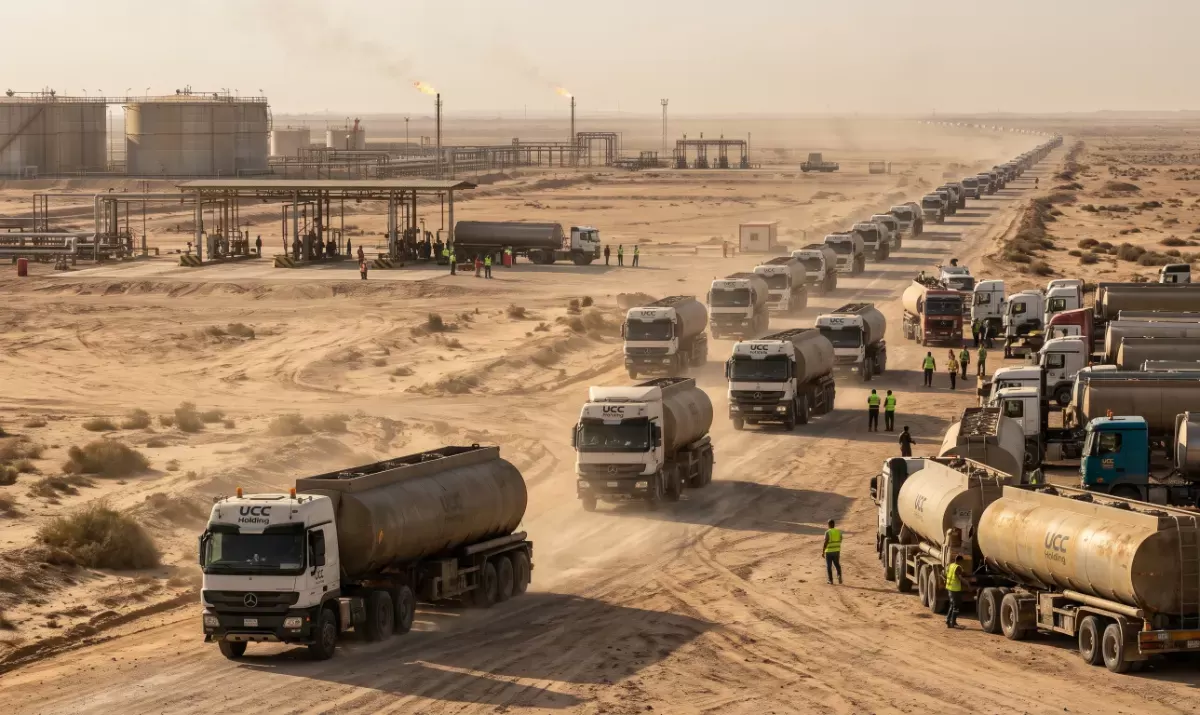
Hundreds of tanker trucks now queue outside a depot near Basra, loading Iraqi crude for a journey across the Syrian desert that had been largely unused for decades. The revival of this route reflects Iraq's urgent need to find alternative export pathways after disruptions to the Strait of Hormuz, through which the vast majority of its crude normally flows, upended its traditional logistics chain . Despite significantly higher transportation costs compared to maritime shipping, the overland corridor has regained strategic appeal, aided also by the end of years of conflict in Syria, which had made the route impassable .
The operational backbone of this revived corridor is Qatar's UCC Holding, which began shipping Iraqi crude to Baniyas under a contract with Iraq's state oil marketer SOMO. Bassem Abdul Karim, director general of the state-run Basra Oil Company, confirmed that UCC is transporting between 120,000 and 150,000 barrels per day, with actual volumes contingent on truck availability . The crude is loaded at the Tuba storage facility near Basra and driven to Baniyas, with a round trip taking up to five days, according to drivers involved in the operation .
UCC's logistics footprint for this operation is substantial. The company currently deploys a fleet of 6,000 trucks and is expanding it to 10,000 to sustain the route, supported by approximately 10,000 drivers . Since the deal took effect on 26 October, UCC has loaded roughly 1.6 million barrels, according to Luay Jawad, manager of the Tuba facility . The contract envisions loading between 5 million and 14 million barrels of heavy crude over a three-month period starting 14 October, at a discount of $38 per barrel, with UCC entitled to approximately $12 per barrel to cover trucking and related transportation costs through Syria .
Upon reaching Baniyas, the crude is transferred onto ships for delivery to Mediterranean refineries, including facilities in Greece, Italy, and Turkey . This onward maritime leg effectively connects Iraqi oilfields to European and Mediterranean markets without traversing the contested Gulf waterways. The route represents a small but strategically significant alternative for Iraq, OPEC's second-largest producer, which pumped nearly 4.5 million barrels per day in October, approximately 500,000 barrels more than the previous month .
However, the corridor faces inherent constraints. Sources familiar with the arrangement indicated that volumes are unlikely to rise above planned levels in the near future due to bottlenecks in truck supply and other logistical limitations . The reliance on road transport introduces vulnerabilities absent from pipeline or maritime systems, including driver availability, vehicle maintenance, border crossings, and the physical condition of the desert route itself. The $12 per barrel transportation cost is also significantly higher than conventional shipping, making the route economically viable primarily as a strategic hedge rather than a primary export channel.
For the broader Middle East logistics landscape, Iraq's revived Syrian corridor illustrates how regional conflicts are reshaping trade routes in real time. The Strait of Hormuz disruption has forced Iraq to develop land-based alternatives that were previously considered uneconomical, while Syria's stabilization has made such routing physically possible. The involvement of a Qatari firm in operating the corridor also highlights the growing role of Gulf logistics companies in managing cross-border energy supply chains, a trend that could persist even if maritime routes normalize, given the strategic value of diversified export options for major oil producers.