
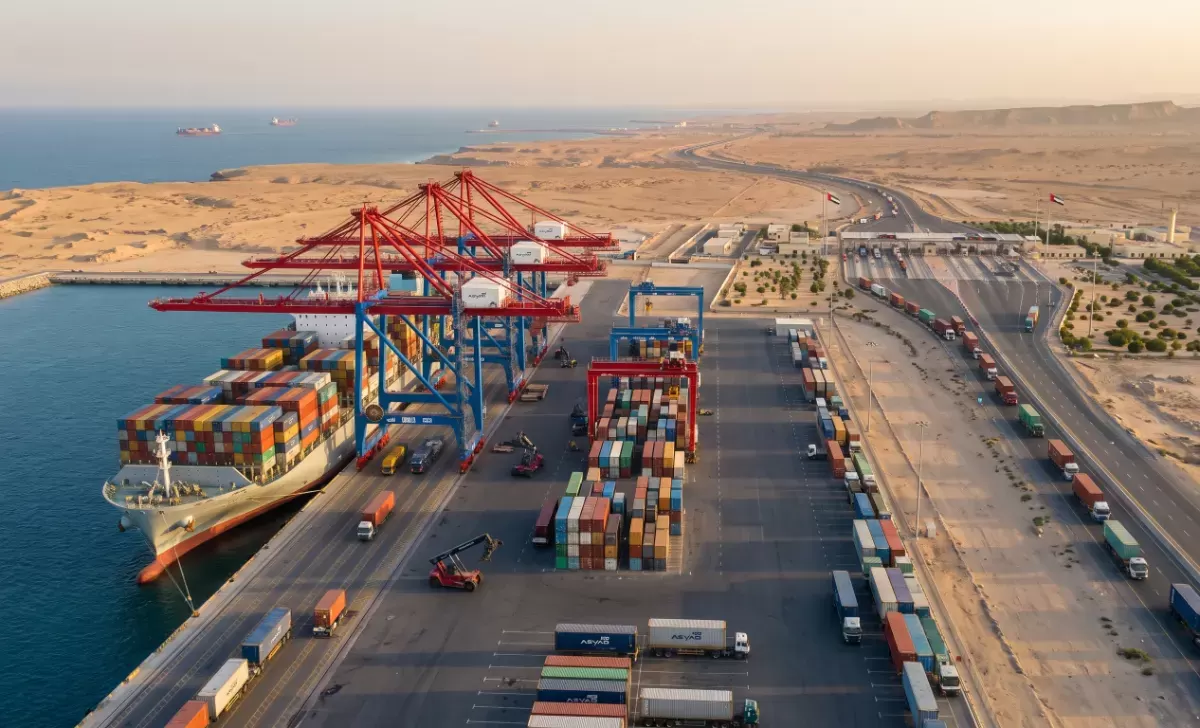
The Green Corridor represents an integrated trade route that combines container handling at Duqm Port with land transport across the Oman-UAE border. Goods arriving at Duqm are transported by road through the Khatmat Malahah crossing to Al Ain Dry Port, then onward to Khalifa Port in Abu Dhabi, from where they connect to distribution networks serving markets across the GCC countries . The operational design is intended to provide a seamless multimodal pathway that leverages Oman's port infrastructure and the UAE's distribution reach.
The corridor is already handling regular weekly shipments through the Asyad Container Terminal at Duqm, with expectations of growing cargo volumes in the coming period . This regular cadence establishes the route as a viable alternative for cargo owners seeking predictable transit schedules between Oman and the wider Gulf market. The port's ability to accommodate large vessels and handle containers efficiently underpins the corridor's operational reliability .
A key feature of the corridor is its coordinated cross-border customs system, which aims to facilitate transit procedures and reduce the time goods remain at handling and transit points. This customs integration provides cargo owners with more flexible options for managing shipping and distribution operations, while also improving the efficiency of operational resource utilization . The reduction in dwell times is particularly significant for time-sensitive cargo moving between the two countries.
Al Khattab bin Salim Al Maani, Vice President of Commercial Affairs at Asyad Ports and Free Zones, stated that global trade is undergoing rapid transformations that impose increasing requirements on supply chain flexibility, operational integration, and speed to market. He noted that the Duqm-Khalifa Port corridor has witnessed growing demand, reflecting the importance of providing integrated and flexible transport solutions that respond to the requirements of partners and cargo owners . This demand signals market appetite for alternatives to traditional routing.
The Green Corridor is not an isolated initiative but part of a broader network of integrated trade corridors that Asyad Group has launched to link Omani ports with regional markets. Al Maani indicated that this network includes green corridors connecting Duqm Port to Qatar and Saudi Arabia, in addition to corridors developed from Sohar Port linking Oman to Gulf markets . This expanding web of routes reflects a strategic approach to positioning Oman as a logistics hub rather than a single-port operator.
From a strategic perspective, the corridor reinforces Duqm Port's role as a logistics gateway on global East-West trade routes. The port benefits from its geographical location, advanced infrastructure, and technical capabilities that qualify it to receive large vessels and handle containers efficiently . By connecting maritime shipping lines with land transport networks and regional distribution systems, the corridor enhances supply chain connectivity and supports Oman Vision 2040's objectives of increasing the logistics sector's contribution to economic diversification .
For the regional logistics sector, the Duqm-Khalifa corridor offers an additional routing option at a time when supply chain resilience remains a priority for Gulf traders. The integration of port operations, land transport, and customs procedures into a single operational framework reduces the friction traditionally associated with cross-border cargo movement. As volumes grow, the corridor could establish itself as a regular component of intra-GCC trade flows, complementing existing maritime and road routes while providing a landbridge alternative for containerized cargo moving between Oman and the UAE.