
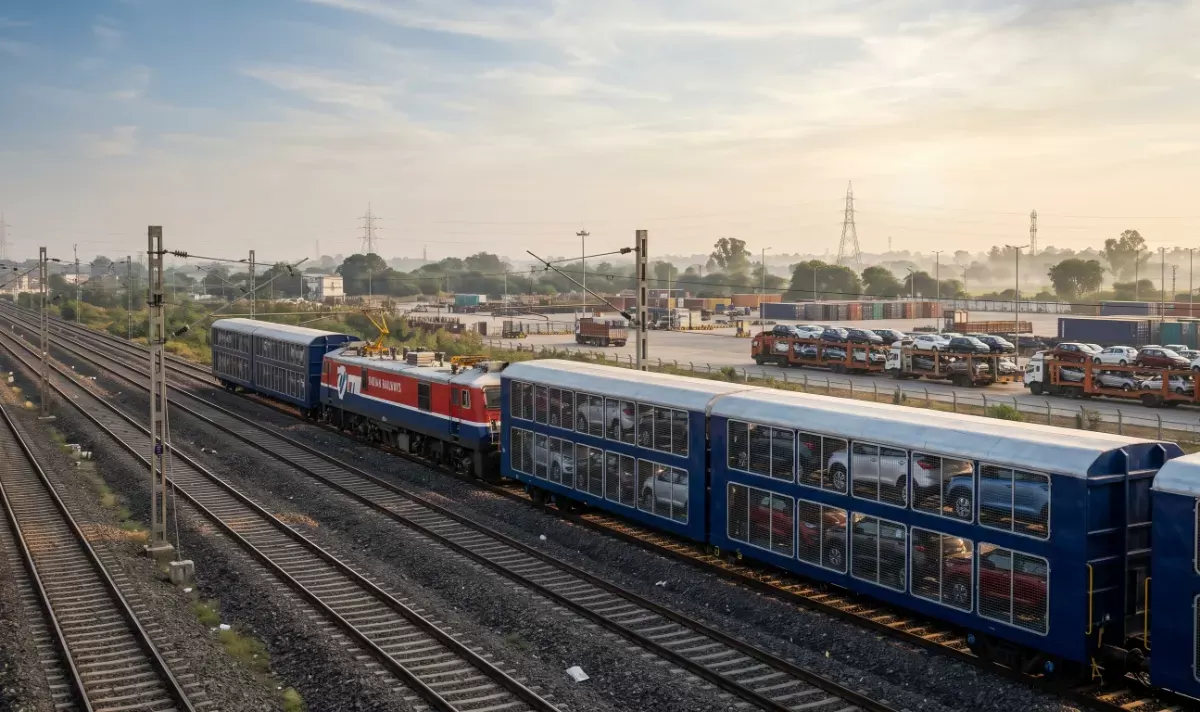
The contract represents one of the largest single orders for automobile carrier wagons placed by a private logistics operator in India. Texmaco will manufacture and supply 434 auto carrier wagons of the ACT 1 and ACT 3 types, designed to accommodate passenger cars and sport utility vehicles on both decks. The order also includes 15 BVCM wagons, with the total value of ₹329.53 crore inclusive of taxes .
The technical specifications of the wagons are central to the order's significance. The ACT 1 and ACT 3 designs fall within the clearance profile used for double-stack dwarf containers, enabling higher loading capacity than conventional auto carrier wagons. Crucially, the new design allows SUVs to be carried on both decks, a configuration that addresses the shifting product mix of Indian automobile manufacturers, where SUVs now account for a growing share of production and sales .
Delivery timelines indicate an accelerated rollout. Texmaco is required to supply the first ACT 1 rake within five months of the order, with each subsequent ACT 1 rake due within 50 days of the preceding one. The ACT 3 wagons will be delivered in phases, though the filing did not specify a final completion date for the full order or the split between the two wagon types .
The strategic rationale behind Jujhar's investment is the integration of rail capability into what has traditionally been a road-based automotive logistics business. Arshdeep Singh Mundi, Managing Director of Jujhar Group, described the move as "a decisive step in building rail capability alongside our road network," emphasizing that purpose-designed wagons carrying more vehicles, including SUVs on both decks, would enable more efficient service to automobile customers while lowering fuel consumption and carbon emissions .
Jujhar's existing road operations provide a substantial platform for the rail expansion. The company operates more than 400 enclosed car carriers across over 600 delivery locations, serving major OEMs including Maruti Suzuki, Tata Motors, Kia, Jaguar Land Rover, Volkswagen, Toyota, Hyundai, Mahindra, and Škoda. The rail service is positioned as a complement to, rather than a replacement for, this road network, potentially offering a multimodal solution for long-haul vehicle movements .
The timing of the order aligns with a broader policy shift by Indian Railways. In March 2026, the Ministry of Railways announced changes permitting industry to develop specialised, higher-capacity auto carrier wagons for specific routes. The ministry has set a target of increasing rail's share of passenger vehicle transport, which currently stands at approximately 24%. As of August 2026, around 54 industry-owned rakes were operating under the separate automobile transport scheme, providing a baseline against which Jujhar's 15-rake addition will be measured .
From a sustainability perspective, the investment is framed as part of Jujhar's broader environmental strategy. The company has already invested in CNG-powered road vehicles and now plans to offer rail transport to major OEMs. Rail-based automobile logistics is generally considered to reduce road congestion, lower fuel consumption per vehicle moved, and decrease carbon emissions compared with conventional truck-based distribution, particularly over longer distances where rail's efficiency advantages are most pronounced .
The order also has implications for Texmaco's order book and the domestic wagon manufacturing sector. The Jujhar contract constitutes approximately 77% of the ₹428.55 crore in wagon orders Texmaco disclosed on 5 November 2026, the remainder comprising smaller orders from UltraTech Cement and APL Logistics Vascor Automotive. This concentration underscores the growing role of private logistics operators, rather than traditional wagon owners, in driving demand for specialised rail freight equipment in India .
For the automobile logistics sector, Jujhar's entry into rail-based vehicle transport signals a potential structural shift. As SUV volumes grow and manufacturers seek more efficient distribution networks, the availability of higher-capacity rail wagons capable of carrying SUVs on both decks could gradually alter the modal mix for vehicle movement from factory to dealership. The success of this order in commercial operation will likely influence whether other road-focused logistics providers follow suit in committing capital to dedicated rail assets.