
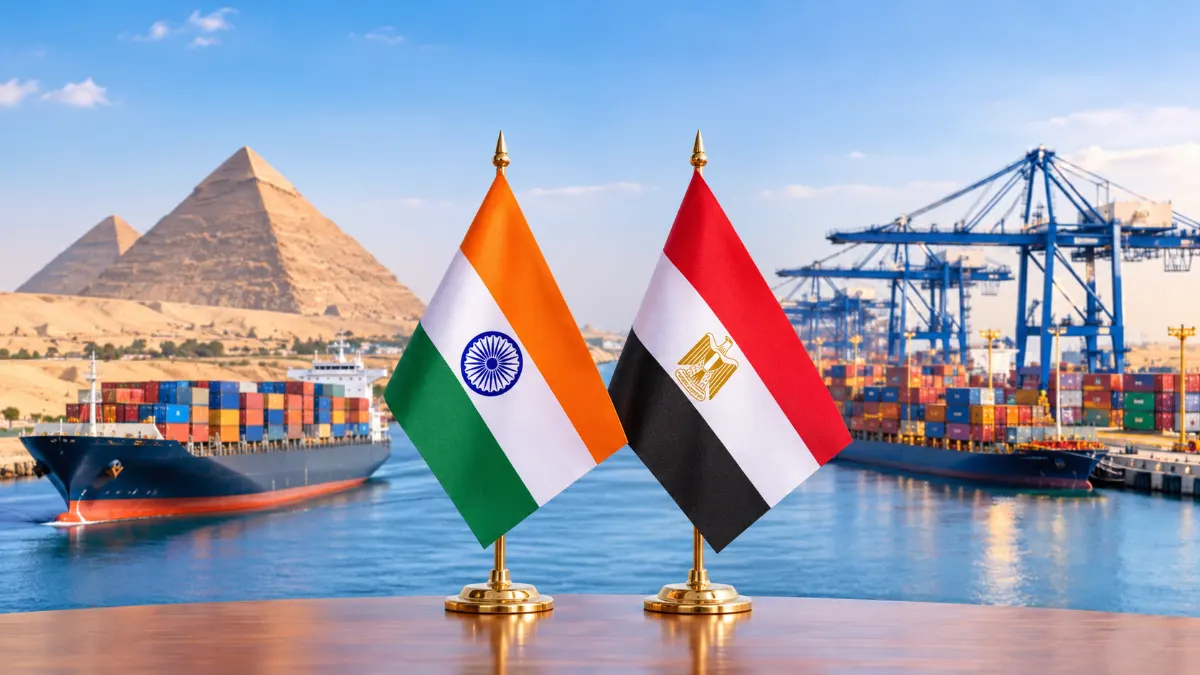
The visit marks a significant elevation of the India-Egypt Joint Trade Committee to the ministerial level, co-chaired by Goyal and Egypt's Minister of Investment and Foreign Trade, Mohamed Farid Saleh. The agenda spans a wide range of trade facilitation issues, including market access, non-tariff barriers, customs cooperation, and transport logistics, reflecting both sides' intent to diversify beyond traditional commodities .
Egypt's strategic location is central to the discussions. Indian businesses view the Suez Canal Economic Zone as a potential manufacturing and export hub capable of accessing markets across Africa, the Middle East, and Europe. The commerce ministry's statement explicitly identifies opportunities for cooperation in industrial development, infrastructure, and regional value chains, signaling a shift from purely transactional trade toward deeper investment integration .
The scale of the business delegation—over 140 CEOs and senior industry representatives—underscores the private sector's appetite for Egyptian market entry. The Joint Business Council and Business Forum are designed to facilitate direct engagement between industry leaders, exploring joint ventures, technology partnerships, and industrial collaboration in sectors ranging from pharmaceuticals and automobiles to renewable energy and green hydrogen .
Logistics infrastructure features prominently in the discussions. Ports, transport corridors, and customs facilitation are listed among the key areas for cooperation, alongside emerging sectors like green hydrogen and services. For Indian exporters and logistics providers, Egypt represents a gateway to African and European markets that could reduce dependence on traditional routes and add resilience to supply chain networks .
The timing of the visit is notable given the broader regional context. With disruptions persisting in the Strait of Hormuz and Red Sea shipping lanes, Egypt's Suez Canal has regained strategic importance as a reliable alternative corridor. The October 2026 Suez Canal revenue figure of approximately $724 million—the highest since the Red Sea crisis began—reflects this renewed relevance, and Indian logistics interests are positioning themselves to capitalize on the canal zone's industrial and distribution potential .
The Joint Trade Committee session also covers trade remedies, agricultural products, pharmaceuticals, engineering goods, chemicals, textiles, and MSME cooperation. These discussions aim to address longstanding market access concerns and create a more predictable framework for bilateral commerce, which has already demonstrated robust momentum with 64% growth in the first half of the fiscal year .
Meetings with Afreximbank and the Egypt-India Startups Forum further broaden the engagement beyond traditional trade. Access to African export financing and startup ecosystem collaboration could open new avenues for Indian logistics technology and service providers seeking to expand into African markets through Egyptian platforms .
For the logistics sector specifically, the dialogue signals a potential shift in India-Egypt relations from commodity trade toward integrated supply chain partnerships. If the Suez Canal Economic Zone cooperation materializes, Indian companies could gain a foothold in a zone that combines port access, industrial incentives, and proximity to three continents—a proposition that directly addresses the sector's search for resilient, multi-modal routing options amid persistent Middle East disruptions.