
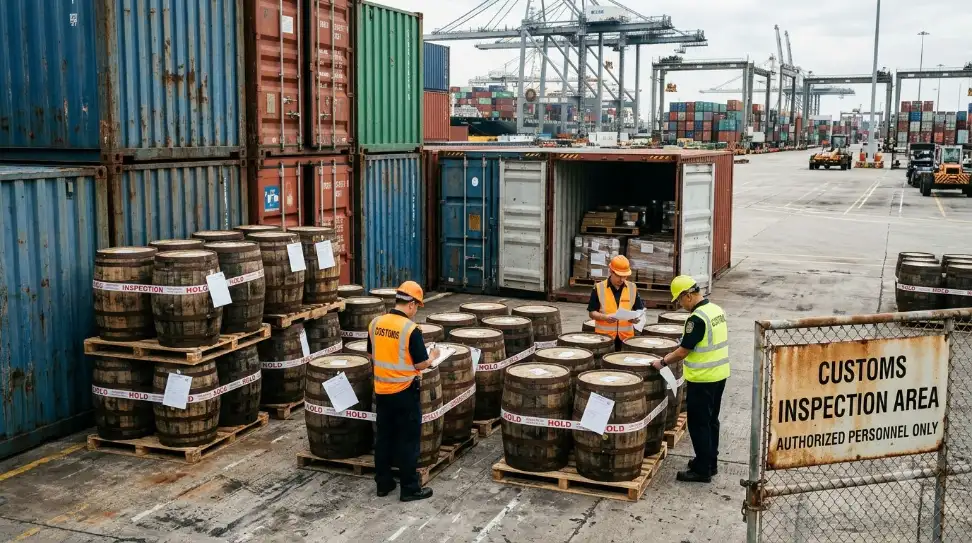
India has moved to defuse a customs dispute over bulk Scotch whisky imports that has held up dozens of containers at Indian ports, with Trade Secretary Rajesh Agrawal stating on 13 November 2026 that New Delhi will honour the duty concessions agreed under its trade pact with the United Kingdom . The dispute has raised concerns about the implementation of the India-UK Comprehensive Economic and Trade Agreement, which took effect in July 2026 and was one of the most significant trade deals India concluded in the past year.
The core of the dispute is a disagreement over the applicable duty rate. Customs investigators have been seeking a 150% import duty on the held containers, despite the CETA providing for a reduced 75% rate on eligible Scotch imports . The discrepancy suggests a classification or eligibility dispute: the trade pact's concession applies to specific product categories and value thresholds, and the customs authorities appear to be challenging whether the bulk shipments qualify for the reduced rate. The Finance Ministry has engaged with stakeholders on the issue, according to Agrawal's statement, indicating that the matter is being addressed at the policy level rather than left to individual customs assessments.
For the UK, the dispute is a test of whether the trade agreement delivers the market access that was promised. The Scotch whisky industry was one of the sectors that benefited most visibly from the CETA's tariff reductions, and the reduced 75% rate was a headline outcome of the negotiations. If Indian customs authorities continue to apply the higher rate to bulk shipments, the practical benefit of the concession is eroded, and UK exporters may find that the agreement is less valuable in practice than its text suggests.
For India's import logistics sector, the dispute has immediate operational consequences. Dozens of containers are being held at ports while the duty question is resolved, creating storage costs, demurrage exposure, and uncertainty for importers and their logistics providers . The resolution of such disputes requires coordination between customs authorities, the Commerce Ministry, and the Finance Ministry, and delays can cascade through supply chains that depend on predictable clearance times.
The timing of the dispute is significant because it comes as India is actively negotiating and implementing trade agreements with several major economies. The India-UK CETA was presented as a template for future agreements, and the India-EU FTA is expected to be signed in December. If the UK agreement's implementation is seen to be faltering due to customs disputes, it could complicate the political case for the EU deal and raise questions about India's capacity to deliver on the commitments it makes in trade negotiations.
For Indian importers of Scotch and other UK beverages, the outcome of the dispute will determine their cost structure for the remainder of the year. The 75% rate under CETA represents a substantial saving relative to the 150% standard rate, and importers who have built their pricing around the concessional rate face uncertainty if customs authorities prevail in applying the higher duty. The Finance Ministry's engagement with stakeholders suggests that a resolution is being sought, but the timeline remains unclear.
Looking ahead, the key milestone is the Finance Ministry's decision on the applicable duty rate for the held containers, which will set a precedent for how CETA's Scotch provisions are implemented in practice. For India's trade policy, the dispute is a reminder that signing an agreement is only the first step; implementation requires alignment across customs, commerce, and finance authorities, and disputes at the border can undermine the benefits that negotiators intended. For now, Agrawal's statement signals that the government intends to honour its commitments, and the resolution of the held containers will indicate whether that intention translates into operational reality.