
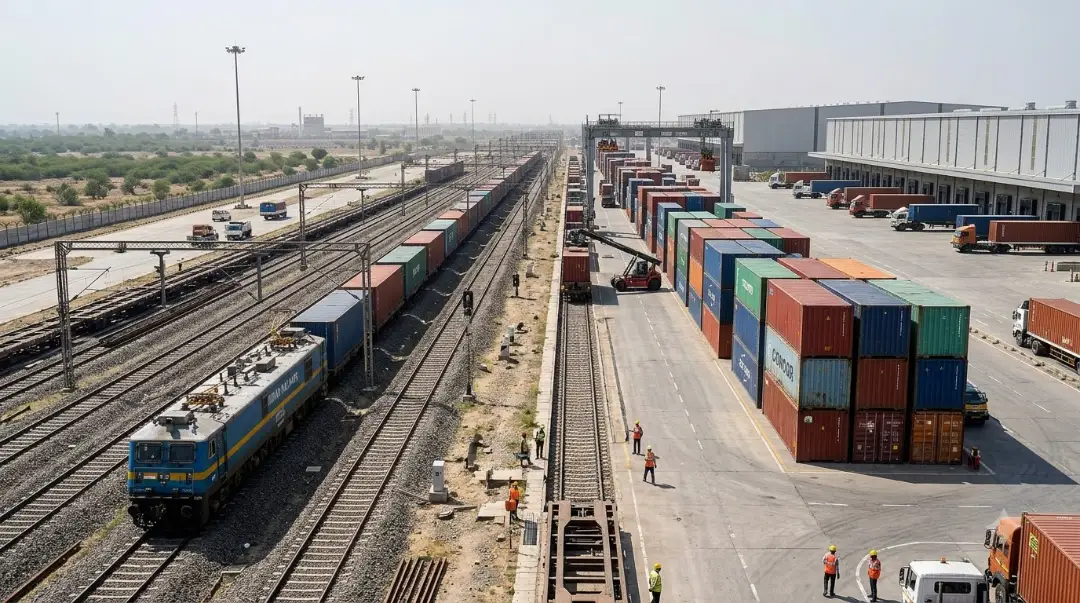
JSW Infrastructure has secured a Gati Shakti Multi-Modal Cargo Terminal contract at New Shambhu station near Rajpura in Punjab, with its step-down subsidiary JSW Minerals Rail Logistics receiving the Letter of Allotment from the Dedicated Freight Corridor Corporation of India . The project, valued at ₹60 crore, involves planning, constructing, developing, and operating the terminal on DFCCIL land on goods line number 4 towards the Ambala end of the station .
The award is significant because it extends the Gati Shakti terminal programme to the DFCCIL network, rather than the Indian Railways network where most of the earlier terminals have been developed. DFCCIL is the special purpose vehicle responsible for building and operating the dedicated freight corridors, and its land is a distinct asset class from conventional railway land. The New Shambhu terminal will be developed on this land, adding terminal capacity on a corridor that is designed for high-speed freight movement.
The project's purpose is to facilitate freight movement and augment terminal capacity through private participation . JSW Infrastructure's involvement reflects the broader pattern of industrial groups developing rail-linked logistics infrastructure to serve their own supply chains and those of other shippers in the region. The terminal's location near Rajpura places it on a corridor that serves Punjab's industrial and agricultural belts, and it could handle a range of commodities depending on the demand from local shippers.
The financial scale of the project is modest relative to the large port and corridor investments that dominate headlines, but it is typical of the Gati Shakti terminal programme, which relies on relatively small, targeted investments to expand loading and unloading capacity at specific locations. The ₹60 crore value reflects the cost of developing the terminal infrastructure on land provided by DFCCIL, with the concessionaire responsible for construction and operations.
For India's rail freight sector, the New Shambhu award illustrates how the Gati Shakti framework is being extended beyond the Indian Railways network to the dedicated freight corridor system. The DFCCIL corridors are intended to carry higher volumes of freight at faster speeds than the conventional network, and terminal capacity at key junctions is essential to realising that potential. Private participation through the Gati Shakti model allows DFCCIL to expand terminal capacity without bearing the construction costs.
The timing of the award aligns with the broader expansion of rail-linked logistics infrastructure in India. CONCOR has been ordering container rakes, DP World has launched double-stack services, and the government has been promoting private investment in cargo terminals through the Gati Shakti policy. JSW's award adds another node to this network, and it signals that industrial groups see commercial value in developing terminal capacity even at locations that are not among the largest freight hubs.
For JSW Infrastructure, the terminal is a small addition to a portfolio that includes ports, logistics parks, and other infrastructure assets. The company has been expanding its logistics footprint, and the New Shambhu terminal gives it a presence on the DFCCIL network that could support its own cargo movements and those of other shippers in Punjab. The project's success will depend on whether the terminal attracts sufficient cargo to justify the investment, which in turn will depend on the industrial demand in the surrounding region.
Looking ahead, the key milestones are the execution of the concession agreement with DFCCIL, the commencement of construction, and the commissioning of the terminal. JSW has not disclosed a timeline for these milestones. For now, the award signals that the Gati Shakti model is being applied to DFCCIL land, and that private operators are willing to invest in terminal capacity on the dedicated freight corridor network.