
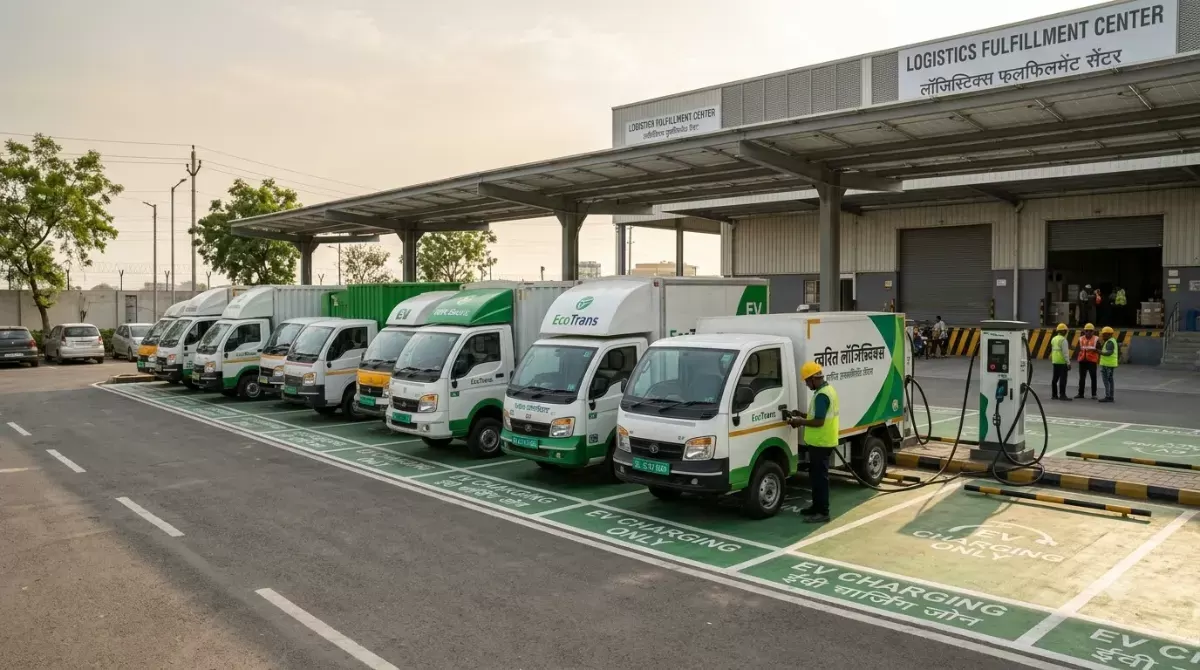
Delhivery has signed memoranda of understanding with three electric commercial vehicle manufacturers—Tata Motors, Euler Motors, and Montra Electric—to deploy 1,500–2,000 electric trucks over the next 12–18 months, with a longer-term target of scaling the fleet to approximately 5,000 units within three years . The announcement, made on 13 November 2026, represents one of the largest commitments to electric commercial vehicle adoption by an Indian logistics company, and it signals that the electrification of India's freight and delivery networks is moving from pilot projects to fleet-scale deployment.
The scale of the commitment is substantial relative to the current state of India's electric truck market. Electric commercial vehicles have been slower to penetrate India's logistics sector than electric two-wheelers and three-wheelers, primarily because of higher upfront costs, limited charging infrastructure, and concerns about payload and range. A deployment of 2,000 vehicles across multiple manufacturers and use cases would provide a meaningful demand signal for the domestic EV manufacturing ecosystem, and it would generate operational data on how electric trucks perform under the duty cycles of e-commerce and parcel logistics.
The partnership structure reflects a multi-vendor approach rather than reliance on a single supplier. By signing MoUs with Tata Motors, Euler Motors, and Montra Electric, Delhivery is diversifying its exposure to vehicle technology and manufacturing capacity . Tata Motors is India's largest commercial vehicle manufacturer and has been expanding its electric truck lineup; Euler Motors focuses on electric commercial vehicles for logistics; and Montra Electric is an emerging player in the segment. The multi-vendor strategy reduces the risk of supply bottlenecks and allows Delhivery to match vehicle specifications to different route profiles.
The operational context for the deployment is the growth of e-commerce and quick-commerce logistics in India. Delhivery has been expanding its express parcel and part-truckload businesses, and the company reported a profit in Q2 FY27 as volumes grew. Electric trucks offer lower operating costs per kilometre and reduced maintenance requirements compared with diesel vehicles, which can improve unit economics on high-utilisation routes. The deployment is likely to be concentrated in urban and peri-urban corridors where charging infrastructure is available and route lengths are predictable.
The timing of the announcement aligns with a broader wave of electric truck deployments in India's logistics sector. Tata Motors and Amazon have announced plans to deploy 3,000 electric trucks, GreenLine Mobility has been expanding its electric and LNG fleet for industrial logistics, and EIM has been building battery-swapping infrastructure around JNPA. The common thread is that the deployments are concentrated in captive or semi-captive operations where routes are predictable and charging can be planned around operational schedules, rather than in the open road freight market where range anxiety and charging uncertainty remain significant barriers.
For India's logistics sector, Delhivery's commitment illustrates the incremental approach that is characterising the early phase of electric freight adoption. Rather than attempting to electrify entire supply chains at once, companies are identifying specific lanes and use cases where the operational case is strongest, deploying vehicles there, and using the experience to inform broader decisions. This approach is slower than a wholesale transition, but it is more likely to produce sustainable deployments that can be scaled as infrastructure matures.
Looking ahead, the key milestones are the actual deployment of the first 1,500–2,000 vehicles, the commissioning of supporting charging infrastructure, and the operational data that emerges from the first year of service. Delhivery has not disclosed the cost of the vehicles, the charging arrangements, or the specific cities where they will be deployed . For now, the MoUs establish a framework and a target, and the immediate implementation will test whether the multi-vendor model can deliver the reliability and cost profile that e-commerce logistics requires.