
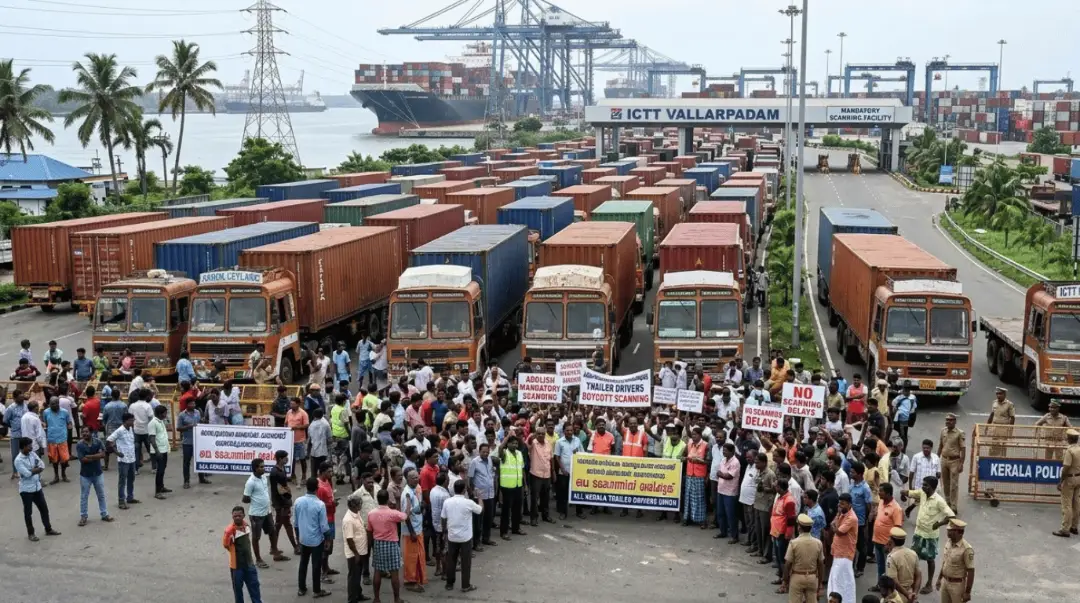
Container movement at Vallarpadam terminal has been disrupted since 9 November 2026, as trailer crews boycott the mandatory drive-in scanning facility installed by the Customs Department, slowing EXIM operations and creating bottlenecks at the terminal gates . The protest has led to long queues of container trailers along NH 966A, the Container Road connecting Kalamassery with Vallarpadam, and trade bodies are warning of mounting costs for importers and exporters.
The dispute centres on the health concerns of trailer workers who are required to pass through the scanning facility multiple times a day. Trade union leaders said workers have complained of severe health-related and psychological issues, including vomiting, headaches, and elevated heart rates, after passing through the scanner six to seven times daily . The unions alleged that the Customs Commissioner had earlier assured them that protective gear would be provided, but later backtracked during discussions, prompting the boycott .
The operational impact has been significant. Trade sources said the scanner boycott has effectively disrupted cargo traffic and trailer movement through the terminal gates, with workers staging protests outside the facility . The disruption has created bottlenecks at customs clearance gates, and the Cochin Chamber of Commerce and Industry has sought urgent intervention from the Customs Commissioner to facilitate smooth container movement, reduce additional costs, and prevent further disruption to trade .
The Chamber has proposed practical alternatives to the blanket scanning mandate. Bipu Punnuran and Prakash Iyer, president and secretary of the Chamber respectively, suggested random or selective scanning until adequate scanning infrastructure is in place, and urged that scanning or examination of containers be permitted at designated container freight stations or ICDs to ease congestion at the terminal . They also recommended that until sufficient facilities are available, scanning should be undertaken based on specific requirements and risk assessment rather than mandating scanning of every import container .
The commercial consequences are accumulating. The Chamber pointed out that several trailer and truck drivers have been reluctant to transport containers due to concerns about potential health risks associated with the scanning process, and as a result, hundreds of import containers are being held up at the terminal, causing delays in container movement and additional detention, demurrage, and other charges . For importers, these charges represent a direct cost that is unrelated to their own operations and is instead a consequence of the dispute between workers and customs authorities.
The broader policy context explains why the scanning mandate is in place. According to officials, the mandatory scanning of all import-laden containers at Cochin Port is part of the government's objective to progressively implement 100% scanning of import containers across all ports in the country by 2028 . This is a legitimate security and compliance objective, but the Vallarpadam dispute illustrates the implementation challenges that arise when the policy is applied without adequate worker protections or infrastructure flexibility.
For India's logistics sector, the Vallarpadam disruption is a reminder that port operations depend on the cooperation of the workforce that moves containers, and that health and safety concerns among drivers and crews can halt cargo movement as effectively as any infrastructure failure. The dispute also highlights the tension between customs enforcement objectives and trade facilitation: the scanning mandate serves a security purpose, but its blanket application at a single facility without protective measures for workers has created a bottleneck that affects hundreds of containers and the businesses that depend on them.
Looking ahead, the key question is whether the Customs Department will agree to the Chamber's proposals for selective scanning, alternative examination locations, or protective gear for workers. The resolution of the dispute will determine how quickly the backlog at Vallarpadam is cleared and whether similar boycotts emerge at other ports as the 100% scanning target is rolled out. For now, the protest has effectively halted container movement at one of Kerala's key gateways, and the trade bodies' warning of mounting costs signals that the economic impact is already being felt.