
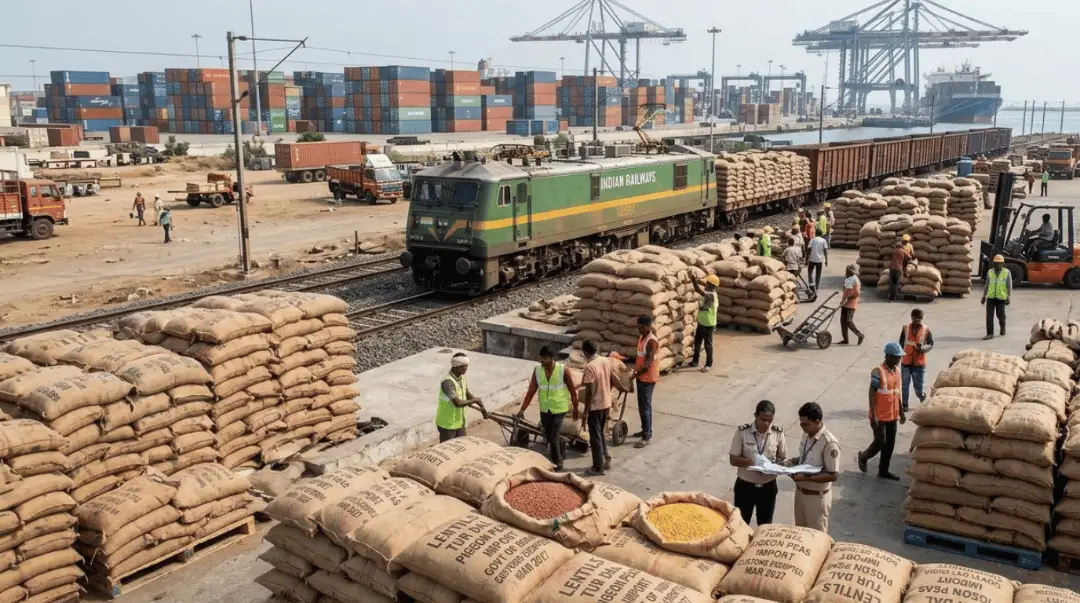
The Central Government has extended the customs duty exemption on imports of lentils and tur by four months, from 31 December 2026 to 31 March 2027, in a move aimed at maintaining adequate domestic supplies of pulses and containing price pressures . The notification, reported by TaxGuru and other trade outlets on 12 November 2026, amends the earlier exemption that was set to expire at the end of the calendar year.
The exemption covers the Basic Customs Duty and the Agriculture Infrastructure and Development Cess on the two pulse varieties . This means importers can bring lentils and tur into the country without paying the duties that would normally apply, lowering the landed cost of imported pulses and making them more competitive relative to domestic production. The measure is intended to ensure adequate availability in the domestic market, particularly during the winter and early summer months when pulse consumption typically remains steady while domestic arrivals may be limited.
The timing of the extension reflects concerns about domestic pulse production and prices. India is the world's largest producer and consumer of pulses, and the government has historically used trade policy to smooth out supply fluctuations. When domestic output is under pressure—whether from adverse weather, reduced acreage, or other factors—the government has periodically waived or reduced import duties to encourage inflows and prevent sharp price increases. The four-month extension through March 2027 provides certainty for importers and traders planning their shipments for the first quarter of the next calendar year.
The extension follows a similar measure for cotton imports, which was extended to 31 December 2026 in late October . The pattern suggests that the government is actively using customs duty exemptions as a tool to manage input costs and food inflation across multiple agricultural commodities. For pulses, the stakes are particularly high because they are a staple protein source for a large share of the Indian population, and price spikes can have significant political and social implications.
For India's agricultural import logistics, the extension has implications for shipping and port handling. Lentils and tur are imported primarily from Canada, Australia, Myanmar, and East African countries, and they move through both container and bulk shipments depending on the volume and the supplier. The extension provides a longer window for importers to plan their procurement and shipping schedules, reducing the risk that shipments will arrive after the exemption expires and face unexpected duty liabilities.
The measure also connects to the broader food security concerns that have emerged during the maritime disruptions of 2026. The Hormuz crisis and Red Sea security concerns have affected shipping routes and freight costs for agricultural commodities, and the government has been monitoring pulse prices and availability as part of its overall food inflation management strategy. Extending the duty exemption is a relatively low-cost intervention that can help offset some of the cost pressures that importers face, without requiring direct subsidies or price controls.
Looking ahead, the key question is whether the extension will be sufficient to keep pulse prices stable through the first quarter of 2027, or whether further measures will be needed. The government has not disclosed the volume of imports it expects under the exemption, and the effectiveness of the measure will depend on whether global suppliers can deliver at competitive prices and whether shipping capacity remains available. For now, the extension signals that the government is prepared to maintain an open import regime for pulses, and that it sees trade facilitation as a tool for managing domestic food security.