
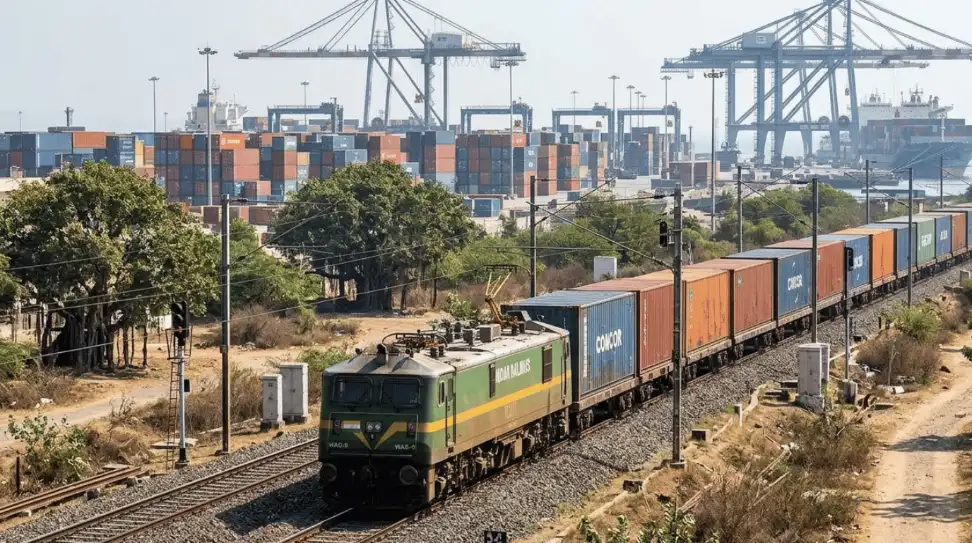
Container Corporation of India has introduced a weekly scheduled train service connecting its inland container depot at Juhi in Kanpur, Uttar Pradesh, to Mundra Port in Gujarat, creating a fixed-schedule rail link between one of northern India's key industrial hubs and the country's largest private port . The first train is scheduled to be flagged off on Wednesday, 18 November 2026, with subsequent services operating every Wednesday thereafter .
The service is designed to provide exporters with predictability in cargo transportation. A published departure day gives exporters and freight forwarders a date around which to plan factory dispatch, container stuffing, and delivery to the inland depot . For cargo booked on a specific vessel, the rail departure needs to allow enough time for the container to reach Mundra before the shipping line's cargo cut-off, and the weekly timetable makes the inland departure predictable even though the full journey still depends on rail transit time and the onward vessel schedule .
For the Kanpur region, the service addresses a connectivity gap that has constrained exporters' access to western ports. The industrial belt around Kanpur produces goods that require reliable access to international markets, and moving containers by rail from the inland depot to Mundra reduces dependence on road haulage for the long leg of the journey . The service is also aimed at providing a time-bound and cost-efficient option, though actual costs will depend on the tariff and the shipper's inland haulage and handling requirements .
Mundra's role as a gateway for northern India's container exports provides the context for the service. The port connects to the national railway network at Adipur through a 64-km electrified rail line, and its dedicated rail network has been doubled to handle double-stack container trains . Mundra handled 8.5 million TEUs in the financial year ended March 2026, and APSEZ says the port accounts for nearly 35% of India's container trade .
The timing of the launch aligns with the broader expansion of rail-linked container services in India. DP World has launched double-stack services connecting JNPA with northern and western inland terminals, and the dedicated freight corridor network has improved transit reliability on trunk routes. CONCOR's Kanpur–Mundra service adds another node to this growing network, reinforcing the role of rail in connecting inland production centres with maritime gateways.
The operational model reflects CONCOR's broader strategy of offering scheduled, reliable services rather than relying solely on demand-driven train operations. The weekly frequency is modest, but it establishes a foundation that can be scaled if cargo uptake justifies additional departures. The service is likely to appeal to exporters who value schedule integrity over the lowest possible freight rate, particularly for time-sensitive shipments or cargo destined for vessels with fixed departure windows.
For India's logistics sector, the Kanpur–Mundra service illustrates the incremental improvements that are reshaping inland container movement. It is not a transformative project in the way that a new port or dedicated freight corridor is, but it addresses a specific connectivity gap with a practical, commercially viable solution. The cumulative effect of such services—combined with the DFC network, double-stack operations, and port-linked logistics parks—is to make rail a more credible alternative to road for container movement.
Looking ahead, the key milestone is the first departure on 18 November and the service's ability to establish consistent utilisation. CONCOR has not disclosed the expected volume or the number of rakes that will be deployed, and the service's success will depend on whether exporters in the Kanpur region adopt the rail option in sufficient numbers to sustain weekly operations. For now, the launch signals that CONCOR is continuing to expand its scheduled services beyond the major corridors, connecting smaller inland markets to the ports that serve them.