
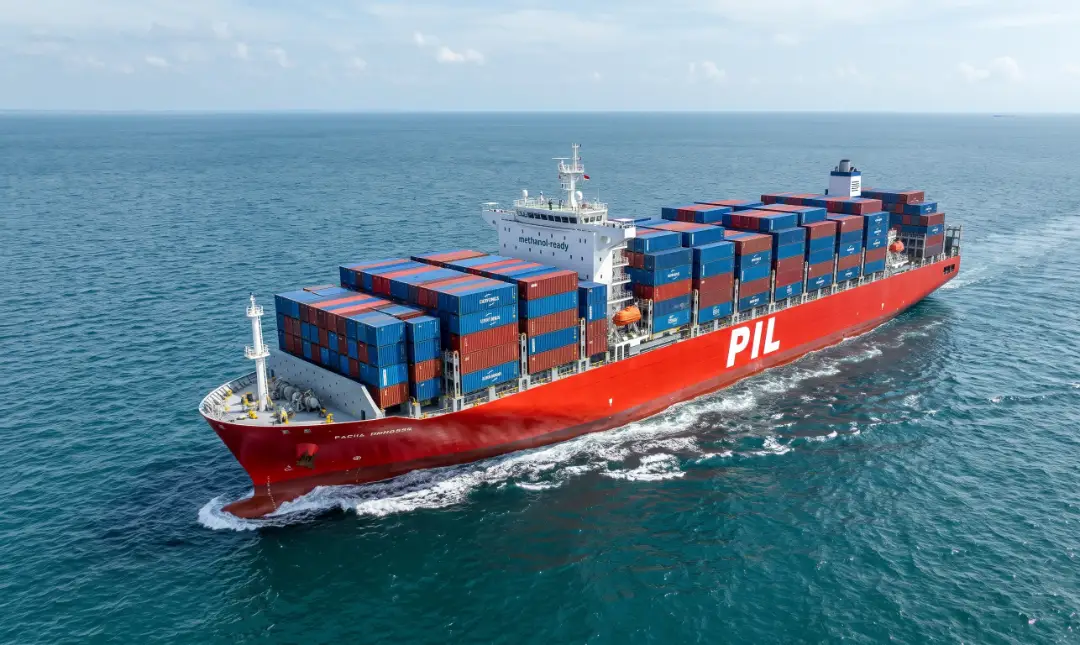
The order was announced by PIL on November 5, 2026, and the signing ceremony was attended by Abhishek Chawla, Chief Marine Officer of PIL, and Chang Junde, Vice President and Director of Huanghai Shipbuilding, representing both parties. The seven vessels are scheduled for delivery between 2029 and 2030, and will strengthen PIL's feeder capacity and operational flexibility on its Intra-Asia and Pacific Islands networks. PIL CEO Lars Kastrup stated: "Investing in these new feeder vessels will strengthen our capabilities and capacity across the Intra-Asia and Pacific Islands network".
The vessel design was tailored for regional market requirements. The 172-meter length and 25-meter beam were optimized by Shanghai Merchant Ship Design & Research Institute (SDARI) to maximize cargo capacity while ensuring berthing flexibility at smaller ports. PIL stated that this size configuration enables the vessels to connect smaller ports within the network with major transshipment hubs, filling a capacity gap in the feeder segment. The vessels will carry a total capacity of 9,800 TEU across the seven ships.
The "methanol-ready" designation is a key feature of this order. This is the first time PIL has selected methanol-ready design when ordering newbuildings. This design allows the vessels to initially operate on conventional marine fuel, while retaining the option to convert to methanol propulsion in the future once methanol fuel supply and bunkering infrastructure mature. Several shipowners in recent years have ordered methanol-ready or alternative-fuel-ready vessels, but relatively few have actually completed conversions to methanol propulsion, reflecting the industry's wait-and-see approach to alternative fuel infrastructure.
In terms of energy efficiency, the vessels will incorporate pre-swirl vanes and propeller boss cap fins to improve propulsion efficiency and reduce fuel consumption. The vessels will also be equipped with fixed fire water monitors and cargo hold water spray systems to enhance firefighting and cargo safety capabilities. Digital systems will support performance monitoring and operational management. PIL stated that these features will "optimize fleet operations while supporting the company's goal of achieving net-zero emissions by 2050".
The selection of Huanghai Shipbuilding was based on the shipyard's technical capabilities, industry experience, and comprehensive performance in ship quality, construction efficiency, and on-time delivery. Huanghai Shipbuilding is located in Shidao, Shandong Province, China, and has extensive experience in the feeder container vessel segment. This order also reflects the competitiveness of Chinese shipyards in the feeder containership construction sector. As a reference, Clarksons data shows that the current newbuilding price for a 1,000-1,200 TEU containership is approximately USD 25.25 million.
From a fleet strategy perspective, this order is part of PIL's ongoing fleet renewal and expansion program. PIL's capacity has increased by more than 50% to approximately 500,000 TEU. By the first half of 2026, PIL had taken delivery of ten LNG dual-fuel vessels, with 18 additional LNG dual-fuel newbuildings and 14 long-term chartered vessels scheduled for delivery through 2029. This methanol-ready feeder order complements PIL's larger LNG dual-fuel vessel investments, forming a fleet structure that combines "large vessels on trunk routes + flexible feeders on regional routes."
For South and Southeast Asian logistics markets, the deployment of these vessels will directly affect feeder network connectivity between smaller ports and transshipment hubs. PIL's Intra-Asia network covers key routes connecting Southeast Asia, South Asia, and the Pacific Islands. The entry of new tonnage may improve service frequency and capacity stability on routes connecting smaller ports in India, Bangladesh, Sri Lanka, and other countries/regions with hubs such as Singapore and Port Klang. However, PIL has not disclosed the specific port rotation for these vessels, and the direct impact on specific India-related routes remains to be observed.