
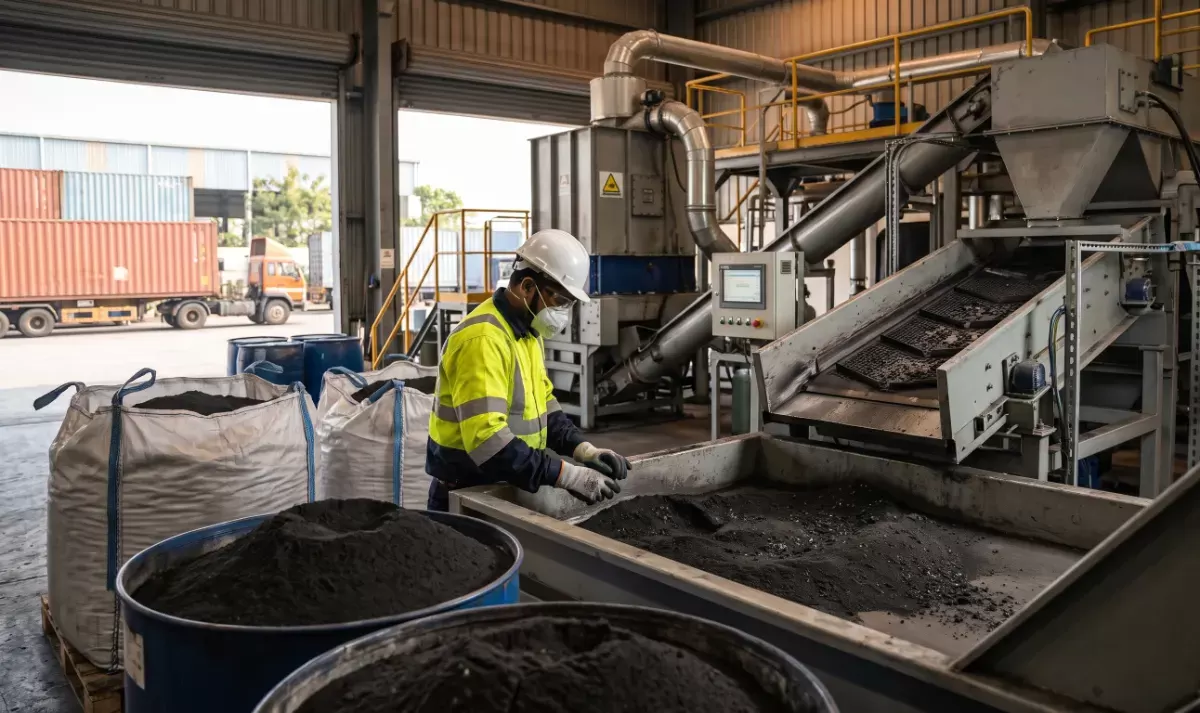
Black mass refers to the powdered material obtained from shredding end-of-life lithium-ion batteries and battery manufacturing scrap, rich in recoverable critical minerals such as lithium, cobalt, nickel, and manganese. India's demand for these minerals currently relies heavily on imports, and battery recycling is considered one of the fastest and most sustainable ways to establish domestic supply. The DGFT notification explicitly states that the export prohibition is intended to ensure black mass generated in India is recycled and refined domestically, thereby guaranteeing feedstock supply for domestic recycling and refining units and improving their capacity utilization.
This policy directly addresses a structural contradiction in India's recycling industry. According to data cited by the Ministry of Commerce and Industry, India's battery waste recycling and critical mineral refining capacity has grown considerably, but is not fully utilized due to insufficient feedstock. Black mass generated in India is exported abroad, while domestic recyclers sometimes have to import materials to meet production needs. Global Trade Research Initiative (GTRI) founder Ajay Srivastava noted that India's exports under this tariff code were zero in the 2025-26 fiscal year, and the government's action is "preventive," aimed at preventing future exports and retaining materials for domestic refiners.
From an industry capacity perspective, India currently has 57 lithium-ion battery recyclers registered on the Central Pollution Control Board's Battery Waste EPR portal, with a combined annual processing capacity of approximately 517,000 tonnes. However, the capacity specifically for processing black mass is estimated at only approximately 75,500 tonnes per year. This gap indicates that installed recycling capacity should not be equated with actual capability to produce battery-grade minerals. GTRI noted that India's black mass processing capacity exceeds its generation, leaving refiners with insufficient raw materials.
Policy enforcement faces challenges in distinguishing declared goods. GTRI pointed out that black mass may contain toxic electrolyte residues and heavy metals requiring further treatment. Although hazardous waste regulations require prior permission for such shipments, exporters may evade scrutiny by declaring the material as cobalt powder, nickel intermediates, or other industrial products. Effective enforcement will depend on customs authorities verifying not only how the material is declared, but also how it is produced, as different names or tariff codes may disguise the same waste.
This export ban is part of India's broader critical minerals strategy. In January 2025, India approved the National Critical Mineral Mission with an outlay of ₹16,300 crore; in September 2025, the cabinet approved a ₹1,500 crore incentive scheme to develop recycling capacity for separating and producing critical minerals from secondary sources such as battery waste and e-waste. Retaining black mass domestically will help ensure recycling capacity being built under this scheme has access to sufficient domestic feedstock. Additionally, in November 2026, the Indian cabinet approved a ₹2,814 crore capital expenditure support scheme aimed at establishing two lithium and two nickel processing plants.
The Material Recycling Association of India (MRAI) welcomed the amendment, stating it is "an important step toward strengthening India's resource security, encouraging investment in indigenous recycling capacity, and building a self-reliant circular economy". The Ministry of Commerce and Industry also stated that the measure will increase domestic recovery of lithium, cobalt, nickel, and other critical minerals, reduce foreign exchange expenditure associated with import dependence, and strengthen supply chains for battery manufacturing, electric vehicles, energy storage, and clean energy technologies.
It is worth noting that the notification applies transitional arrangements under Paragraph 1.05 of the Foreign Trade Policy 2023. Exporters with existing contracts must carefully examine prescribed safeguard measures, including provisions for goods already exported and qualifying irrevocable commercial letters of credit, rather than assuming all prior contracts automatically remain eligible for export. For logistics and customs clearance operators, this means shipments involving tariff code 85491400 require stricter verification of policy applicability, and any ambiguity in customs declaration of goods may trigger delays or compliance risks.