
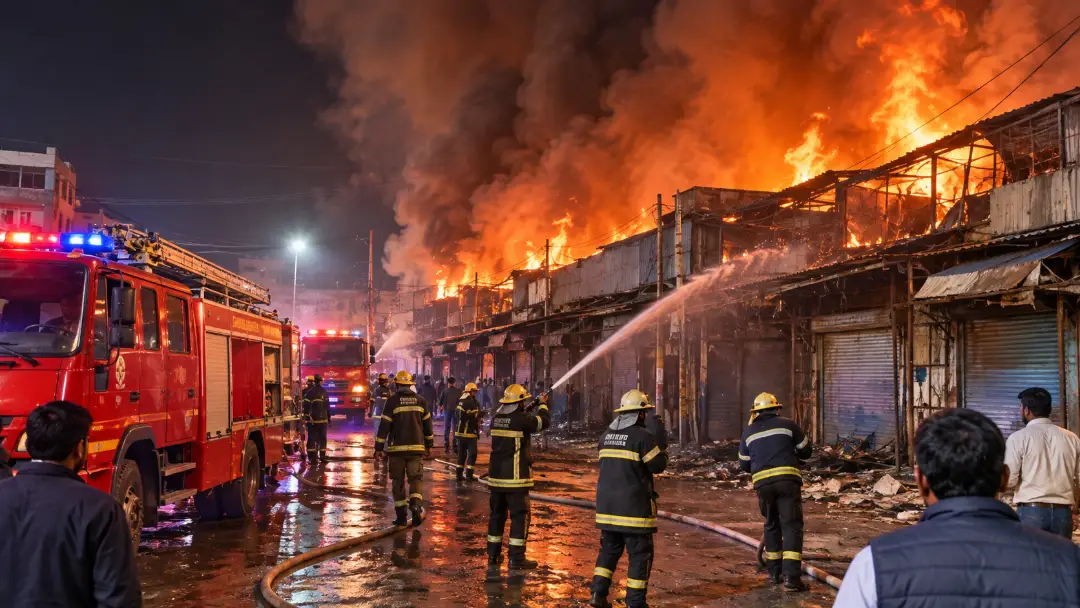
The fire broke out around 8:30 p.m. on November 8, Diwali night, in Block-C of the Warehouse-Nehru Market. According to preliminary assessments, sparks from firecrackers ignited cotton stored outside a shop, and the flames spread rapidly to adjacent shops and godowns. The market is one of the oldest commercial hubs in Jammu, specializing in wholesale trade of food grains, edible oil, dry fruits, pulses, and other essential commodities. Eight shops were completely destroyed, and goods in two other shops were substantially damaged. In addition, water used during firefighting operations damaged goods in another eight to ten adjacent shops.
The traders' federation alleged serious delays in the arrival of fire tenders. Federation President Deepak Gupta claimed that fire stations were less than five minutes away, but the first fire tenders took approximately 90 minutes to arrive, and only two tenders were initially deployed. The Fire and Emergency Services Department denied the allegation, stating that the emergency call was received at 9:18 p.m. and CCTV footage showed fire tenders departing at 9:38 p.m., with three additional tenders arriving about ten minutes later. Ultimately, approximately 25 to 30 fire tenders from across the city were deployed, and the fire was brought under control around 3 a.m. the following day.
In protest against the alleged negligence, the Warehouse-Nehru Market Traders Federation called for a market shutdown. What was initially announced as a 48-hour closure was extended to three days. The shutdown paralyzed logistics operations at the market, which serves as the primary wholesale distribution point for food grains and essential commodities for all ten districts of the Jammu division and also supplies goods to Ladakh. Retailers across the region faced supply shortages, and trucks carrying goods from outside the Union Territory were unable to unload.
The impact on road freight was particularly severe. Truck drivers from Punjab, Indore, and Nashik who had arrived with shipments of potatoes, pulses, and onions were stranded for up to four days. A driver from Punjab who had departed before Diwali with a potato shipment stated that he had expected to unload on Monday but was stuck until Thursday. A driver from Nashik carrying onions reported that some of the produce had begun to spoil during the three-day wait. The federation's General Secretary, Abhimanyu Gupta, estimated that the market normally handles approximately ₹100 crore in business daily, meaning the three-day closure affected around ₹300 crore in trade.
The political and administrative response unfolded over several days. Lieutenant Governor Manoj Sinha constituted a two-member inquiry committee on November 11, comprising Inspector General of Police (Jammu) Tejinder Singh and Divisional Commissioner Vikas Kundal. The committee was directed to investigate any lapses or negligence, fix responsibility, and submit its report within 15 days. Following the announcement of the inquiry, the traders' federation called off the strike on the evening of November 11, and supply resumed the next morning. The LG also visited the market and handed over a cheque of ₹11 lakh as immediate relief, including ₹1 lakh each for 11 affected shop owners.
Normal operations resumed on November 12, with buyers and traders moving through the market from morning to evening. Trucks that had been waiting for days were finally unloaded. The federation stated that traders would work around the clock to replenish stocks and restore normal supply levels to affected areas. Municipal teams also began clearing debris from the damaged shops. The traders are now awaiting repairs and rehabilitation, with the Jammu Development Authority (JDA) expected to undertake reconstruction of the damaged shops. The federation has also demanded financial assistance for affected traders and the allocation of land outside the city for new godowns, a long-standing demand that has gained urgency following the fire.
The fire and subsequent shutdown highlighted the vulnerability of Jammu's food grain logistics chain. The Warehouse-Nehru Market, established in 1972, is the largest wholesale goods market in the Jammu region and handles critical volumes of essential commodities. The concentration of storage and trading activity in a dense urban market with aging infrastructure presents fire risks and operational bottlenecks. Traders have argued for decades that adequate warehouse facilities should be developed outside the city limits, and the interim Chief Secretary reportedly issued directions to the JDA Vice Chairman to identify suitable land for this purpose. The incident also underscored the dependence of retailers and consumers across the Jammu division, as well as in Ladakh, on a single wholesale hub, meaning that any disruption at this node propagates rapidly through the downstream supply chain.
The insurance dimension added another layer to the aftermath. Representatives from New India Insurance Company conducted surveys of the damaged shops but had not approved claims as of November 11. Affected traders reportedly confronted the surveyor, and the Deputy Commissioner directed the representative to submit the survey report and necessary documents at the collectorate the following day. The resolution of insurance claims and the disbursement of government compensation will be critical for the affected traders to restart their businesses. Meanwhile, the inquiry committee's findings on the fire response will determine whether any departmental accountability measures are taken and whether recommendations are made to strengthen fire safety infrastructure at the market.
From a broader logistics perspective, the Jammu warehouse incident illustrates the intersection of urban infrastructure governance and supply chain resilience. The market functions as a critical node in the road-based freight network serving the Kashmir valley and Ladakh, particularly during winter months when alternate routes may be constrained. The three-day disruption, while localized, rippled through the supply chain to retailers and consumers across a wide geographic area. The incident may accelerate administrative momentum toward relocating or upgrading wholesale warehousing infrastructure in Jammu, a reform that traders have advocated for years. For logistics operators and shippers using the Jammu corridor, the episode serves as a reminder of the operational risks posed by concentrated, fire-vulnerable storage facilities in dense urban settings.