
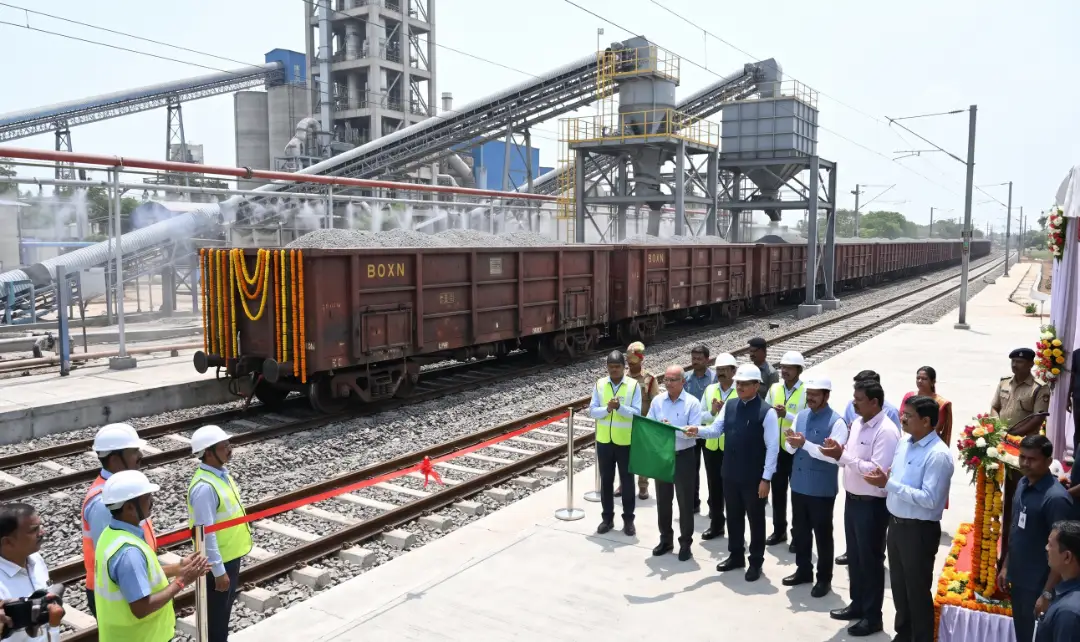
The mechanized clinker loading facility was inaugurated on Thursday, November 12, 2026, by Southern Railway General Manager U. Subba Rao at the Kallakudi Palanganatham railway siding in Ariyalur district, Tamil Nadu. Following the inauguration, Subba Rao flagged off the first consignment of clinker destined for Meenatchi Cement Works at the Gati Shakti Multimodal Cargo Terminal located in Nalli, within the Madurai division. The event was attended by Balak Ram Negi, Divisional Railway Manager of the Trichy Division, and S.T. Ramalingam, Chief Freight Transportation Manager of Southern Railway.
The operational capacity of the new facility is projected at 50,000 to 60,000 tonnes of clinker per month. On an annual basis, this translates to an additional freight loading of approximately 0.7 million tonnes for Southern Railway. The railway projects that this new traffic stream will generate freight revenue of around ₹28.8 crore per annum. The facility is designed to streamline the loading process for clinker, a key raw material in cement production, replacing or supplementing conventional loading methods at the siding.
The Kallakudi Palanganatham railway siding has a long operational history, having been commissioned on May 28, 1963. The siding primarily serves the logistics requirements of the Dalmiapuram cement plant operated by Dalmia Cement (Bharat) Limited. That plant has an installed annual cement production capacity of four million tonnes. The introduction of mechanized loading at this established siding reflects an upgrade in the interface between the cement producer's operations and the railway freight network.
According to the Trichy Railway Division, the mechanized loading facility is expected to strengthen the partnership between industry and the railway system. The division stated that the facility will provide reliable and sustainable logistics solutions to industries. For Dalmia Cement, the mechanized system reduces dependence on manual or less efficient loading arrangements, potentially improving turnaround times for rakes and reducing handling losses associated with clinker, a granular material prone to spillage and dust generation during conventional loading.
The facility also contributes to Indian Railways' broader freight growth strategy, specifically the "Mission 3000 MT" initiative. This mission sets a target of achieving 3,000 million tonnes of freight loading by 2030. Indian Railways recorded 1,670 million tonnes of freight in the 2025-26 financial year, representing a 3.25 percent increase over the previous year. The addition of 0.7 million tonnes from a single facility in Tamil Nadu represents a incremental contribution toward the national target, illustrating how localized infrastructure upgrades aggregate into system-level capacity growth.
From a regional logistics perspective, the facility strengthens the rail freight corridor serving the Ariyalur-Trichy-Madurai axis in central Tamil Nadu. Ariyalur district is a significant cluster for cement manufacturing, with substantial limestone reserves and multiple cement plants in operation. Efficient rail evacuation of clinker and cement from this cluster is critical for supplying construction markets across Tamil Nadu and neighboring states. The mechanized facility reduces the friction involved in moving clinker from the Dalmiapuram plant to the railway network, supporting the competitiveness of rail versus road for this bulk commodity.
The Gati Shakti Multimodal Cargo Terminal at Nalli, which received the first consignment, represents another element of the logistics infrastructure being developed under the PM Gati Shakti framework. These terminals are designed to function as aggregation and distribution points that integrate rail with road transportation, enabling more efficient last-mile connectivity for bulk and containerized cargo. The routing of the first clinker consignment from a production site siding to a multimodal terminal illustrates the type of integrated freight movement that the Gati Shakti initiative aims to facilitate.
The inauguration of this facility follows a pattern of incremental capacity additions across Southern Railway's freight network. While large-scale projects such as dedicated freight corridors and new line construction receive significant attention, upgrades at existing industrial sidings—such as mechanized loading systems—can deliver relatively rapid returns in terms of additional tonnage and revenue with lower capital expenditure. The ₹28.8 crore annual revenue projection from the Kallakudi Palanganatham facility suggests a favorable payback profile for the investment. For freight customers in the cement sector, the availability of mechanized loading at a long-established siding provides greater certainty in rake placement and dispatch scheduling, which is particularly important during peak construction seasons when cement demand surges.