
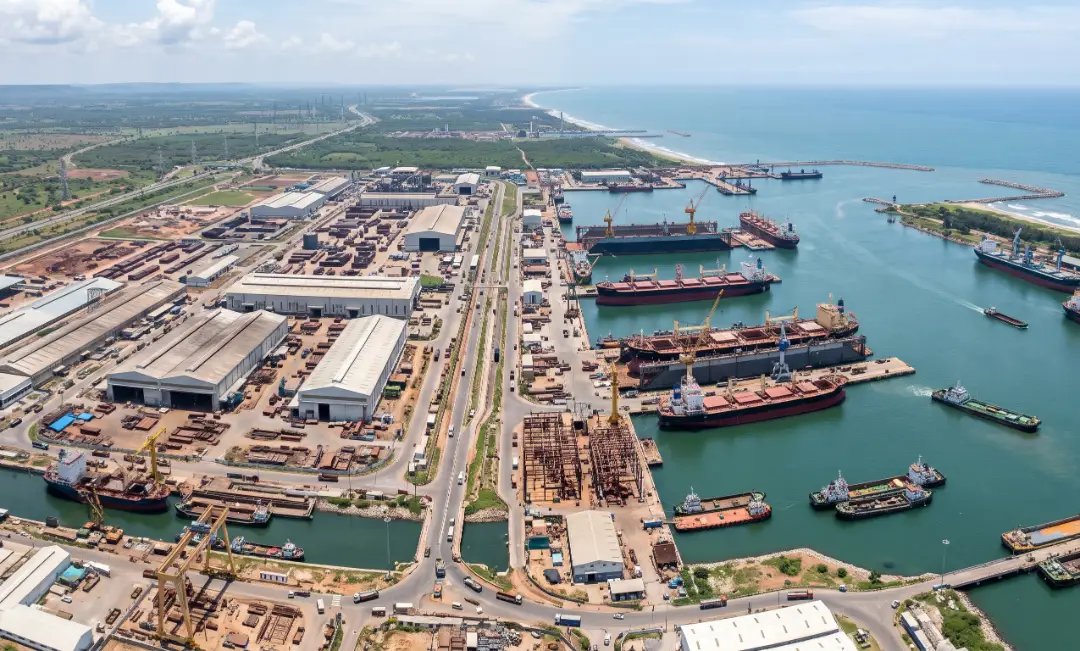
The Dugarajapatnam shipbuilding cluster is one of five greenfield shipbuilding clusters shortlisted in India, and it received the largest land allocation, covering 3,488 acres with approximately 2.1 kilometers of waterfront, located along the Visakhapatnam-Chennai Industrial Corridor. After dredging, the water depth at the project site is expected to reach 13 to 15 meters, capable of accommodating large vessel construction and repair operations. The project plans include an anchor shipyard, ship repair yards, and heavy engineering facilities, along with dry docks, ship lifts, and outfitting berths.
The project is being promoted by a 50:50 joint venture between the Andhra Pradesh Maritime Board and the Visakhapatnam Port Authority, named "National Shipbuilding and Heavy Industries Park Andhra Pradesh Limited" (NSHIP-AP). This special purpose vehicle will be responsible for investor recruitment, land due diligence, negotiations with potential anchor shipyards, as well as the construction of shared infrastructure such as dredging, waterfront facilities, internal logistics, and public utilities. Under the National Shipbuilding Scheme, at least one anchor shipyard must achieve an annual capacity of 500,000 GT within ten years of commissioning.
At the CII Partnership Summit, Sonowal emphasized that shipbuilding and ship repair are regarded as major growth opportunities for Andhra Pradesh. He noted that the central government has allocated ₹70 billion in financing support for shipbuilding and maritime activities to promote industry development and attract investment. The ₹30,000 crore figure announced this time is the estimated total investment for the cluster, but the Ministry of Ports, Shipping and Waterways did not disclose a specific funding breakdown, construction start date, or commissioning timeline at the summit.
The project's approval comes at a time when India is striving to elevate its position in the global shipbuilding industry. Currently, India's share of the global shipbuilding market is far below that of China, South Korea, and Japan. The Indian government hopes to build a complete shipbuilding industry ecosystem by establishing greenfield clusters, including component manufacturing, technology research and development, and workforce training. Dugarajapatnam's location advantages lie in its proximity to the Visakhapatnam port cluster, which already possesses a certain industrial foundation and skilled workforce.
The remaining four shortlisted sites are located in Thoothukudi in Tamil Nadu, Kucchadi in Gujarat, Dighi in Maharashtra, and Kendrapara in Odisha. These five sites together form the spatial layout of India's National Shipbuilding Mission, aiming to build shipbuilding capacity on both the east and west coasts. The revised Techno-Economic Feasibility Report for the Dugarajapatnam project is currently under review, and land acquisition is progressing.
For Andhra Pradesh, this project carries significant implications for regional economic development. The state has long aimed to leverage its long coastline to develop a maritime economy, but its industrial base remains dominated by agriculture and traditional manufacturing. The shipbuilding cluster is expected to drive the development of supporting industries such as steel, engineering machinery, and electronic equipment, while creating a large number of skilled jobs. The Visakhapatnam-Chennai Industrial Corridor, as one of India's key industrial corridor plans, will also benefit from this.
However, the project still faces uncertainties. The report indicates that the anchor shipyard has not yet been selected, and NSHIP-AP is engaging with potential investors and shipyard operators. Global shipbuilding competition is fierce, and Indian shipyards face disadvantages in terms of cost, technology, and delivery cycles compared to East Asian competitors. Additionally, the pace of land acquisition and environmental approvals will directly affect the project's timeline. The Indian Ministry of Ports, Shipping and Waterways has not provided a specific construction schedule for the project, stating only that it is "advancing in an orderly manner."
From a strategic perspective, the Dugarajapatnam shipbuilding cluster is part of India's broader "Maritime Amrit Kaal Vision 2047" framework, which aims to substantially enhance India's self-sufficiency in shipbuilding, ship repair, and maritime logistics by 2047. The project also aligns with the "Make in India" and "Aatmanirbhar Bharat" policy orientations, aiming to reduce dependence on foreign shipbuilding and shipping services. For global shipbuilders and marine equipment manufacturers, the project could present opportunities for technology transfer and joint ventures, particularly in the fields of green shipbuilding and methanol/ammonia dual-fuel propulsion systems.