
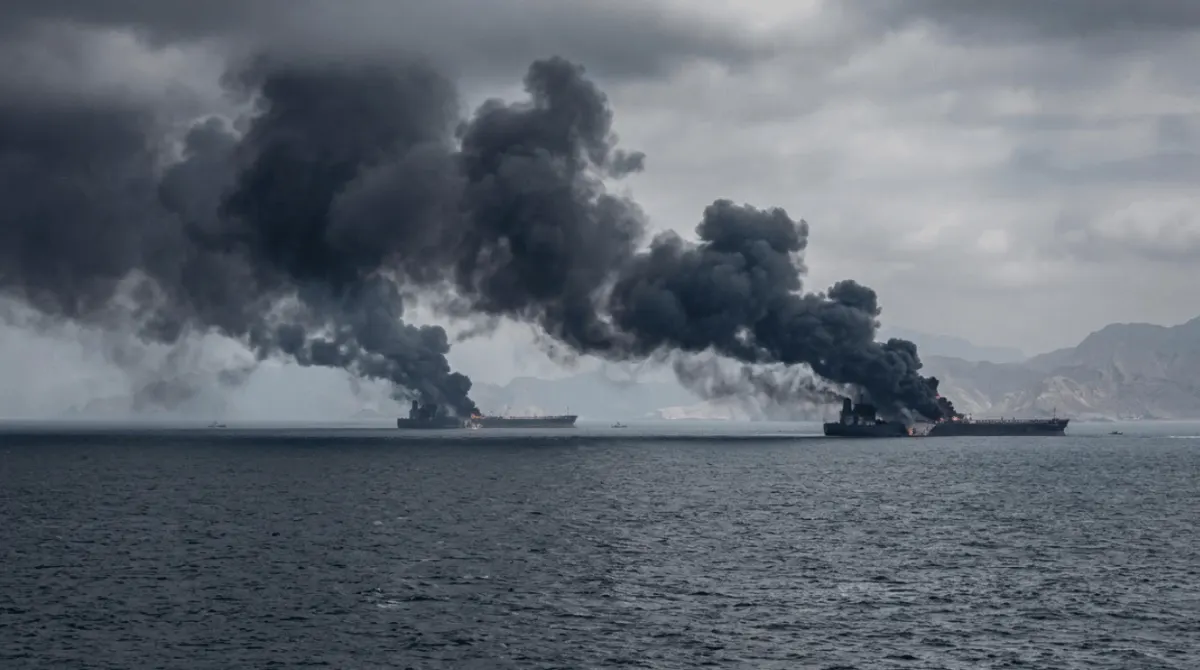
Iran's Islamic Revolutionary Guard Corps announced on 12 November 2026 that two supertankers carrying more than 4 million barrels of oil combined exploded and caught fire overnight in the Strait of Hormuz, in the latest of a series of claims that have accompanied the escalating maritime confrontation in the Gulf . According to the IRGC statement, both vessels were using an unauthorized southern route through the strait and had ignored repeated warnings from the Guard's naval forces that the route was prohibited and dangerous . The IRGC said the vessels were disabled after the explosions and were burning, and it blamed the crews for placing their trust in the US military .
The statement did not identify the tankers, their flags, their ownership, or the condition of their crews, and independent regional sources have not confirmed the claims . The IRGC's account is consistent with its recent pattern of attributing incidents to mines that vessels strike while using routes Tehran considers unauthorized, rather than to direct attacks. The US military has maintained that it has cleared mines from primary transit routes and has been escorting vessels through the strait, a claim the IRGC has rejected .
The timing of the claim places it within a period of intense diplomatic and military activity. The incident occurred as Iran and the United States remain engaged in mediated talks over the reopening of the strait, with Tehran maintaining a two-day proposal that would see the US lift its naval blockade and ease sanctions before Iran restores normal navigation. The IRGC's assertion that unauthorized routes remain dangerous serves as a reminder that Tehran retains the capability to impose costs on shipping regardless of the diplomatic track.
Separately, UK Maritime Trade Operations and maritime security firm Ambrey reported a projectile striking a commercial vessel approximately 14 nautical miles northwest of Ras Al Khaimah in the UAE on 11 November. The projectile hit the stern and ignited a fire in the engine room, with no injuries or pollution reported . It was not immediately clear whether this vessel was among the two supertankers claimed by the IRGC.
The cumulative toll on shipping continues to mount. The IMO has verified 133 incidents involving merchant vessels since the conflict began on 28 February, resulting in 25 seafarer fatalities and others injured or missing . IMO Secretary-General Arsenio Dominguez used the occasion to warn that unsafe shipping practices—including substandard vessels, concealed IMO numbers, fraudulent registrations, and false flags—are compounding the dangers seafarers face, and he urged flag, port, and coastal states to enforce international regulations .
For India, the IRGC's claims reinforce the operational reality that the Strait of Hormuz remains a high-risk corridor for the energy imports on which Indian refiners depend. The attack on the VLCC MT Fujairah Energy on 10 November injured an Indian seafarer, and the broader pattern of incidents sustains the freight and insurance premiums that have inflated India's energy import bill throughout 2026. Indian refiners have already responded by diversifying supply and shifting toward delivered-basis crude purchases, and the latest escalation justifies the continuation of those measures.
Looking ahead, the credibility of the IRGC's claims will depend on whether independent sources can verify the incidents and identify the vessels involved. The absence of attribution and the competing narratives between Tehran and Washington leave the shipping industry to operate on the assumption that the strait remains unsafe, regardless of which account is accurate. For now, the IRGC's statement confirms that the Hormuz crisis is not approaching resolution, and that the threat to commercial shipping remains a live and lethal risk.