
Union Minister of Ports, Shipping and Waterways Sarbananda Sonowal has outlined a national maritime investment programme of approximately ₹80 lakh crore under Sagarmala, Maritime India Vision 2030, and Maritime Amrit Kaal Vision 2047, positioning Andhra Pradesh as the principal gateway for India's eastern and central hinterland . Speaking at the 31st CII Partnership Summit in Visakhapatnam on 12 November 2026, Sonowal framed the investment as part of a comprehensive maritime transformation aimed at supporting India's emergence as a developed nation by 2047.
The Minister identified three clear ambitions for Andhra Pradesh. First, to make the state India's leading destination for port-led development in line with the Sapta Dhara roadmap for Viksit Bharat 2047. Second, to develop it into a globally competitive shipbuilding and ship-repair hub. Third, to position it as India's eastern maritime gateway to Asia, East Asia, and the Indo-Pacific . These ambitions connect the state's 1,053-kilometre coastline and its proximity to major international shipping routes to the broader national maritime strategy.
The Dugarajapatnam shipbuilding cluster is the centrepiece of the state's shipbuilding ambition. The project has received in-principle approval under the National Shipbuilding Mission, with an estimated investment of about ₹30,000 crore and a targeted annual capacity of 1.2 million gross tonnage . A special-purpose vehicle involving the Andhra Pradesh Maritime Board and Visakhapatnam Port Authority has been formed to take the project forward . Sonowal extended a direct invitation to global shipbuilders, technology companies, equipment manufacturers, port operators, and investors to partner in the cluster's development.
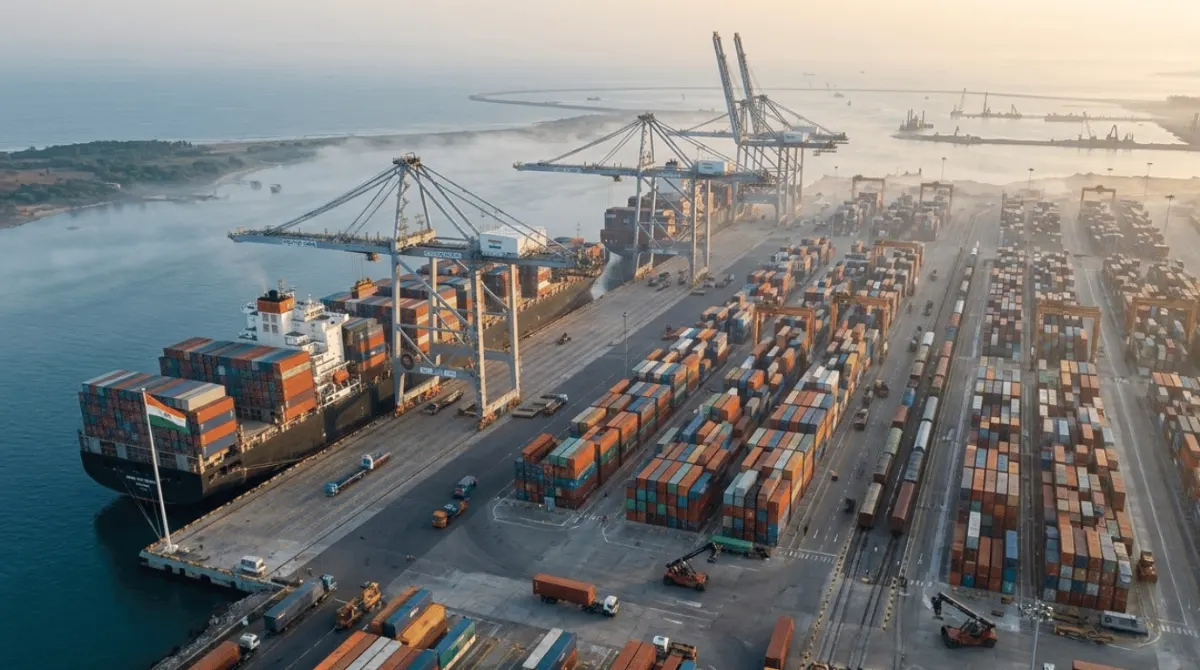
Visakhapatnam Port's operational performance provides the foundation for the state's maritime ambitions. The port handled a record 91.17 million tonnes of cargo in FY 2025-26, registering nearly 10% growth and sustaining continuous growth for the fourth consecutive year . Sonowal also laid the foundation for projects worth nearly ₹600 crore at the port to further expand capacity, improve ease of doing business, and generate employment . The port is moving toward a landlord-port model with four PPP projects worth approximately ₹800 crore under construction, expected to be commissioned by 2027, and it has one of the deepest container terminals among India's major ports with a permissible draft of 16 metres.
Four major greenfield port projects are under construction across the state: Mulapeta, Machilipatnam, Ramayapatnam, and Kakinada SCJ Port . These projects, combined with the existing facilities at Visakhapatnam and Krishnapatnam, will significantly enhance Andhra Pradesh's cargo-handling capacity and industrial potential. The state's port network is being developed as an integrated system rather than a collection of isolated facilities, with each port serving specific hinterland and commodity flows.
For India's maritime sector, the Andhra Pradesh vision reflects the broader pattern of state-level competition for maritime investment that has emerged in 2026. Tamil Nadu has the Thoothukudi shipyard project with HD Hyundai, Gujarat has a concentration of port and terminal development, and Maharashtra has signed maritime investment agreements worth ₹76,000 crore. Andhra Pradesh's ₹30,000-crore shipbuilding cluster adds another major project to this pipeline, and the national investment figure of ₹80 lakh crore provides the overarching framework within which these state-level initiatives are being pursued.
Looking ahead, the key milestones are the operationalisation of the Dugarajapatnam SPV, the identification of anchor investors for the shipbuilding cluster, the commissioning of the four greenfield ports, and the completion of the PPP projects at Visakhapatnam Port by 2027. The ₹80 lakh crore investment figure is an estimate of total investment across all initiatives rather than a committed government outlay, and its realisation will depend on private participation and the pace of project approvals. For now, the Summit has provided a platform for the government to articulate its maritime vision at the state level, and Andhra Pradesh has positioned itself at the centre of that vision for India's eastern coast.