
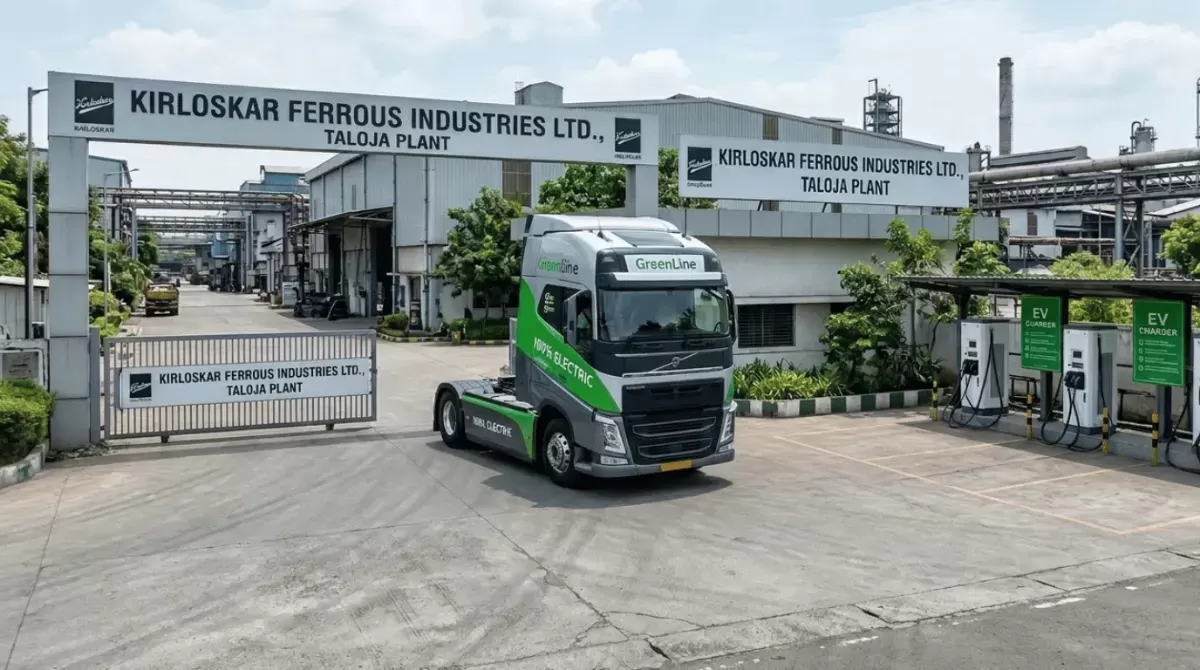
GreenLine Mobility Solutions Ltd, an Essar Group venture and one of India's leading green logistics operators, has entered into a partnership with Kirloskar Ferrous Industries Limited to deploy electric trucks for industrial logistics at KFIL's plant in Taloja, Navi Mumbai . The electric trucks were flagged off on 12 November 2026, marking the introduction of electric mobility into Kirloskar Ferrous's goods transportation operations and representing another step toward cleaner freight transportation in India's industrial supply chains.
The partnership reflects a growing trend among Indian manufacturers to incorporate alternative-fuel transportation into their logistics networks. Madhur Taneja, CEO of GreenLine Mobility Solutions, framed the collaboration in terms of matching solutions to operational needs. "At GreenLine, our focus is on promoting low-emission freight transportation through solutions tailored to different logistics requirements," he said. "LNG continues to play an important role in our strategy for decarbonising long-haul transportation, while electric trucks offer new opportunities in areas where electric mobility is suitable. Our partnership with Kirloskar Ferrous is another step toward expanding the deployment of electric trucks and helping companies incorporate clean transportation solutions into their supply chains" .
The Kirloskar Ferrous leadership team emphasised the operational logic of the deployment. "Electrification of logistics between plants is an area where sustainability and operational excellence meet," the company said. "This promotes greater efficiency, lower costs, and a cleaner future" . The framing connects environmental objectives with the practical benefits that electric trucks can deliver for industrial logistics: lower fuel costs per kilometre, reduced maintenance requirements, and predictable performance on fixed routes between manufacturing facilities.
GreenLine's operational profile provides context for the partnership's significance. The company operates more than 1,200 LNG and electric heavy commercial vehicles across major freight corridors in India, serving industries including steel, cement, mining, FMCG, and chemicals . Its fleet has collectively covered more than 100 million kilometres, helping customers avoid over 30,000 tonnes of CO2 emissions . This scale of operation gives GreenLine the experience and infrastructure to support Kirloskar Ferrous's transition, rather than requiring the manufacturer to build electric trucking capability from scratch.
For Kirloskar Ferrous, the deployment at Taloja is a manageable first step. The plant is located in Navi Mumbai, within a geographic area where route lengths and operating conditions are well-suited to electric trucks. Fixed routes between plants and warehouses, predictable payloads, and the ability to plan charging around operational schedules are the conditions under which electrification delivers the most favourable economics. By starting with a defined deployment at a single facility, Kirloskar Ferrous can test the technology and build internal familiarity before considering broader adoption.
The timing of the partnership aligns with a broader wave of electric truck deployments in India's industrial logistics sector. Tata Motors and Amazon have announced plans to deploy 3,000 electric trucks, and EIM has been building battery-swapping infrastructure around JNPA. The common thread is that the deployments are concentrated in captive or semi-captive operations where routes are predictable and charging can be planned, rather than in the open road freight market where range anxiety and charging uncertainty remain significant barriers.
For India's logistics sector, the GreenLine-Kirloskar partnership illustrates the incremental approach that is characterising the early phase of electric freight adoption. Rather than attempting to electrify entire supply chains at once, companies are identifying specific lanes and facilities where the operational case is strongest, deploying vehicles there, and using the experience to inform broader decisions. This approach is slower than a wholesale transition, but it is more likely to produce sustainable deployments that can be scaled as infrastructure matures.
Looking ahead, the key questions are whether the Taloja deployment achieves the efficiency and cost gains that the partners expect, and whether it leads to further electrification within Kirloskar Ferrous's logistics network or serves as a reference case for other manufacturers. GreenLine's ability to expand its fleet and maintain the supporting charging infrastructure will determine how quickly it can serve additional customers. For now, the flag-off at Taloja marks another concrete step in the electrification of India's industrial freight, and it signals that the transition is proceeding through partnerships between logistics specialists and manufacturers rather than through a single, sector-wide shift.