
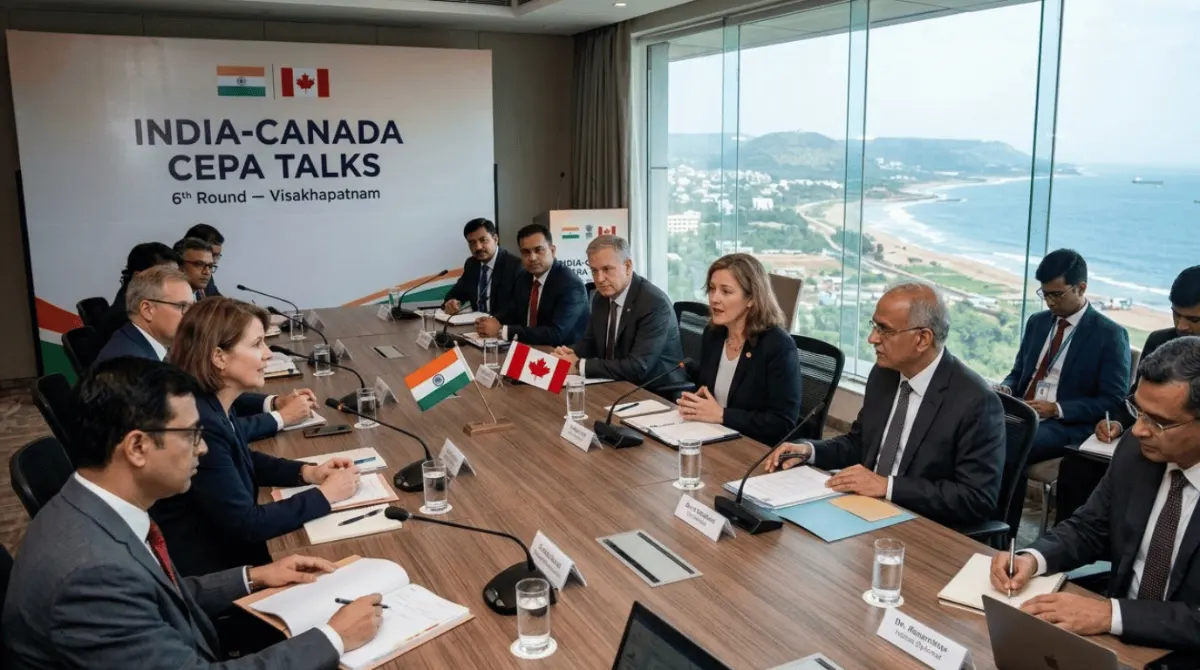
India and Canada are accelerating negotiations on a Comprehensive Economic Partnership Agreement, with Canadian Minister of International Trade Maninder Sidhu stating on 12 November 2026 that both sides hope to conclude the talks by December, when Prime Minister Narendra Modi is scheduled to visit Canada . Sidhu, who is leading a Canadian delegation to Visakhapatnam for the CII Partnership Summit, confirmed that the sixth round of negotiations between the two countries' chief negotiators is currently underway .
The minister framed the agreement in terms of complementarity rather than competition. "Between India and Canada, it's not about competition, it's about complementarities between the two economies," Sidhu said at the summit . He held discussions on the pact with Commerce and Industry Minister Piyush Goyal, and both sides expressed a shared interest in advancing the negotiations toward a conclusion . The target of December aligns with the planned Modi visit and reflects a deliberate effort to deliver a tangible outcome during that engagement.
Canada's pitch to India is built around the resources and capabilities that align with India's growth requirements. Sidhu noted that India's rapid growth will require 75% more energy by 2035, and that Canada is building up its LNG capacity, with several projects expected to make it the world's fifth-largest LNG exporter within five years . He also referenced the $2.5 billion uranium deal signed earlier in 2026 to supply India's nuclear sector, and highlighted Canada's potential to support India's SHANTI Act, which allows private-sector participation in nuclear energy .
The critical minerals dimension is central to Canada's offer. Sidhu said Canada is the only country in the Western Hemisphere that has every element required to build an electric vehicle battery, and that it can provide India with options for stabilising and diversifying its supply chains as it pursues electric mobility and battery manufacturing . He also identified potash as a complementary resource, noting that Canada's potash can help Indian farmers improve yields and efficiency, supporting food security alongside energy security .
The investment relationship provides a foundation for the trade pact. Sidhu said Canadian institutional investors and pension funds, including Fairfax, have already invested over $100 billion in India, making Canada one of India's largest investors . He added that Canadian companies are interested in expanding into data centres, AI, and technology, and that the trade agreement would provide a framework for deeper commercial engagement in these sectors .
For India's logistics and trade sector, the CEPA negotiations carry implications beyond tariff reductions. Canada's offer of LNG, uranium, potash, and critical minerals addresses some of India's most significant import dependencies, and a concluded agreement would establish predictable supply relationships for these strategic commodities. The trade pact would also open opportunities for Indian exporters in sectors where Canada's market is currently underserved by Indian suppliers, and it would complement India's broader strategy of concluding trade agreements with major economies including the UK, EU, and US.
The timing of the negotiations reflects India's effort to build a diversified network of trade partners amid global disruptions. The Hormuz crisis has highlighted the risks of dependence on a narrow set of supply routes for energy and critical minerals, and Canada's geographic position outside the contested Gulf corridor makes it an attractive alternative source for commodities that India currently imports from the Middle East. A CEPA with Canada would not replace those Gulf relationships, but it would add a layer of diversification that reduces exposure to any single corridor.
Looking ahead, the key milestone is the conclusion of the sixth round of negotiations and the announcement of a concluded agreement, ideally before or during Modi's visit to Canada in December. The negotiations have moved at a faster pace in recent months, with both sides targeting an end-of-year conclusion . If the December target is met, the agreement would add Canada to a growing list of India's trade partners, and it would provide a framework for expanded cooperation in energy, critical minerals, and technology that aligns with India's long-term economic and strategic interests.