
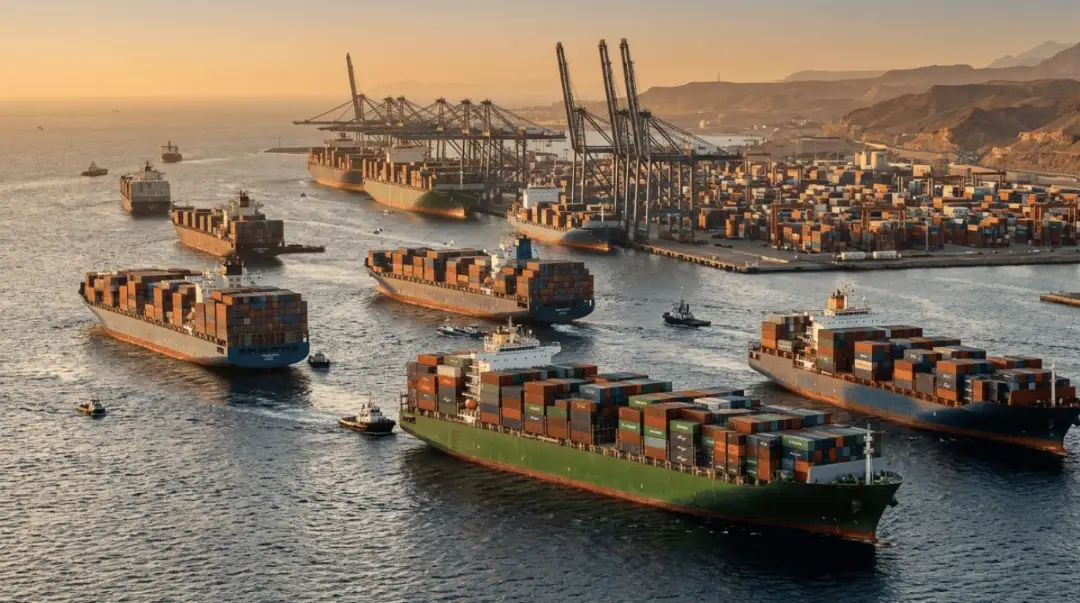
The return of container services to the Red Sea is accelerating, with Evergreen and Emirates Shipping Line both scheduling direct sailings to Red Sea ports from mid-November, raising concerns that the restored services could concentrate cargo at a small number of gateways and test terminal capacity . According to Alphaliner data reported by The Loadstar on 10 November 2026, Evergreen is planning eight ad hoc Suez Canal and Bab-el-Mandeb transits for its Far East–Europe services, plus four sailings aimed specifically at the Red Sea market.
Evergreen's first ad hoc Red Sea service vessel, the 7,024 TEU Ever Superb, is scheduled to depart Qingdao on 14 November, operating a rotation that includes Jeddah, Sokhna and Aqaba . The carrier's 16,556 TEU Ever Eon made its first Suez transit last weekend on the Ocean Alliance's China Europe Shuttle service, and three more eastbound transits are planned this year, with Ever Even scheduled for a westbound passage reaching Suez on 12 December . Emirates Shipping Line is also launching a fortnightly Central/South China–Red Sea service using three vessels of 2,500–4,900 TEU, serving the same three Red Sea ports of Sokhna, Aqaba and Jeddah, with the inaugural sailing scheduled to leave Shanghai on 13 November .
The overlapping port choices are the crux of the congestion concern. Both carriers are concentrating their Red Sea calls on Jeddah, Sokhna and Aqaba rather than distributing traffic across a wider set of ports . This reflects the commercial logic of serving the largest and most connected gateways, but it also means that the additional cargo from restored services will land on a small number of terminals that may not have spare capacity to absorb it. Jeddah's South Container Terminal, operated by DP World, handled more than 221,200 TEU in July, its highest monthly throughput since operations began in 1999, following a 79% year-on-year increase in first-half volumes . DP World has invested in additional handling equipment and is expanding capacity, but the port has already faced operational pressure: Expeditors reported landside delays of 10–12 days after discharge in its September update.
The congestion risk is not confined to the Red Sea. Flexport has warned that the return to Suez routings could create a second congestion risk at North European ports, as vessels taking the shorter route arrive alongside ships still sailing around the Cape of Good Hope. The forwarder forecasts arriving vessel capacity at 131% of normal levels in Week 47, with around 40% of that capacity arriving via Suez, and it considers arrivals exceeding 120% of normal capacity a congestion risk. Rotterdam is already under pressure, with average container dwell times reaching 3.37 days in Week 42 and yard utilisation running between 80% and 90%.
For Indian exporters and importers, the restoration of Red Sea services has mixed implications. On one hand, the return to shorter Suez routings could cut transit times by seven to ten days compared with the Cape route, improving delivery reliability for India–Europe and India–Red Sea cargo. On the other, the congestion that the restored services may create at Jeddah and other gateways could offset some of those gains, particularly for cargo transiting through Red Sea hubs before reaching Indian destinations. The overlap between the carriers' port choices and the existing pressure on Jeddah's terminals suggests that shippers should plan for potential delays in the coming weeks.
The broader context is a shipping market in transition. Drewry's World Container Index fell from $4,585 per FEU on 22 October to $4,389 on 5 November, reflecting the capacity that is returning to the market as Suez routings resume . MSC and CMA CGM have filed FAK rates above Drewry's assessed spot levels for early November, but Drewry counted five announced Asia–Europe blank sailings for the following week, which it read as evidence of ample capacity that makes the rate increases uncertain . The return to Suez is adding capacity faster than demand is growing, and the congestion risk at receiving ports is the operational counterpart to the rate pressure that carriers are facing.
Looking ahead, the key milestones are the Ever Superb's departure on 14 November, the Emirates CRC service's inaugural sailing on 13 November, and the arrival of the additional capacity at Red Sea and North European ports in the following weeks. If the ports can absorb the restored services without significant delays, the transition to Suez will deliver the transit time savings that shippers have been waiting for. If congestion builds, the gains could be eroded by port delays, and the industry may find that the return to Suez has shifted the bottleneck from the Cape route to the receiving terminals.