
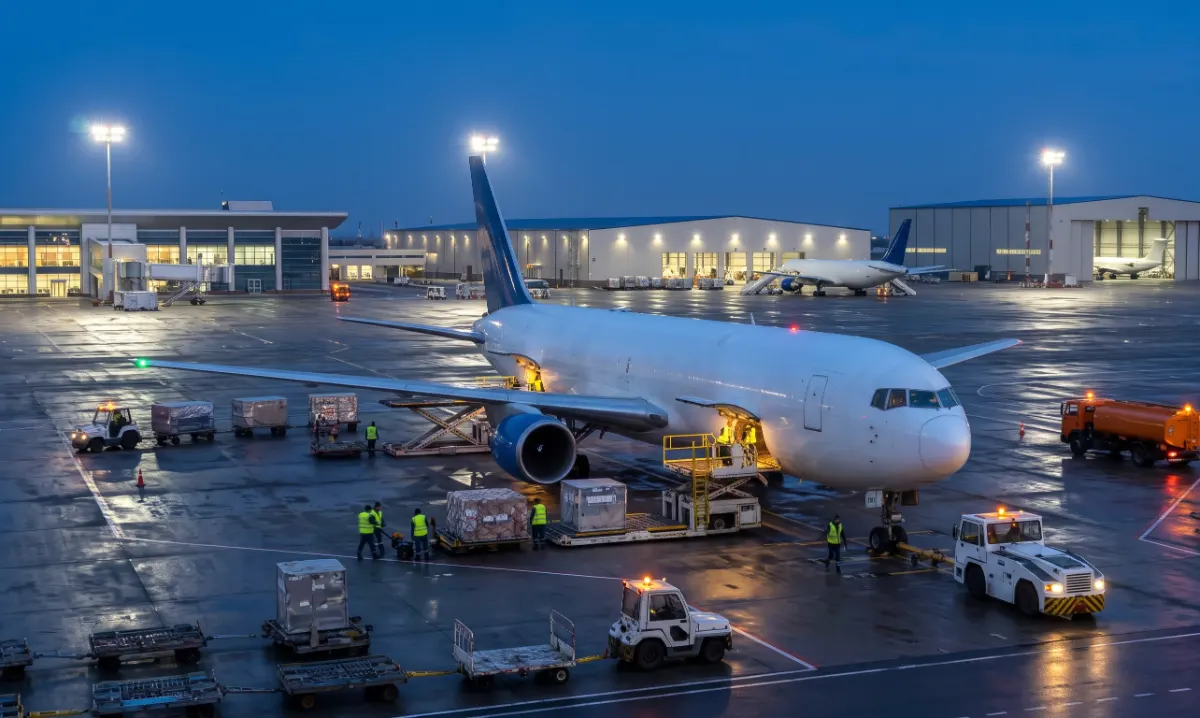
Central Asian airports are recording rapid growth in air cargo activity as geopolitical disruptions reshape Eurasia's aviation corridors, but the region's emergence as a genuine alternative to established Middle East hubs remains a gradual process rather than an overnight shift. Uzbekistan's air cargo market has expanded by 182% between 2019 and 2024, making it one of Central Asia's fastest-growing markets, with 98,000 tonnes handled through the country's airports in 2025 and a further 33% increase in the first half of 2026, according to Jamoliddin Nazarov, head of the air transport authority at Uzbekistan's Ministry of Transport . The country aims to expand annual air freight capacity to 300,000 tonnes by 2036 .
Navoi International Airport has emerged as a focal point for this growth. In April 2026, CMA CGM Air Cargo launched its first technical landing on the Hong Kong–Navoi–Paris route, with plans for 11 weekly flights on Hong Kong–Navoi–Paris and Hong Kong–Navoi–Brussels routings . Navoi has also attracted a strategic alliance with Harvest Epoch Strategic Investment Limited, with test cargo flights scheduled for December 2026 and a target of 45,000 tonnes annually by 2030 . The airport has additionally been developing cargo connections with India, with preliminary shipments of dried fruits dispatched to Delhi and discussions underway for regular Navoi–Delhi–Navoi cargo flights .
Kazakhstan has pursued a parallel strategy. Cathay Pacific Cargo launched scheduled freighter technical stops at Astana in August 2026, initially operating five flights weekly between Southeast Asia and Europe via the Kazakh capital . Flydubai began weekly cargo flights between Dubai and Almaty in October 2026, establishing a direct air freight connection between Central Asia and the Middle East . Kazakhstan's national cargo carrier has signed an agreement to acquire its first Airbus A340 freighter, expected in November 2026, with plans to eventually expand its fleet to 10 aircraft .
The growth trajectory reflects structural shifts in global air cargo flows. IATA data showed that Central Asia's share of direct transit movements surged from 59% to around 65% of total regional air cargo, with regional volumes more than doubling since 2019 . Uzbekistan's outbound volumes rose sharply in 2024, suggesting the region is evolving beyond simple technical stopovers toward more active connections and consolidation functions linking Europe and China . Five dedicated domestic freight carriers now operate in Uzbekistan, flying a fleet that includes Boeing 767-300Fs and converted aircraft .
However, the transition from technical stopover to genuine cargo hub faces structural constraints. Technical stops generate limited local economic spillovers, and the infrastructure required for cargo transfer, customs clearance, and multimodal connectivity takes time to develop. Freightos data from early November 2026 showed no significant surge in bookings through Central Asian hubs, with market rates on established lanes such as China–North America reaching $7.76/kg, up 40% year-on-year, indicating that shippers continue to rely primarily on traditional routings . The International Air Transport Association reported global air cargo demand growth of 7.7% in September 2026, driven by stronger trade and AI-related shipments, with capacity increasing 2.7% .
The region's long-term ambitions are substantial. Uzbekistan is proceeding with a US$4.5 billion infrastructure programme centred on a new Tashkent airport and a 1,000-hectare "Aero City" logistics district, designed to process 129,000 tonnes of cargo annually at full build-out . Kazakhstan has designated key aviation hubs as special economic zones and is modernising cargo terminals and rail-road connections . These investments signal confidence that the shift in Eurasian freight flows is structural rather than temporary, even as current volumes through Central Asian hubs remain modest relative to established gateways.
From an India-Middle East logistics perspective, Central Asia's emergence offers a supplementary corridor rather than an immediate substitute for established routings. Indian exporters facing elevated air freight rates and constrained capacity on traditional routes may find limited near-term alternatives through Central Asian hubs, but the corridor's development over the coming years could provide additional flexibility as infrastructure matures and carriers establish regular commercial operations beyond technical stops. For now, the growth is real but incremental, and the region's role in global air cargo remains one of rising importance rather than immediate transformation.