
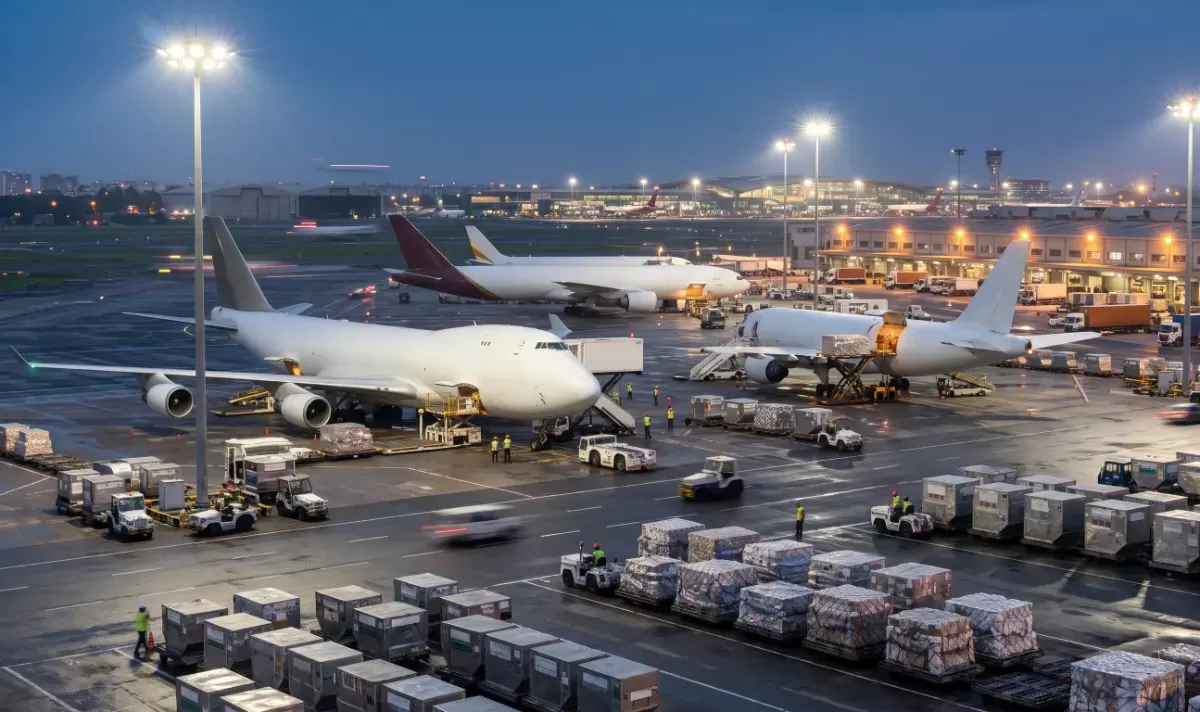
Air freight rates from India have recorded one of the sharpest year-on-year increases in the global air cargo market, with TAC Index data showing gains of approximately 80% as of the week ending 2 November 2026. Rates from South Asia firmed slightly on both European and US-bound routes during that week, extending a sustained upward trajectory that has persisted through the second half of 2026 . The India-origin increase stands out against a global backdrop in which overall air freight rates eased 1.1% week-on-week but remained 22.8% higher year-on-year, with gains from India, Hong Kong, and Shanghai offsetting declines on several other major trade lanes .
The scale of the India increase reflects a confluence of demand-side and supply-side pressures. On the demand side, India’s air cargo exports have been driven by e-commerce, pharmaceuticals, electronics, and engineering goods, with high-value and time-sensitive shipments increasingly reliant on air freight as ocean freight rates and port congestion have made sea transport less attractive for urgent cargo . The Diwali holiday period, which fell around 6–11 November in 2026 compared with 18–23 October in 2025, provided an additional demand boost, with air cargo volumes from the Middle East and South Asia region growing 10% year-on-year in October despite continuing capacity challenges in the Arabian Gulf .
On the supply side, capacity constraints have amplified the rate increase. The Middle East conflict has disrupted traditional routings through Gulf hubs, forcing carriers to reroute or suspend services. Cathay Cargo, for example, has shifted technical stops for Europe-bound freighters from Dubai to Indian airports, and Air India has suspended two European non-stops and cut frequencies on other routes, removing belly space for exporters . Jet fuel prices have also put a hard floor under rates, with global jet fuel averaging $192.44 a barrel and up 113.7% year-on-year as of mid-October, while aviation turbine fuel in Delhi reached approximately ₹137 a litre after the October revision, the third consecutive monthly increase .
The rate surge has prompted a capacity response from freighter operators. Over the past two months, EgyptAir, Hong Kong Air Cargo, and Qatar Airways have added cargo flights connecting India with key international gateways including Cairo, Doha, Hong Kong, and Kuala Lumpur, while other foreign carriers have operated additional ad hoc flights to meet rising demand . Cathay Cargo plans to add a leased Airbus A330 converted freighter in mid-November for intra-Asia and India feeder services, supplementing its existing freighter capacity on India routes . These capacity additions may provide some relief, but with fuel costs elevated and belly space constrained, the downward pressure on India-origin rates is likely to remain limited in the near term.
The India rate increase has significant implications for exporters and the broader economy. Air freight is typically used for high-value, time-sensitive goods where transport costs represent a smaller share of total product value, but an 80% year-on-year increase still erodes margins for exporters of electronics, pharmaceuticals, perishables, and garments on tight lead times. The weaker rupee, which traded at 94.47 to the dollar in late October, 7.4% weaker than a year earlier, adds to the cost burden for dollar-denominated air freight . For importers, the impact is more nuanced: inbound rates from Europe to India have been softer week-on-week, providing some relief on import cover, though the overall cost environment remains elevated .
From a market structure perspective, the India rate surge reflects a broader realignment of air cargo flows driven by geopolitical disruption. With Gulf hubs constrained and traditional routings disrupted, India has emerged not only as an origin market but also as a transit point for long-haul freighter operations. The combination of strong export demand, reduced belly capacity, elevated fuel costs, and rerouted freighter traffic has created a pricing environment in which India-origin rates have outperformed the global average. Whether this persists into 2027 will depend on the trajectory of Middle East disruptions, fuel prices, and the pace at which carriers restore and reconfigure capacity on India-linked routes. For now, Indian shippers face a peak season in which air freight costs are roughly double what they were a year ago, with limited prospects for near-term relief.