
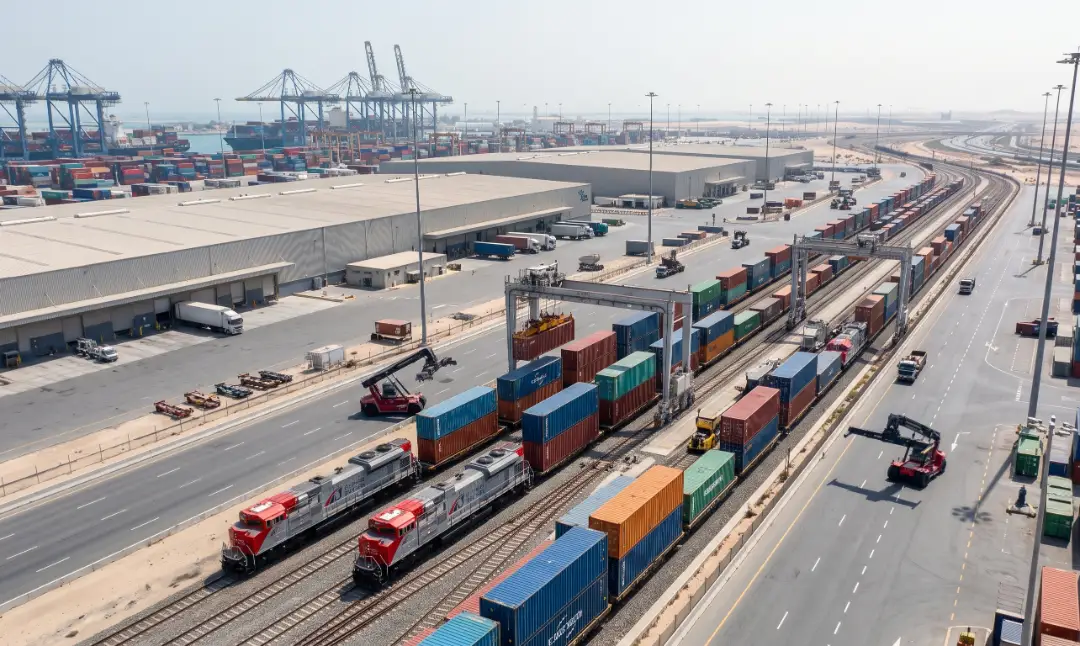
DP World has identified two infrastructure investments as critical to maintaining operational fluidity at Jebel Ali Port during the prolonged disruption of the Strait of Hormuz: the Jebel Ali Rail Terminal and the Al Awir empty container depot. Shehab Mohamad Aljasmi, Chief Commercial Officer for Ports and Terminals at DP World GCC, highlighted both facilities in the company's disclosure that it had moved more than one million TEUs through UAE land corridors between March and October 2026 .
The Jebel Ali Rail Terminal began operations on 1 March 2026 under a concession arrangement with the port authority, with tariffs and operating conditions taking effect the same day . The facility connects the Middle East's largest container port directly to the UAE's national railway network operated by Etihad Rail, which spans approximately 900 kilometres from the Saudi border at Ghuwaifat to the east-coast port of Fujairah . Through this network, Jebel Ali gained direct rail connectivity with major logistics and industrial zones including Khalifa Port, the Industrial City of Abu Dhabi, Dubai Industrial City, Khorfakkan Port, Port of Fujairah, and inland facilities such as Al Ghail Dry Port .
The operational significance of the rail terminal lies in its ability to shift cargo movements from road to rail at a time when road corridors were absorbing exceptional volumes. Etihad Rail's freight operations, which predated the passenger launch in June 2026, connect Khalifa Port, Jebel Ali, Fujairah, and industrial centres across the seven emirates into a single logistics corridor, with each freight train removing roughly 300 heavy trucks from the roads . During the Hormuz disruption, this rail connectivity provided an alternative mode for moving containers between Jebel Ali and other UAE gateways, reducing pressure on the trucking network that was simultaneously handling diverted cargo from east coast ports .
The Al Awir empty container depot, a 100,000-square-metre facility, was opened to add empty container storage and release capacity outside Jebel Ali Port. Located with direct access to Emirates Road, the depot connects major logistics and industrial zones across the UAE and provides potential for future rail-based container movement through Etihad Rail . The facility handles 20-, 40-, and 45-foot empty containers and offers inspection, condition reporting, and shipping line inventory management services . Raveen Guliani, Chief Operating Officer for Logistics at DP World GCC, explained the depot's function: "By moving empty container storage and handling closer to customers, we can reduce unnecessary movements to the port and make it easier for shipping lines and logistics companies to access and reposition equipment" .
The combined effect of these two facilities was to decongest the port area during a period of extraordinary stress. Jebel Ali Port handled 15.6 million TEUs in 2025 and has annual container-handling capacity of 19.4 million TEUs, connected to more than 80 weekly services reaching 150 ports worldwide . Despite the Hormuz closure, the port remained open and operational, with disruption since the beginning of the crisis limited to just six hours . The rail terminal and Al Awir depot contributed to this resilience by providing alternative pathways for cargo and equipment that would otherwise have relied solely on road trucking through congested port approaches.
Beyond the port itself, the Jebel Ali Free Zone (Jafza) maintained strong occupancy levels during the disruption period, supporting the integrated logistics ecosystem. Jafza hosted more than 11,650 companies by the end of the first half of 2026, with warehouses and storage facilities achieving 98% occupancy, residential units at 97%, and offices and land at approximately 93% . This density of commercial activity around Jebel Ali reinforced the importance of keeping cargo flowing through the port and its supporting infrastructure.
Aljasmi stated that the experience had demonstrated the importance of accelerating cross-border rail connectivity and converting contingency arrangements into ready-to-activate plans . The rail terminal and Al Awir depot represent concrete steps in that direction, embedding multimodal capability into Jebel Ali's operating model rather than treating it as an emergency measure. As DP World accelerates its Fujairah terminal development to provide a longer-term Hormuz bypass, the Jebel Ali Rail Terminal and Al Awir depot serve as evidence that landside infrastructure investments can deliver immediate operational benefits during maritime disruptions while also building the foundation for more resilient logistics networks .