
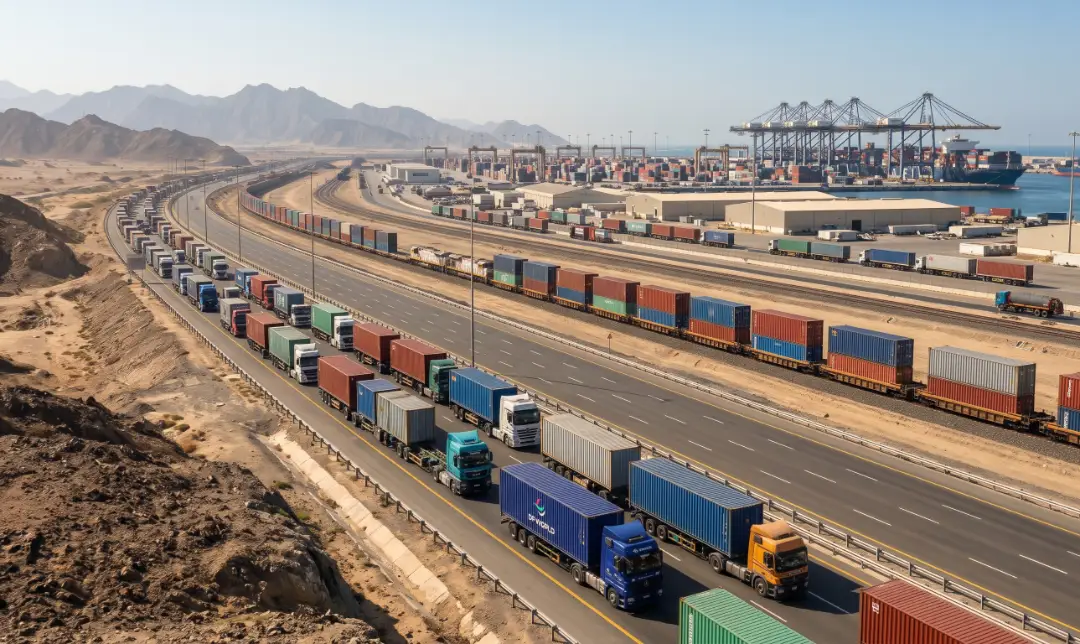
DP World has disclosed that it moved more than one million TEUs through UAE land corridors between the first week of March and the end of October 2026, as alternative trade routes sustained cargo flows during the prolonged closure of the Strait of Hormuz. The operator is handling approximately 3,500 TEUs daily through road and rail connections linking UAE east coast ports to Jebel Ali and domestic markets, supported by a trucking network of more than 3,000 vehicles, including 700 owned by DP World .
Shehab Mohamad Aljasmi, Chief Commercial Officer for Ports and Terminals at DP World GCC, explained that the company built its trucking capability from the ground up in response to the disruption. Cargo arriving at ports outside the Strait of Hormuz is transported through customs-controlled corridors to Jebel Ali for clearance, storage and distribution. Additional routing options through Oman’s Sohar and Duqm ports, alongside connectivity through Jeddah, provide alternative access to UAE and wider Gulf markets .
The Jebel Ali Rail Terminal and a 100,000-square-metre empty-container depot in Al Awir have helped ease operational pressure on the port. Etihad Rail has connected Jebel Ali to the UAE national railway network, allowing some cargo movements to shift from road to rail. Dubai Customs and Oman Customs activated a Green Corridor within 72 hours of the disruption, enabling sealed containers to move directly to Jebel Ali under customs control, facilitating trade flows worth approximately AED 34 billion between March 1 and June 30 .
DP World has accelerated the targeted phased opening of its two Fujairah terminals to 18–24 months from an earlier estimate of 24–30 months, representing an investment of approximately AED 2.5 billion over several years. The terminals are being developed under a 50-year concession agreed with the Fujairah Ports Authority. Al Rugaylat, near Fujairah International Airport, is designed to handle approximately 2.5 million TEUs annually, alongside 1.7 million tonnes of general cargo and 190,000 car equivalent units. Dibba will add capacity of up to 3.6 million tonnes of general cargo annually .
Once operational, the terminals will increase DP World’s UAE container-handling capacity from 19.4 million to almost 22 million TEUs. Al Rugaylat will provide a deep-water gateway capable of accommodating ultra-large container vessels, while both terminals will connect with Jebel Ali and Jafza through DP World’s inland logistics network. Aljasmi stated that the strategy is designed to support long-term trade flows regardless of whether traffic through the Strait of Hormuz is fully restored or remains disrupted .
Jebel Ali Port remained open and operational throughout the crisis, with disruption limited to six hours since the conflict began. The port is connected to more than 80 weekly services reaching 150 ports worldwide and has annual container-handling capacity of 19.4 million TEUs. It handled 15.6 million TEUs in 2025. Ahmad Yousef Al-Hassan, CEO of DP World GCC, said meetings with nine shipping lines in Asia reinforced confidence that Jebel Ali will regain traffic once safe passage through Hormuz resumes, with recovery expected within one to three months depending on how quickly carriers can reposition services and networks .
Jebel Ali Free Zone (Jafza) hosts more than 12,000 companies across approximately 57 square kilometres. Occupancy remains above 90% across asset classes, including 94% for land and 99% for warehouses, while office occupancy reached its highest level in a decade. The free zone attracted more than AED 1 billion in new investments during the first six months of 2026. DP World’s South Container Terminal at Jeddah Islamic Port recorded record throughput in July and October following expansion that raised annual capacity to 4 million TEUs, and the company is preparing to open its US$250 million Jeddah Logistics Park in the first quarter of 2027 .
From a strategic perspective, the land corridor operation represents a significant logistical adaptation to the Hormuz closure. DP World absorbed some transportation costs and worked with shipping lines on solutions to reduce expenses, including the transportation of empty containers from alternative ports. Container freight rates from China to Dubai increased from around $2,000 before the disruption to $10,000–$12,000, reflecting the cost impact of replacing sea miles with road miles. Al-Hassan emphasized that the experience has demonstrated the need to accelerate cross-border rail connectivity and establish contingency arrangements that can be activated quickly during future crises, stating that “even if the Strait opens up tomorrow, our contingency planning has to be all ready” .