
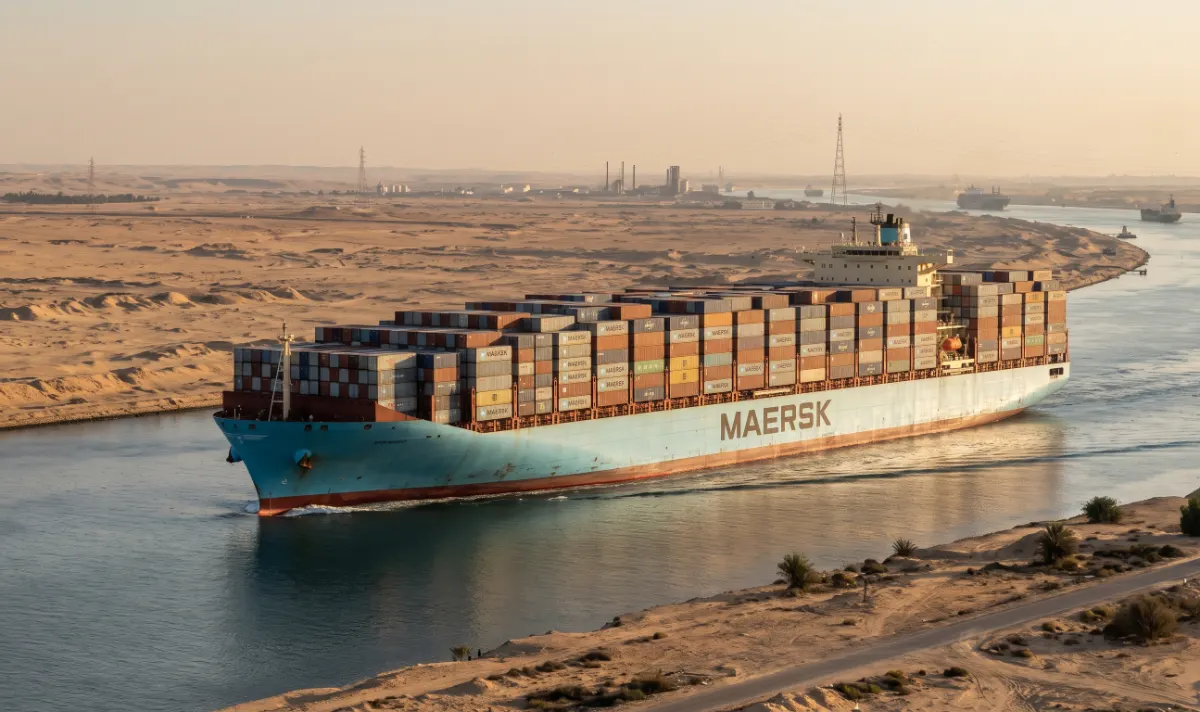
Maersk and Hapag-Lloyd have announced a structural change to their jointly operated ME1 Gemini service, shifting the India-Europe connection from the longer Cape of Good Hope routing back through the Suez Canal and Red Sea corridor. The announcement, made on 2 November 2026, marks the latest step in the Gemini Cooperation's phased return to Suez routings after most Asia-Europe services were diverted around Africa following Red Sea security disruptions. For Indian exporters and importers, the change promises shorter transit times on the Europe trade, with both Mundra and Nhava Sheva retained on the revised rotation.
The revised ME1 rotation now runs: Mundra – Nhava Sheva – Salalah – Suez Canal – Tangier – Rotterdam – Wilhelmshaven – Hamburg – London – Algeciras – Tangier – Suez Canal – Salalah – Mundra. The first westbound sailing under the new routing was the Atlanta Express, voyage 644W, departing Salalah on 4 November. The first eastbound departure is the Savannah Express, voyage 644E, from Tangier, with Maersk listing 13 November and Hapag-Lloyd indicating 12 November, noting that departure dates are approximate and subject to operational conditions. Maersk stated that the Suez routing represents the fastest, most sustainable and most efficient way to serve customers on the India-Europe trade, though the carriers emphasized that any further alterations to Gemini services remain dependent on ongoing stability in the Red Sea area.
Alongside the ocean network adjustment, Maersk's November IMEA Market Update highlighted several landside and regional dynamics shaping logistics across India, the Middle East and Africa. The carrier reported that interest in the Saudi Landbridge corridor increased during October as evolving conditions at Khor Fakkan and disruption linked to the Strait of Hormuz led shippers to explore alternative routings into Saudi Arabia and the wider Gulf. Maersk noted that capacity, border processing and onward delivery requirements should be confirmed for each shipment before routing decisions are finalised, and encouraged customers considering the Landbridge to contact the carrier early to check on space, customs requirements, documentation and delivery feasibility, particularly for urgent or high-volume shipments.
The Strait of Hormuz continues to present significant operational challenges. Maersk maintains separate operational updates for cargo moving through the strait, and the carrier has implemented a surcharge of $1,000 per container for shipments transiting the waterway, covering insurance premiums and crew risk compensation. Booking acceptance has been tightened for several Upper Gulf destinations including Iraq, Kuwait, Qatar, Bahrain and Saudi Arabian ports of Dammam and Jubail, while UAE-bound cargo is limited to Khor Fakkan (import only) and Jebel Ali via landbridge. Port congestion has also spread from the maritime side to landside operations: Khor Fakkan recorded average waiting times of 7.25 days as of late October, Fujairah container vessels averaged 8.86 days of waiting over the past seven days, and transit times from Khor Fakkan and Fujairah to Jebel Ali, Sharjah and Abu Dhabi have extended from approximately five days to 12–15 days.
The November update also flagged seasonal pressure on South African air cargo, with year-end peak demand affecting capacity on routes connecting the region to Middle East and Indian hubs. Maersk advised customers across the IMEA region to plan ahead, remain flexible on routing, and allow sufficient time for connections and onward movements as market conditions continue to evolve. For Indian shippers, the ME1 return to Suez offers a measure of predictability on the Europe trade, but the broader IMEA logistics picture remains shaped by Hormuz-related disruptions, landside congestion in the Gulf, and the need for careful verification of alternative routings before cargo commitment.