
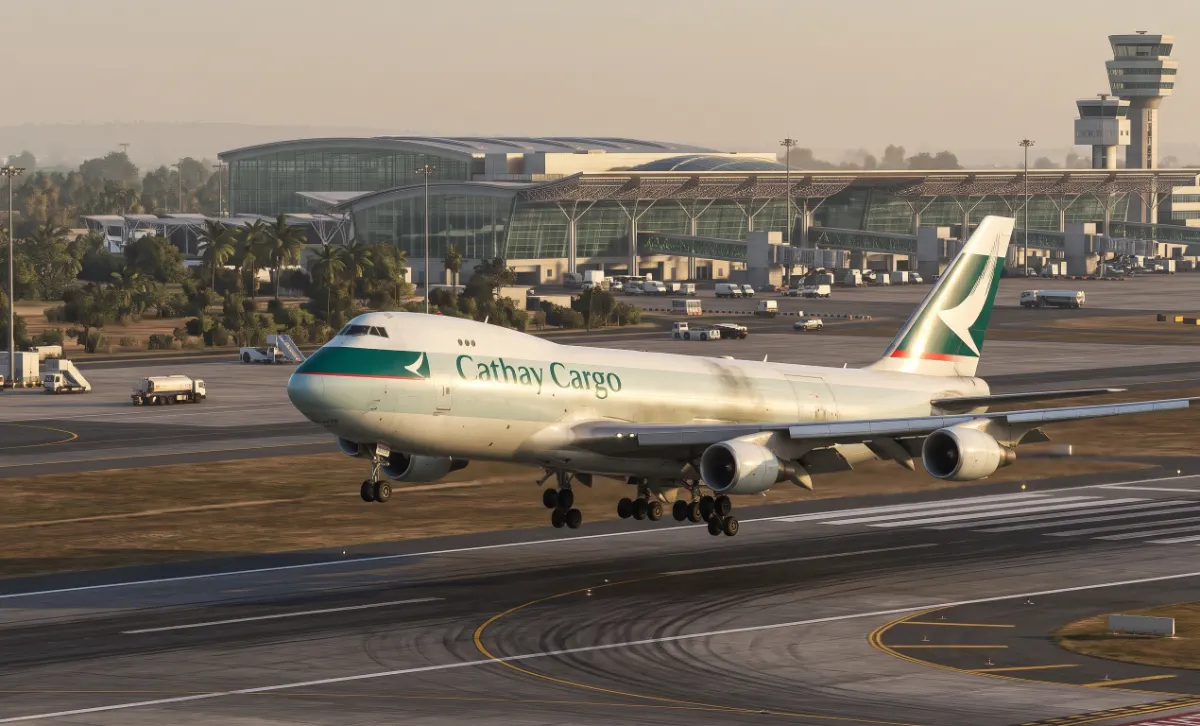
Cathay Cargo has confirmed a significant operational adjustment for its Europe-bound freighter network this winter, relocating technical stopovers from Central Asia to India. The Hong Kong-based carrier will use Navi Mumbai International Airport and Bengaluru as technical stops for its Boeing 747 freighters operating to Europe, replacing Astana, Kazakhstan, where winter weather conditions are expected to become increasingly challenging . The change was outlined by Dominic Perret, Director of Cargo at Cathay Cargo, during an interview on the sidelines of the TIACA Air Cargo Forum in Miami .
The rerouting is a direct consequence of the Middle East conflict, which has disrupted Cathay's established network since late February. Cathay Cargo has not flown to Dubai or Riyadh since the conflict broke out, removing Dubai as the midpoint for five of its weekly freighters to Europe . Operating these flights directly without an intermediate stop would result in what Perret described as "about a 20 percent payload haircut," a substantial capacity penalty on routes that are in high demand . The airline had initially established temporary stops in India before shifting to Astana for the summer months, but the onset of winter has forced a return to Indian gateways .
The payload constraint is particularly significant given the nature of Cathay's Europe freighter traffic. The seven weekly Boeing 747 freighter services to Europe have consistently seen strong demand, with Hong Kong-origin flights carrying primarily e-commerce cargo, while return legs transport fresh produce, pharmaceuticals and medical supplies, machinery, and live animals, particularly horses from various European locations . Two of the seven weekly flights already transit Delhi and were unaffected by the Dubai suspension. The remaining five required a new technical stop to maintain payload integrity, and the airline's South Asia, Middle East and Africa (SAMEA) cargo services team, led by Vishal Pillai, was credited by Perret for establishing both the initial Indian routings and the subsequent Astana arrangement under tight timelines .
Operational complexity at Indian airports added a layer of difficulty to the arrangement. Chennai, one of Cathay's existing Indian destinations, cannot handle the Boeing 747-8F due to airport constraints, requiring the airline to ensure appropriate aircraft types were deployed on affected rotations . The airline also had to adjust flight schedules almost monthly since March to accommodate available slots at busy Indian airports, while simultaneously training local ground teams to handle freighter operations safely and efficiently . Perret specifically acknowledged the India operations team for setting up both routings, describing the effort as a cross-team collaboration involving engineering, flight operations, and cargo services .
Alongside the routing changes, Cathay Cargo is expanding its regional feeder capacity with an Airbus A330P2F converted freighter on long-term lease from Air Transport Services Group (ATSG). The aircraft, already in Hong Kong, is expected to enter service by mid-November and will support regional operations connecting the Chinese mainland, Southeast Asia, and India . The lease was originally announced in June 2026, with the aircraft owned by ATSG's leasing arm, Cargo Aircraft Management, and operated by Cathay-owned Air Hong Kong . The A330P2F is well suited for high-frequency regional cargo operations, offering fuel efficiency and payload flexibility for the intra-Asia network .
The Riyadh freighter service previously operated by Cathay has also been reassigned to other markets, including Southeast Asia, as the carrier adapts its network to the prolonged absence of Middle East routings . Looking further ahead, Cathay Cargo expects its first Airbus A350F freighter in the second half of 2028, with its firm order increased from six to eight aircraft and 18 additional purchase rights remaining . For the current winter season, however, the immediate priority is maintaining Europe capacity through Indian technical stops while managing the payload penalty that direct routing would impose.
From an India air cargo perspective, Cathay's decision reinforces the country's role as a critical operational node for long-haul freighter connectivity at a time when Middle East hubs remain disrupted. Navi Mumbai's emergence as a technical stop for Cathay follows its recent entry into international freighter operations, with Hong Kong Air Cargo having launched thrice-weekly services there in August 2026 . The combination of Cathay's Europe freighter stops and its expanding regional feeder capacity through the A330P2F positions India as both a transit point and a destination market for the carrier's cargo network, even as the underlying geopolitical disruptions that necessitated these changes remain unresolved.