
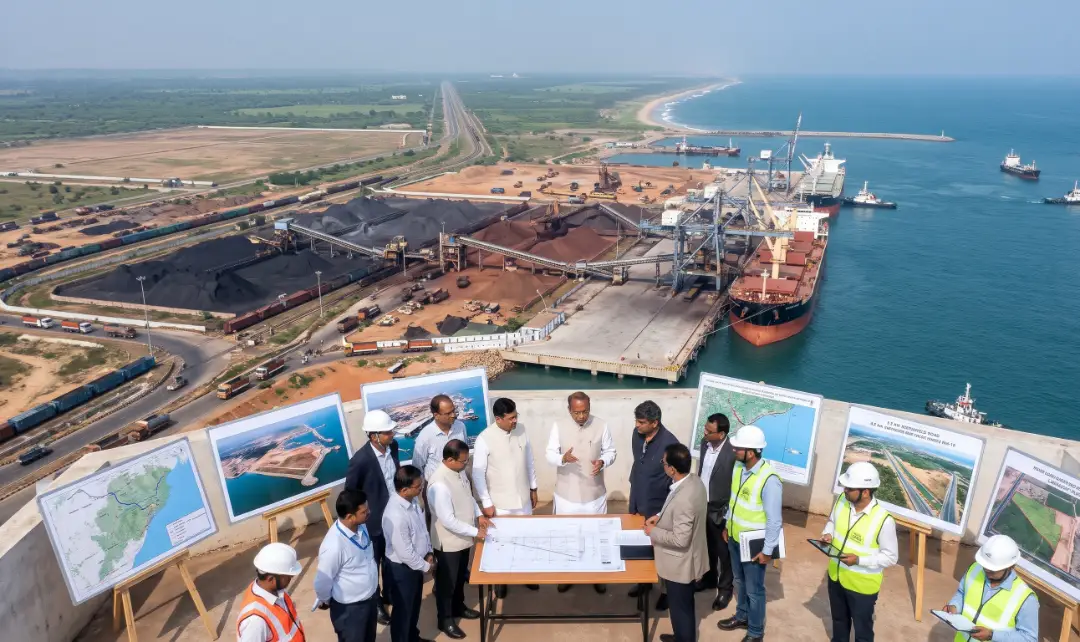
Gopalpur Port's expansion ambitions hinge on two critical enablers: additional land and improved connectivity to the mineral-rich interiors of Odisha and adjacent states. This message was delivered directly to a high-level state government delegation that visited the port on Wednesday, 11 November 2026, led by NBS Rajput, Principal Secretary of the Commerce and Transport Department. The visit underscored the state government's focus on strengthening maritime infrastructure and accelerating port-led economic development in southern Odisha .
During a detailed presentation, port officials outlined the additional land requirements for the proposed expansion and emphasised the need to strengthen rail and road links to mineral-rich hinterland regions. The rationale is straightforward: improved connectivity would enhance the port's EXIM cargo-handling capabilities, accelerate cargo movement, and develop supporting infrastructure to facilitate industrial growth across the region. Port officials also highlighted Gopalpur's strategic location and multimodal connectivity as foundations for its potential emergence as a key maritime gateway for southern Odisha .
The delegation undertook a comprehensive inspection of the port's key infrastructure, including cargo-handling facilities, operational areas, logistics support systems, and connectivity infrastructure. The team also visited identified land parcels proposed for future expansion and assessed their potential to support capacity enhancement and long-term development plans. The visit included Chhatrapur MLA Krushna Chandra Nayak, Ganjam Collector V Keerthi Vasan, and Odisha Maritime Board COO Sundara Madhaba Padhi, signalling coordination across political, administrative, and maritime governance levels .
This review follows earlier discussions at the Odisha Maritime Board level. In September 2026, a board meeting chaired by Chief Secretary Anu Garg considered a proposal to construct an approximately 4.5-kilometre, four-lane greenfield road connecting National Highway 16 near Chhatrapur with Gopalpur Port, in response to rising cargo traffic. That project is proposed to be taken up jointly by the National Highways Authority of India, the state Works Department, and Gopalpur Port authorities . The same meeting discussed developing container terminals at Dhamra and Gopalpur ports, along with identifying land for container freight stations, customs-controlled areas, and multimodal logistics centres to facilitate EXIM trade .
The expansion context is shaped by Gopalpur Port's ownership transition. Adani Ports and Special Economic Zone (APSEZ) acquired a 95% stake in Gopalpur Port in 2026, with the port currently capable of handling approximately 20 million metric tonnes per annum. The concessionaire has received over 500 acres of land on lease for development, with an option to receive additional land on lease for future capacity expansions . The port handles a diverse mix of dry bulk cargo including iron ore, coal, limestone, ilmenite, and alumina, and its location provides access to mining hubs in Odisha and neighbouring states .
Odisha's broader maritime strategy provides the policy backdrop for Gopalpur's expansion push. The state has been reviewing major maritime projects including shipbuilding clusters, cruise terminals, and port connectivity improvements. The Odisha Maritime Board has also moved toward a unified governance framework by absorbing the Directorate of Ports and Inland Water Transport, aiming to streamline decision-making and reinforce personnel strength across maritime oversight divisions . These institutional changes are intended to accelerate project execution and create a more coherent policy environment for port-led development.
From an EXIM perspective, Gopalpur's expansion would add capacity to India's east coast port network, which handles significant volumes of dry bulk cargo linked to steel, alumina, and mineral processing industries. Improved rail and road connectivity to hinterland mining regions would reduce logistics costs for these cargoes and potentially attract containerised cargo as the port develops container-handling infrastructure. The proposed dedicated road link to NH-16 would address a specific bottleneck by providing a direct, high-capacity corridor between the port and the national highway network, reducing congestion and transit times for cargo moving to and from the port .
The political and administrative attention to Gopalpur reflects a broader recognition that non-major ports can play a meaningful role in India's logistics ecosystem if land availability and connectivity constraints are addressed. The port's strategic location between Paradip and Visakhapatnam on the east coast positions it to serve as a supplementary gateway for southern Odisha's industrial belt. The delegation's visit signals that the state government is actively engaging with these requirements, though concrete commitments on land allocation and connectivity funding will determine how quickly the expansion plans translate into operational capacity. For now, Gopalpur Port has placed its requirements clearly before the state administration, and the review process has been formally initiated.