
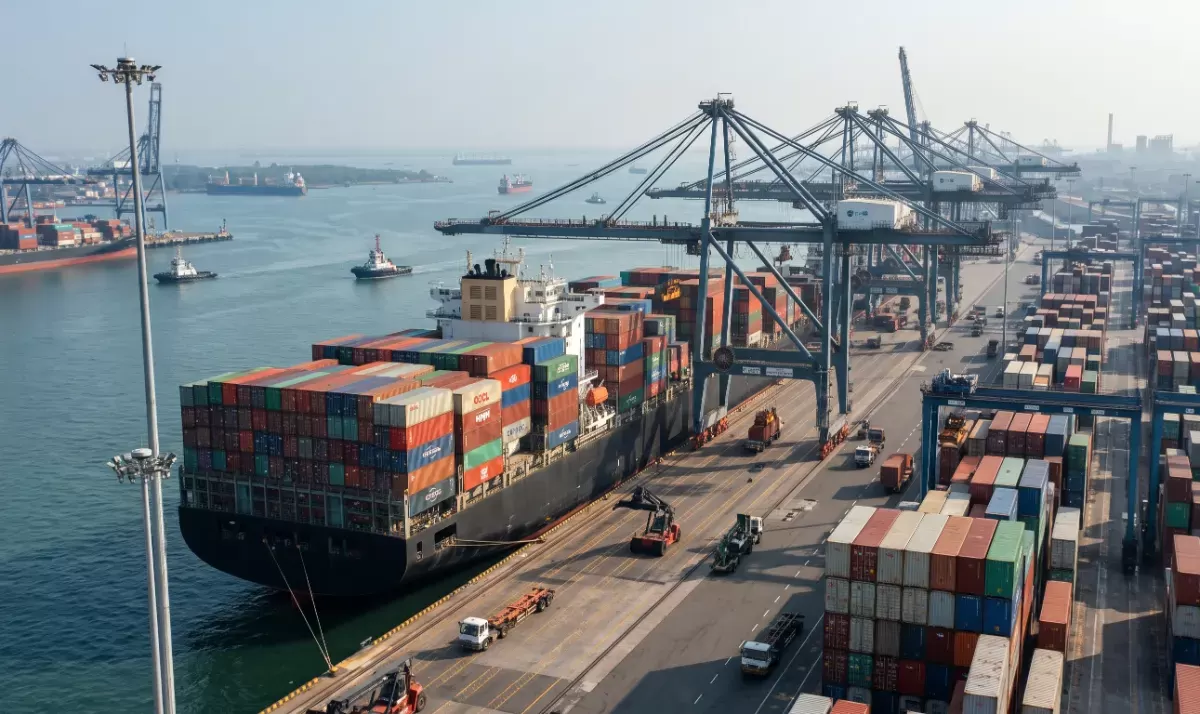
Asian container shipping lines are accelerating their strategic deployment in the Indian market, no longer satisfied with incidental port calls but instead launching dedicated independent services. According to industry sources, Orient Overseas Container Line (OOCL) will officially launch the Far East-Chennai Service 4 (FCS4) on November 22, with a port rotation of Port Klang–Visakhapatnam–Chennai–Port Klang. This service is specifically designed to strengthen direct cargo connections between Malaysia and India's east coast while targeting Indian transshipment cargo transiting through Port Klang . OOCL stated that this service will provide greater flexibility and reliability, and complements its two intra-Asia services launched from India's west coast (JNPA and Mundra) in the second quarter of this year .
South Korean carrier HMM has taken a different approach, launching the Gulf-India-East Africa (GIA) service in late September in partnership with COSCO SHIPPING, Pacific International Lines, and Interasia Lines. This route connects Nhava Sheva and Mundra with Dar es Salaam in Tanzania and Mombasa in Kenya, with a full round voyage of 35 days and deployment of five vessels of approximately 2,800 TEU . Nhava Sheva and Mundra serve as cargo consolidation hubs for the East Africa route, reflecting HMM's assessment of the growth potential in India-Africa trade.
Emirates Shipping Line (ESL) has chosen to restructure its existing network by splitting the India-Red Sea route into two independent loops. The South Red Sea Service (SRS) operates as a shuttle between Nhava Sheva and Jeddah, deploying two vessels of 1,800 to 2,600 TEU with departures every nine days. The North Red Sea Service (NRS) connects Nhava Sheva, Djibouti, Aqaba, Sokhna, and Sohar, with two vessels of 1,700 to 2,500 TEU providing approximately fortnightly departures . This restructuring provides Saudi Arabia with a dedicated shuttle service while retaining coverage of the broader Red Sea region.
The series of capacity deployment moves is backed by solid data. JNPA handled a record 864,255 TEU in October 2026, an increase of 27.05% year-over-year, surpassing the previous monthly record of 834,697 TEU set in September. Container throughput for the April-October period reached approximately 5.53 million TEU, an increase of 18.99% year-over-year . Industry analysts note that this intense wave of capacity injection reflects carriers' expectations of sustained growth opportunities in India's exports, as India's real GDP recorded an impressive 7.8% growth in the first quarter of fiscal year 2026-27, significantly outpacing other traditional emerging markets .
From a competitive landscape perspective, the Indian market is also seeing participation from new entrants. Vietnam-based Hai An Lines launched the standalone CVI service last month, connecting Chennai with Southeast Asia and China using the 1,800 TEU vessel "Haian Beta" . The influx of new capacity is intensifying competition on India-related routes, but carriers remain generally optimistic about demand growth. However, market participants also note that empty container repositioning fee disputes at Indian ports remain unresolved, and cost pressures on the landside may partially offset the positive effects of capacity expansion .