
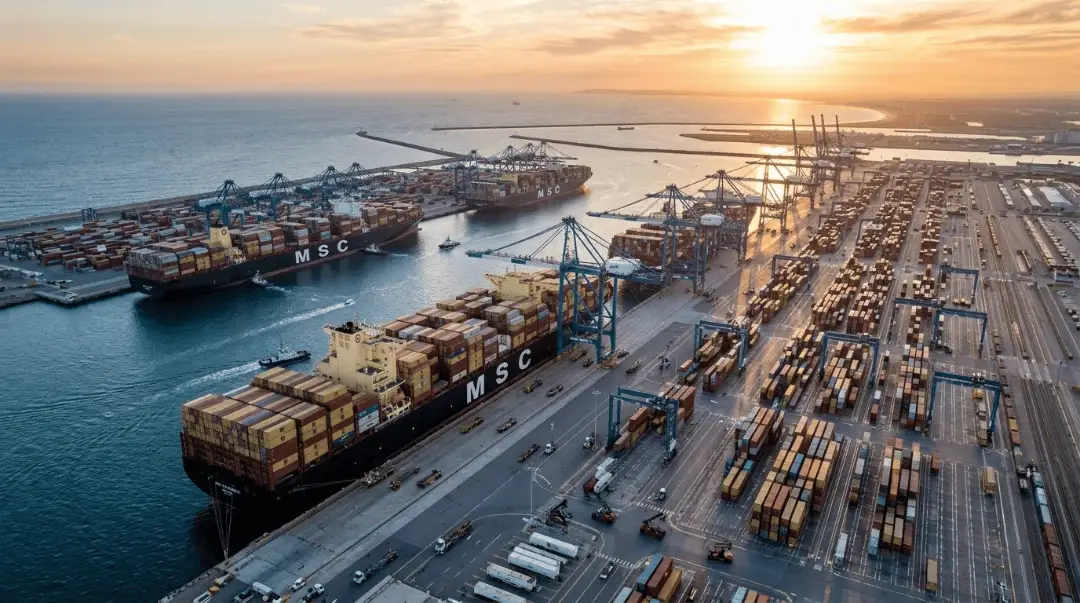
The numbers tell a story of acceleration that has surprised even its proponents. Vizhinjam International Seaport, which began commercial operations in December 2024, crossed 2 million TEUs within 18 months, becoming the fastest Indian port to reach that milestone . In its first full financial year, FY26, the port handled 1.3 million TEUs across 607 vessels . By January 2026, it had risen to 83rd globally in container handling, recording a monthly throughput of 123,092 TEUs and a Gross Crane Rate of 30.12 moves per hour, a benchmark considered globally competitive . These are not the metrics of a tentative new entrant; they are the markers of a port that has found its market and is scaling rapidly.
But the comparison with Colombo and Singapore reveals both the opportunity and the limitation. Colombo handled 5.99 million TEUs in the first eight months of 2026 alone, with transshipment accounting for 81% of volumes . Singapore processed 22.74 million TEUs in the first half of 2026, remaining within striking distance of Ningbo Zhoushan for the title of the world's second-busiest container port . Vizhinjam's 2 million TEUs in 18 months is a fraction of these totals. The gap is not one of ambition but of accumulated infrastructure, network density, and the decades of investment that have made Colombo and Singapore the default routing choices for South Asian and global trade.
The strategic vulnerability that Vizhinjam addresses is rooted in a simple geographic fact. Historically, nearly 80% of Colombo's transshipment volume has comprised containers originating from or destined for Indian ports . India's cargo has been feeding a foreign hub because Indian ports lacked the depth to berth the ultra-large container vessels that now dominate the Asia-Europe trade. Vizhinjam's natural draft of approximately 20 metres and its 800-metre berth, expandable under Phase 2, allow it to handle vessels that most Indian ports cannot accommodate . Its location just 10 nautical miles from the main East-West shipping route, compared to Colombo's 30, means minimal deviation for ships that would otherwise sail past India's coast .
This geographic advantage translates into concrete savings. Luxman Radhakrishnan, former chairman of JNPA, estimates that every container routed through Vizhinjam rather than a foreign hub saves approximately $80–100 in cost and avoids two to seven days of transit delay . For ships, the savings could be $50–70 per container in fuel charges alone, with total port-related logistics costs falling by around 30% . At scale, these figures compound into a structural shift in the economics of Indian trade, not merely a marginal improvement.
The MSC investment is the mechanism through which this shift is being operationalised. In June 2026, Terminal Investment Limited, MSC's port arm, agreed to acquire a 49% stake in Adani Vizhinjam Port Private Limited for $1.397 billion, with $539 million upfront and $858 million earmarked for the port's Phase 2 expansion . The deal values the asset at $2.85 billion and represents the largest foreign private investment in Indian port infrastructure . Crucially, the entire volume at Vizhinjam has been underwritten by MSC, the world's largest container shipping line . The carrier's vessels, which would otherwise call at Colombo, are being redirected to Vizhinjam, and the Phase 2 expansion, scheduled for completion by December 2028, will lift capacity from 1.6 million to 5.7 million TEUs .
This is where the comparison with Singapore becomes instructive. Singapore's success is not merely a function of its location or depth, though both are formidable. It is the product of an integrated ecosystem: free trade zones, sophisticated logistics services, legal and financial infrastructure, and a network of shipping lines that treat the port as a hub rather than a waypoint. Vizhinjam has the maritime geography to compete for the transshipment segment, but it lacks the landside ecosystem that converts port throughput into broader economic activity. Radhakrishnan's warning is pointed: "We need a dozen container freight stations around Vizhinjam, which don't exist currently. Otherwise, we are going to have a very efficient port but no logistics connectivity to it" .
The domestic competitive dynamics illustrate the stakes. Vizhinjam's rise has already cut transshipment volumes at ICTT Vallarpadam, the DP World-operated terminal in Kochi, by nearly 50% in FY26, from 170,000 TEUs to 85,911 TEUs . The advantage is depth: Vizhinjam's 18-metre draft accommodates ultra-large vessels, while Vallarpadam's channel is limited to 14.5 metres . This is the kind of redistribution that occurs when a new entrant with superior infrastructure enters a market that had been constrained by legacy limitations. But it also raises a question: is Vizhinjam capturing cargo from foreign hubs, or is it cannibalising India's existing port capacity?
The answer, for now, is both. MSC's strategy appears to be to redirect volumes that would have transited Colombo, leveraging its position as the world's largest carrier to shift network flows toward a terminal where it holds a substantial equity stake . This is not unique to Vizhinjam; MSC has similar arrangements at Mundra and Ennore, and the carrier's terminal investments are designed to secure capacity and influence operations at key nodes in its network . But the scale of the Vizhinjam commitment, and the fact that it underwrites the port's entire volume, makes it a particularly concentrated bet on India's transshipment potential.
The political economy of the deal adds a layer of complexity. Kerala's state government raised concerns that Adani had not sought prior approval for the stake sale, as required under the concession agreement, and some observers warned that a single carrier's dominance at the port could create monopoly risks . Adani has sought to allay these concerns, stating that Vizhinjam will function as a common-user terminal with non-discriminatory access for all carriers, and that majority control will remain with APSEZ . But the structural reality is that MSC's volumes are what make Vizhinjam viable in its current phase, and that dependence shapes the port's commercial relationships.
The Hormuz crisis has accelerated Vizhinjam's strategic relevance. In April 2026, as tensions in the Strait of Hormuz disrupted Gulf shipping lanes, Vizhinjam saw over 100 vessels seeking berthing access, with dozens reportedly turned away due to capacity constraints . The port's location on the Indian Ocean, outside the contested Gulf corridor, positioned it as a fallback for cargo flows that had been disrupted. This is not a role that Colombo or Singapore can replicate in the same way; they are established hubs, not alternatives to a disrupted corridor. Vizhinjam's value in a crisis is its availability as a deepwater port on a route that bypasses the chokepoints.
But the crisis-driven demand also exposes the limits of the current infrastructure. Capacity constraints, yard space limitations, and the absence of landside connectivity mean that Vizhinjam cannot yet absorb the volumes that its maritime advantages would allow it to attract. Phase 2 will address the berth and crane capacity, but the container freight stations, rail links, and industrial clusters that Radhakrishnan identifies as essential are separate investments that neither MSC nor Adani can deliver alone. They require state government action, central government coordination, and private investment in logistics infrastructure that does not yet have a proven demand base.
The comparison with Colombo's resilience is telling. Despite Vizhinjam's rise, Colombo's volumes grew 10.3% in the first eight months of 2026, with transshipment up 10.9% . The Colombo West International Terminal, operated by John Keells Holdings and Adani, reached full capacity utilisation in its first year and handled 460,000 TEUs against an installed capacity of 1.6 million TEUs . Colombo is not standing still. It is expanding capacity, improving efficiency, and retaining its position as the region's dominant hub. Vizhinjam's challenge is not to displace Colombo overnight but to capture the incremental growth in Indian transshipment demand and to prevent that demand from being routed through foreign ports by default.
The longer-term question is whether Vizhinjam can do what Mundra and JNPA did for their respective regions. Radhakrishnan's observation is that those ports "didn't just move containers. They anchored industrial corridors, SEZs, warehousing clusters and ancillary manufacturing around the port, turning port traffic into a state-level economic engine" . Vizhinjam has the maritime infrastructure to handle the ships. What it lacks is the industrial and logistics ecosystem that would make Kerala a manufacturing and distribution hub rather than a transit point for cargo that is consumed or produced elsewhere.
This is where the MSC investment becomes more than a financial transaction. If MSC redirects its network to Vizhinjam, it creates volume certainty that can justify investment in container freight stations, warehousing, and rail connectivity. Volume certainty is the precondition for the landside ecosystem, not the result of it. The carrier's commitment is, in effect, a guarantee that the cargo will come, which lowers the risk for logistics providers considering investment in Kerala's southern coast. Whether that guarantee is sufficient to trigger the broader ecosystem development is the open question.
For India's trade sovereignty, the stakes extend beyond cost savings. Every container transshipped through Colombo, Singapore, or Dubai represents a dependence on foreign infrastructure, foreign customs regimes, and foreign geopolitical calculations. Vizhinjam's ability to handle ultra-large vessels directly from Indian shores reduces that dependence, and the $200–220 million in foreign exchange savings that Radhakrishnan estimates is a conservative measure of the economic value . But the strategic value is harder to quantify: control over a critical node in the supply chain, the ability to offer direct services to Indian exporters and importers, and the capacity to absorb disruption when foreign hubs are affected by crises beyond India's control.
The reality check is that Vizhinjam is not yet Singapore, and it may never be. Singapore's 22.74 million TEUs in half a year reflect a scale of network integration that Vizhinjam will not approach for years, if ever. Colombo's 5.99 million TEUs in eight months and its 80% transshipment share reflect a position that Vizhinjam is beginning to contest but has not yet displaced. The more realistic comparison is with what Vizhinjam could become: a regional hub for Indian Ocean trade, serving Indian cargo that currently feeds foreign hubs, and offering a deepwater alternative for carriers seeking to diversify their network exposure.
What makes the story compelling is that the outcome is genuinely uncertain. The maritime advantages are real, the MSC commitment is substantial, and the policy environment is supportive. But the landside gaps are equally real, the competitive response from Colombo is underway, and the political sensitivities around foreign carrier dominance at a strategic port are unresolved. Vizhinjam has proved that it can attract ships. The next test is whether it can build the ecosystem that turns a port into a gateway, and whether India can capture the transshipment value that has for decades accrued to its neighbours.