
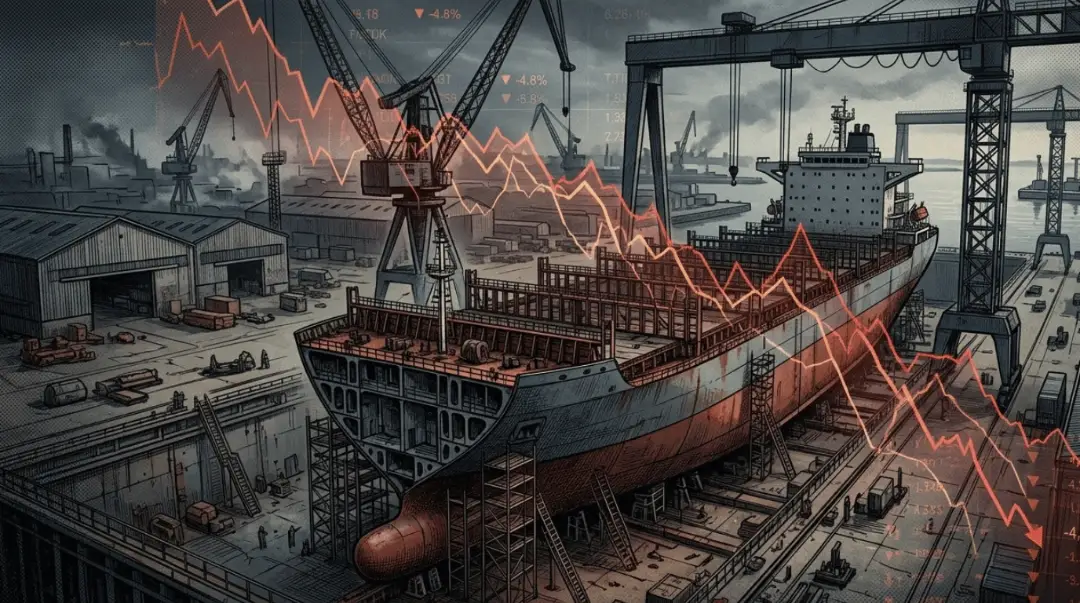
Cochin Shipyard has reported a sharp deterioration in profitability for the second quarter of FY 2026–27, with consolidated net profit halving to ₹53.77 crore from ₹107.52 crore in the same period last year . Revenue from operations rose 11.7% to ₹1,249.19 crore, but total expenses increased faster, reaching ₹1,256.72 crore from ₹1,095.97 crore . The results, announced on 10 November 2026, sent the stock down as much as 8% in early trading on 11 November, reflecting investor concern about the company's operating performance and project execution.
The central weakness was the shipbuilding segment, which swung from a PBIT profit of ₹149.71 crore in Q2 FY26 to a PBIT loss of ₹6.08 crore in Q2 FY27 . Revenue from the segment rose only 3.2% to ₹783.14 crore, and the margin collapse indicates that the projects currently under execution are generating significantly lower returns than the legacy programmes that drove profitability in previous quarters . The company is moving into a lower-margin phase as tender-based defence and commercial projects replace the exceptionally profitable contracts that had previously supported earnings.
The ship repair business provided partial offset. Segment revenue rose 29.6% to ₹466.05 crore, and PBIT more than doubled to ₹143.34 crore from ₹67.20 crore . The repair segment's stronger margin profile, with FY27 EBITDA guidance of 22–24% compared with 10–12% for shipbuilding, explains why the company is expanding its repair infrastructure . The commissioning of the New Dry Dock and International Ship Repair Facility, along with the proposed Vadinar facility, is intended to grow the repair business and improve the overall business mix.
A separate development on 11 November reinforced Cochin Shipyard's role in naval maintenance. The Ministry of Defence signed a ₹498.58 crore contract with the company for the normal refit and re-powering of INS Betwa, a Brahmaputra-class frigate . The refit involves replacing the ship's steam-based propulsion system with diesel engines and installing a modernised weapon suite . The project is expected to involve more than 50 MSMEs and generate employment across the shipbuilding and ancillary industries, and it aligns with the government's Aatmanirbhar Bharat and Make in India objectives .
The execution overhang from two 1,200-passenger vessels for the Andaman and Nicobar Administration adds to the company's challenges. Delivery of the vessels has been halted at the customer's request while alternative deployment is considered, and the vessels were approximately 55% complete as of September-end. Cumulative liquidated damages of ₹215.70 crore across both contracts represent a potential financial exposure that the company will need to resolve . The combination of a shipbuilding segment loss and a stalled passenger vessel project raises questions about project execution that management will need to address in the coming quarters.
For India's shipbuilding sector, Cochin Shipyard's results illustrate the gap between revenue growth and earnings quality that can emerge when a yard transitions from legacy contracts to competitive tenders. The company retains a substantial order book of approximately ₹22,125 crore, equivalent to 4.4 times FY26 revenue, and it is the lowest bidder for next-generation survey vessel orders worth around ₹5,000 crore . These provide visibility, but the margin profile of new contracts is lower than the legacy work, and the transition period is proving difficult for profitability.
Looking ahead, the key variables are whether the shipbuilding segment can return to profitability as new projects progress, whether the Andaman passenger vessel contracts can be resolved without further financial impact, and whether the ship repair expansion delivers the margin improvement that the company expects. The interim dividend of ₹3 per share, with a record date of 16 November and payment by 9 December, provides some return to shareholders despite the earnings decline. For now, the Q2 results mark a difficult quarter for a strategically important Indian shipbuilder, and the coming quarters will test whether the order book can be converted into sustainable earnings.