
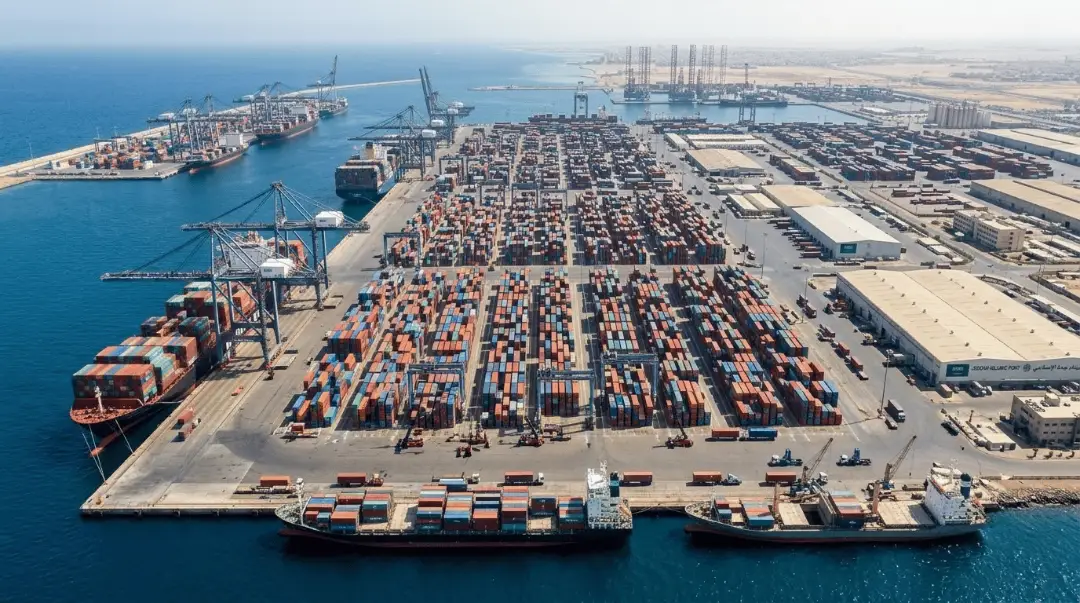
Saudi Arabia's ports recorded a 14% year-on-year increase in container handling during October 2026, reaching approximately 866,200 TEUs, with Jeddah Islamic Port setting a new all-time monthly record . The data, released by the Saudi Ports Authority (Mawani) and reported by Zawya and Saudi Gazette on 10 November, confirms that the kingdom's Red Sea gateways are absorbing a growing share of regional trade as the Hormuz disruption continues to reshape shipping routes.
Jeddah Islamic Port's performance was the standout. The facility handled 582,900 TEUs in October, surpassing its previous record set in June 2026 by 27.45% . Mawani spokesperson Abdullah Al-Munif attributed the record to the port's operational efficiency and advanced logistical capabilities, stating that the achievement "underscores the port's ability to keep pace with the rapid transformations in global trade and accommodate growing trade volumes" . The record reflects both the port's capacity to handle increased throughput and the broader shift of cargo toward Saudi Arabia's Red Sea coast.
The composition of the growth provides insight into the drivers. Inbound containers rose 8.53% year-on-year to approximately 305,600 TEUs from 281,600 TEUs, while outbound containers increased 4.83% to about 282,900 TEUs from 269,900 TEUs . The inbound growth is consistent with Saudi Arabia's role as a consumption market and a transit point for cargo destined for other Gulf states, while the outbound increase reflects the kingdom's export activity. The simultaneous growth in both directions indicates that Jeddah is functioning as a two-way trade gateway, not merely a transshipment point.
Transshipment containers, by contrast, declined 10.54% to approximately 186,400 TEUs from 208,400 TEUs . This decline is notable because it suggests that the growth in Jeddah's overall volumes is driven by gateway cargo rather than by containers being transferred between vessels. Gateway cargo requires inland transport, customs clearance, and distribution services, generating more economic activity within Saudi Arabia than transshipment, which involves minimal local handling. The shift toward gateway cargo is consistent with the broader pattern of Red Sea ports absorbing cargo that would previously have moved through the Gulf.
The timing of Jeddah's record aligns with the reconfiguration of Gulf shipping routes that we have documented throughout 2026. With the Strait of Hormuz constrained, carriers have redirected cargo through Red Sea entry points, and Saudi Arabia's western ports have benefited from this diversion. The kingdom's investment in port infrastructure, including the expansion of container terminals and the development of logistics corridors, has positioned Jeddah to capture this redirected traffic. The record October figure suggests that those investments are paying off in operational terms.
For India, Jeddah's performance has indirect but relevant implications. Indian exporters and importers with Saudi trade now have a Red Sea gateway that is handling record volumes, which could affect routing decisions and transit times. Cargo destined for Saudi Arabia's western region, or for onward movement to other markets, may increasingly move through Jeddah rather than through Gulf ports that require Hormuz transit. The growth of Jeddah as a gateway also supports the broader Red Sea landbridge model that has emerged as an alternative to the disrupted Gulf corridor.
The sustainability of Jeddah's record will depend on whether the Red Sea security environment remains stable and whether the port can maintain operational efficiency as volumes rise. The congestion that has been reported at Saudi western ports in recent weeks, including Jeddah, Yanbu, and King Abdullah Port, indicates that the infrastructure is under strain. If volumes continue to increase, further investment in port capacity, road connectivity, and customs facilitation will be necessary to prevent the gateway from becoming a bottleneck.
Looking ahead, the key question is whether Jeddah's October record represents a peak or a new baseline. The Red Sea route's recovery and the Hormuz disruption's persistence suggest that the port's gateway function will remain important in the near term. For Saudi Arabia, the record is a validation of its logistics investment strategy and its ambition to position itself as a trade hub connecting Asia, Europe, and Africa. For the shipping industry, it is a data point confirming that the geography of Gulf trade is being redrawn, with Red Sea ports gaining at the expense of their Gulf counterparts.