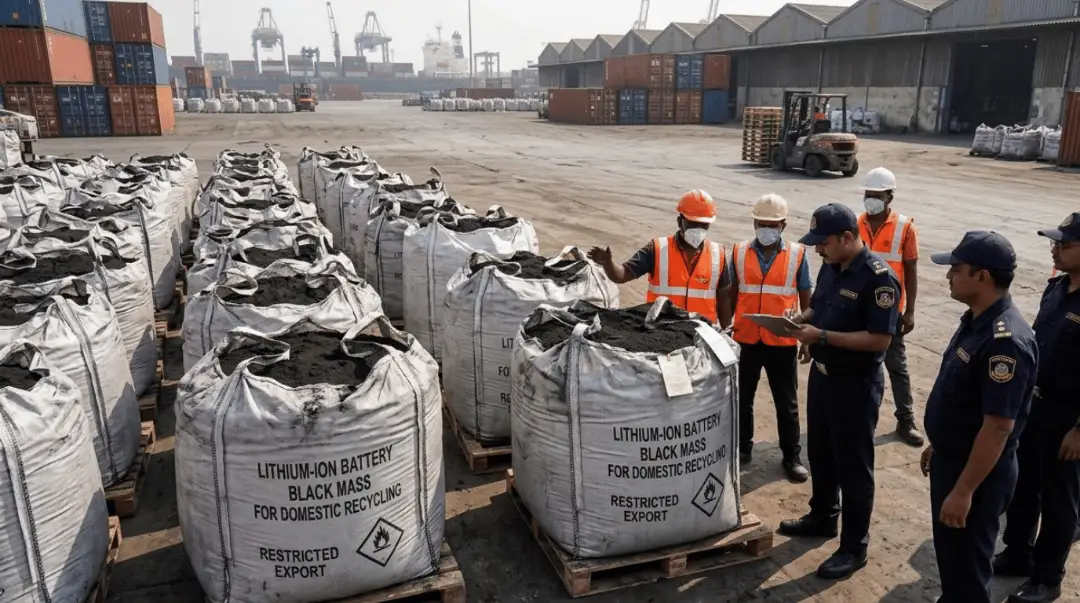
<p class="ds-markdown-paragraph" style="margin: 16px 0px; color: rgb(15, 17, 21); font-family: quote-cjk-patch, Inter, system-ui, -apple-system, BlinkMacSystemFont, "Segoe UI", Roboto, Oxygen, Ubuntu, Cantarell, "Open Sans", "Helvetica Neue", sans-serif; font-size: 16px;"><span class="">The Indian government has prohibited the export of lithium-ion battery black mass and unsorted battery waste with immediate effect, in a decisive move to secure critical minerals for the domestic recycling industry and reduce dependence on imported materials for battery manufacturing . The notification, issued by the Directorate General of Foreign Trade on 10 November 2026, amends the export policy for waste and scrap of primary cells, primary batteries, and electric accumulators under ITC (HS) code 85491400, changing the classification from "Free" to "Prohibited" until further orders . The change was made under the Foreign Trade (Development and Regulation) Act, 1992, and the Foreign Trade Policy, 2023, with transitional arrangements under Para 1.05 of the policy applicable to the notification .</span></p><p class="ds-markdown-paragraph" style="margin: 16px 0px; color: rgb(15, 17, 21); font-family: quote-cjk-patch, Inter, system-ui, -apple-system, BlinkMacSystemFont, "Segoe UI", Roboto, Oxygen, Ubuntu, Cantarell, "Open Sans", "Helvetica Neue", sans-serif; font-size: 16px;"><span class="">Black mass is the powder-like material produced when used lithium-ion batteries or battery-manufacturing scrap is shredded and the larger pieces of metal and plastic are removed . Depending on the battery type, the powder contains recoverable quantities of lithium, nickel, cobalt, manganese, and graphite, making it a secondary source of minerals that are essential for electric vehicle manufacturing, energy storage, and other advanced industrial applications . The ban is intended to ensure that this material remains available to Indian refiners rather than being shipped abroad for processing, where the recovered minerals would then need to be imported back into India at a cost.</span></p><p class="ds-markdown-paragraph" style="margin: 16px 0px; color: rgb(15, 17, 21); font-family: quote-cjk-patch, Inter, system-ui, -apple-system, BlinkMacSystemFont, "Segoe UI", Roboto, Oxygen, Ubuntu, Cantarell, "Open Sans", "Helvetica Neue", sans-serif; font-size: 16px;"><span class="">The rationale for the ban is grounded in a mismatch between domestic processing capacity and feedstock availability. According to the Global Trade Research Initiative, India has greater black-mass processing capacity than the amount of material generated domestically, which has left refiners short of raw material . Processing more black mass within the country could help recover critical minerals and reduce battery manufacturers' dependence on imports . The government has been actively supporting this sector, having launched a ₹1,500-crore incentive scheme for critical mineral recycling in September 2026 to expand domestic capacity to recover materials from spent batteries and electronic waste .</span></p><p class="ds-markdown-paragraph" style="margin: 16px 0px; color: rgb(15, 17, 21); font-family: quote-cjk-patch, Inter, system-ui, -apple-system, BlinkMacSystemFont, "Segoe UI", Roboto, Oxygen, Ubuntu, Cantarell, "Open Sans", "Helvetica Neue", sans-serif; font-size: 16px;"><span class="">The environmental and enforcement dimensions of the ban are significant. Black mass may contain toxic electrolyte residues and heavy metals that require further treatment, and shipments of such hazardous material require prior permission under waste-management rules . However, GTRI warned that exporters may attempt to avoid scrutiny by declaring black mass as cobalt powder, a nickel intermediate, or another industrial product . Effective enforcement will therefore require Customs authorities to examine how the material was produced, in addition to checking how it has been declared, because a change in the product description or tariff code could otherwise conceal the movement of the same waste material .</span></p><p class="ds-markdown-paragraph" style="margin: 16px 0px; color: rgb(15, 17, 21); font-family: quote-cjk-patch, Inter, system-ui, -apple-system, BlinkMacSystemFont, "Segoe UI", Roboto, Oxygen, Ubuntu, Cantarell, "Open Sans", "Helvetica Neue", sans-serif; font-size: 16px;"><span class="">The ban also addresses a structural problem in India's battery recycling ecosystem. According to an ICEA-Accenture report cited by CNBC TV18, around 80% of collected lithium-ion battery scrap is handled by unregulated operators, while only 20% enters formal collection channels . The report also indicated that just 1% of end-of-life batteries are converted into battery-grade materials within the country . By restricting exports, the government aims to channel more material into the formal recycling sector and support the development of a domestic circular economy for batteries.</span></p><p class="ds-markdown-paragraph" style="margin: 16px 0px; color: rgb(15, 17, 21); font-family: quote-cjk-patch, Inter, system-ui, -apple-system, BlinkMacSystemFont, "Segoe UI", Roboto, Oxygen, Ubuntu, Cantarell, "Open Sans", "Helvetica Neue", sans-serif; font-size: 16px;"><span class="">For India's trade logistics sector, the ban removes a small but strategically important export flow. The Global Trade Research Initiative noted that India recorded no exports under the relevant tariff code in FY2026, so the immediate impact on trade volumes is negligible . However, the prohibition prevents future shipments and signals that the government intends to treat battery waste as a strategic resource rather than a disposable export commodity. Exporters and recyclers who may have been planning to ship black mass abroad will need to redirect their material to domestic processors or seek alternative arrangements.</span></p><p class="ds-markdown-paragraph" style="margin: 16px 0px; color: rgb(15, 17, 21); font-family: quote-cjk-patch, Inter, system-ui, -apple-system, BlinkMacSystemFont, "Segoe UI", Roboto, Oxygen, Ubuntu, Cantarell, "Open Sans", "Helvetica Neue", sans-serif; font-size: 16px;"><span class="">Looking ahead, the effectiveness of the ban will depend on enforcement and on the development of domestic recycling capacity. The government's incentive scheme is intended to expand processing capability, but the gap between the 80% of scrap handled informally and the 1% converted into battery-grade materials domestically suggests that significant investment and regulatory oversight will be required to build a functioning recycling ecosystem. For now, the ban establishes a clear policy direction: India intends to retain the critical minerals embedded in its battery waste and build the industrial capacity to recover them, rather than exporting the raw material and importing the processed product.</span></p>
India Bans Export of Lithium-Ion Battery Black Mass to Secure Critical Minerals for Domestic Recycling
The Directorate General of Foreign Trade has prohibited the export of unsorted waste and scrap of lithium-ion batteries, including battery black mass, with immediate effect. The notification, issued on 10 November 2026, changes the export policy for the material under ITC (HS) code 85491400 from "Free" to "Prohibited" until further orders. The ban aims to ensure that valuable minerals such as lithium, cobalt, nickel, and manganese remain available to domestic recyclers, reducing India's dependence on imports for battery manufacturing. India's black-mass processing capacity currently exceeds the amount of material generated domestically, leaving refiners short of feedstock.