
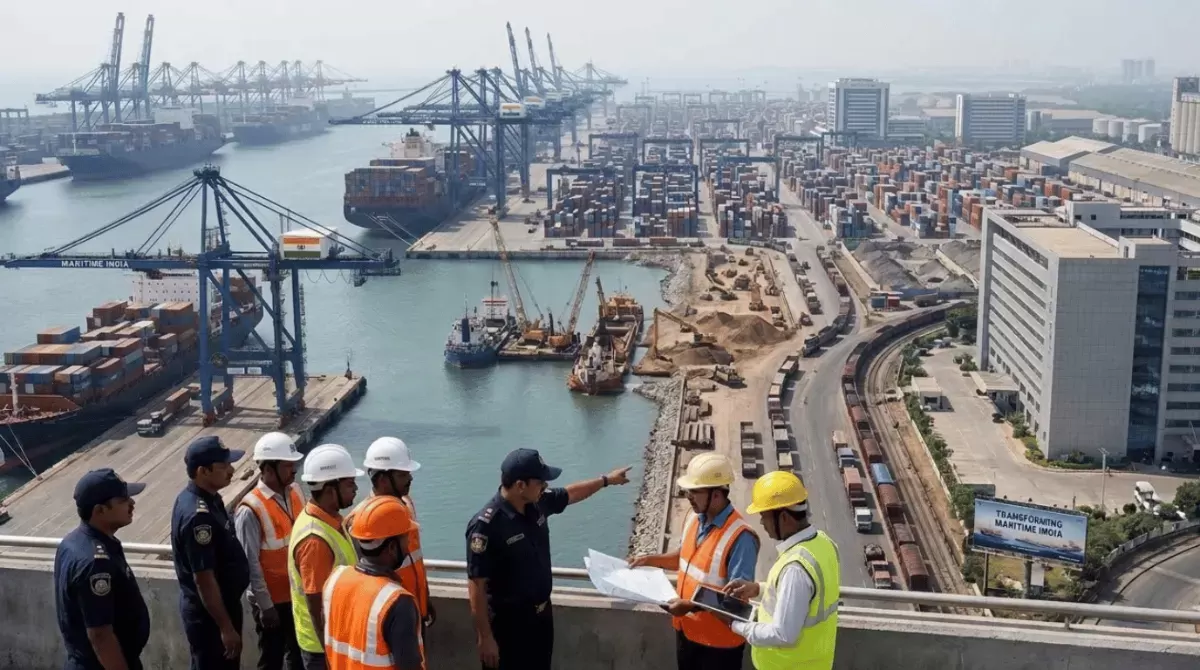
India has set a target of expanding its port capacity fourfold to 10,000 million tonnes per annum by 2047, as part of a broader maritime strategy that envisages approximately $800 billion in investment across more than 300 initiatives . Ports Secretary Vijay Kumar outlined the targets at the Sagarmanthan event in New Delhi on 10 November 2026, providing the most detailed public accounting yet of the government's long-term maritime ambitions under the Maritime India Vision 2030 and Maritime Amrit Kaal Vision 2047.
The capacity trajectory is structured in stages. India's combined port capacity currently stands at around 2,500 million tonnes per annum, and the government aims to raise this to 3,500 million tonnes in the near term before reaching 10,000 million tonnes by 2047 . The expansion covers both the 12 major ports under central administration and more than 200 non-major ports governed by state governments, and it includes the development of new facilities such as Vadhavan Port on the western coast . The share of cargo handled through public-private partnership projects has already increased from 63% to 66%, with a long-term objective of moving almost all cargo through mechanised systems and private-sector participation .
The investment programme extends well beyond berths and terminals. Kumar said the government has identified more than 300 initiatives involving an estimated $800 billion in investment, covering port infrastructure, shipping, shipbuilding, inland waterways, green energy, maritime logistics, and human resource development . The scale of the figure reflects the breadth of the agenda: India is simultaneously seeking to expand port capacity, build domestic shipping tonnage, develop shipbuilding capability, and establish itself as a green fuel bunkering hub.
The shipping and shipbuilding dimension is central to the strategy. India plans to establish a Bharat Container Shipping Line, and the government has aggregated demand from government cargo agencies for more than 400 ships to create a domestic shipbuilding order book . Tenders for 60 ships are expected to be floated by the end of March 2027 . India aims to become one of the world's top 10 shipbuilding nations by 2030 and among the top five by 2047, with shipbuilding output already up 40% over the past year . The country has also emerged as the world's largest ship-recycling nation, commanding a 35% share of the global market.
The green dimension of the vision is equally specific. India aims to meet 60% of port energy requirements through renewable sources by 2030 and nearly 100% by 2047, with around 30% of port energy already green and two major ports operating entirely on renewable energy . Three ports—Tuticorin, Kandla, and Paradip—have been identified as green hydrogen hubs under the National Green Hydrogen Mission . The inland waterways network has expanded from five operational waterways a decade ago to 116 notified waterways, with a target of more than 50 operational for cargo and passenger movement and 500 million tonnes of cargo transported through them by 2047, up from the current 218 million tonnes .
Kumar addressed the strategic context directly, referring to disruptions in the Strait of Hormuz, the Red Sea, and the Black Sea. He said India's ability to maintain energy supplies despite geopolitical tensions was supported by diversified sourcing and strategic partnerships, but stressed the need to strengthen domestic shipping capacity and reduce dependence on foreign maritime infrastructure . The reference to foreign dependence connects to another priority: reducing reliance on foreign transshipment hubs, which currently handle around 75% of India's transshipment containers. The Vizhinjam port development is intended to address this gap, and Kumar's remarks indicate that the government views domestic transshipment capacity as a strategic as well as commercial objective.
For India's logistics sector, the targets announced by the Ports Secretary provide a framework for understanding the direction of policy over the next two decades. The $800 billion figure is an estimate of total investment across all initiatives rather than a committed government outlay, and the actual deployment will depend on private participation, state government action, and the pace of project approvals. But the specificity of the targets—10,000 million tonnes of port capacity, 500 million tonnes of inland waterway cargo, top-five shipbuilding status, and 100% green port energy—gives the sector a set of benchmarks against which progress can be measured.
Looking ahead, the key milestones in the near term are the tenders for 60 ships by March 2027, the operationalisation of additional inland waterways, and the progress of the Vadhavan Port development. The longer-term trajectory will depend on whether the investment materialises at the scale envisaged and whether India can build the domestic capabilities—in shipbuilding, transshipment, and green fuels—that the vision requires. For now, the government has set out an ambitious roadmap that treats maritime capacity as a pillar of strategic autonomy, and the implementation of that roadmap will shape India's position in global trade for years to come.