
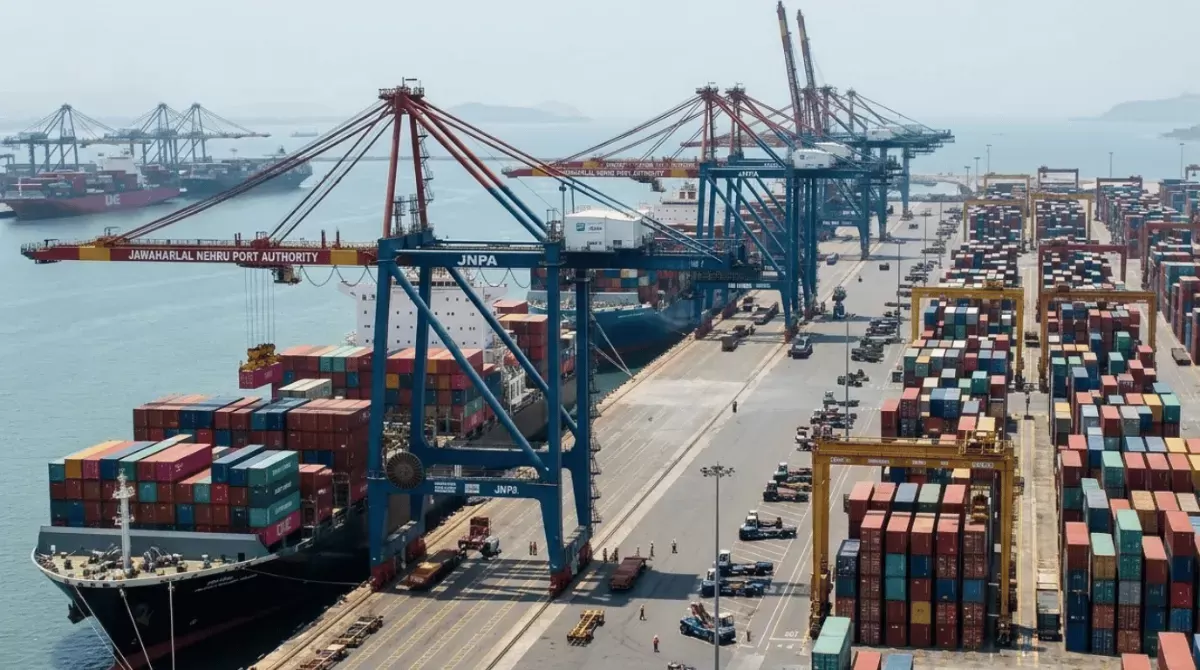
Asian container shipping lines are significantly expanding their capacity on India-linked trade routes, signaling strong confidence in the country's export growth and rising regional cargo demand despite geopolitical uncertainties . Major carriers including Orient Overseas Container Line, Hyundai Merchant Marine, and Emirates Shipping Line have strengthened their Indian operations through new service launches, additional vessel deployments, and network enhancements, according to India Seatrade News.
Hong Kong-based OOCL is set to introduce a new shuttle service, FCS4, connecting Chennai and Visakhapatnam with Port Klang in Malaysia towards the end of November . The service is aimed at improving connectivity for Indian transshipment cargo and strengthening trade links between Malaysia and India's east coast. This new service complements two intra-Asia services introduced by OOCL earlier this year from Jawaharlal Nehru Port and Mundra, providing additional connections to Southeast Asian markets .
Emirates Shipping Line has restructured its Red Sea network into two separate services, deploying two vessels on each loop . The upgraded operations, commencing this month, comprise the South Red Sea Service connecting JNPA and Jeddah, and the North Red Sea Service linking JNPA with Djibouti, Aqaba, Sokhna, and Sohar. South Korean carrier HMM has also strengthened its India-Africa connectivity with the launch of the Gulf-India-East Africa service in late September, in collaboration with COSCO, Interasia Lines, and Pacific International Lines . Operating on a 35-day rotation, the service connects JNPA, Mundra, Dar es Salaam, and Mombasa, offering additional shipping options for growing trade between India and East Africa.
Adding to the competition, Vietnam-based Hai An Lines launched its standalone CVI service last month, connecting Chennai with Southeast Asian and Chinese markets using the 1,800-TEU vessel Haian Beta . The service was subsequently extended to V.O. Chidambaranar Port in November, further expanding its Indian footprint.
The capacity expansion comes amid strong growth in India's container trade. Jawaharlal Nehru Port Authority handled approximately 865,000 TEUs last month, its highest-ever monthly container throughput, compared with 680,000 TEUs in October 2025 . The port's cumulative container volumes reached 5.5 million TEUs during the year so far, registering a 19% year-on-year increase. India's economic outlook is also encouraging carrier investments, with the country's real GDP estimated to have grown by 7.8% in the first quarter of FY2026-27.
Despite geopolitical uncertainties, India's export sector has continued to demonstrate resilience. S.C. Ralhan, President of the Federation of Indian Export Organisations, said Indian exporters were responding to uncertainty with agility, while contributions from both traditional and emerging sectors were supporting export performance . The latest service additions underline growing international carrier confidence in India's trade potential and are expected to provide exporters and importers with more shipping options, improved connectivity, and greater flexibility across key global trade corridors.
For Indian shippers, the proliferation of direct connections and new carrier options improves service flexibility and competitive pricing on India outbound lanes . However, the concentration of capacity expansion in specific trade corridors, combined with persistent port congestion and geopolitical risks, requires careful route planning and carrier partnerships to capitalize on improved connectivity. The development represents a structural shift in the regional shipping network rather than temporary seasonal capacity.
Looking ahead, the sustainability of these new services will depend on whether cargo volumes continue to grow at the pace that has justified the capacity additions. The JNPA record and the 19% year-to-date growth provide a foundation, but the carriers' investments are forward-looking bets on India's trade trajectory. If export growth continues and port productivity keeps pace, the expanded network could give Indian shippers more options and better connectivity than they have had in years. If volumes soften or congestion worsens, some of the new capacity may prove difficult to sustain.