
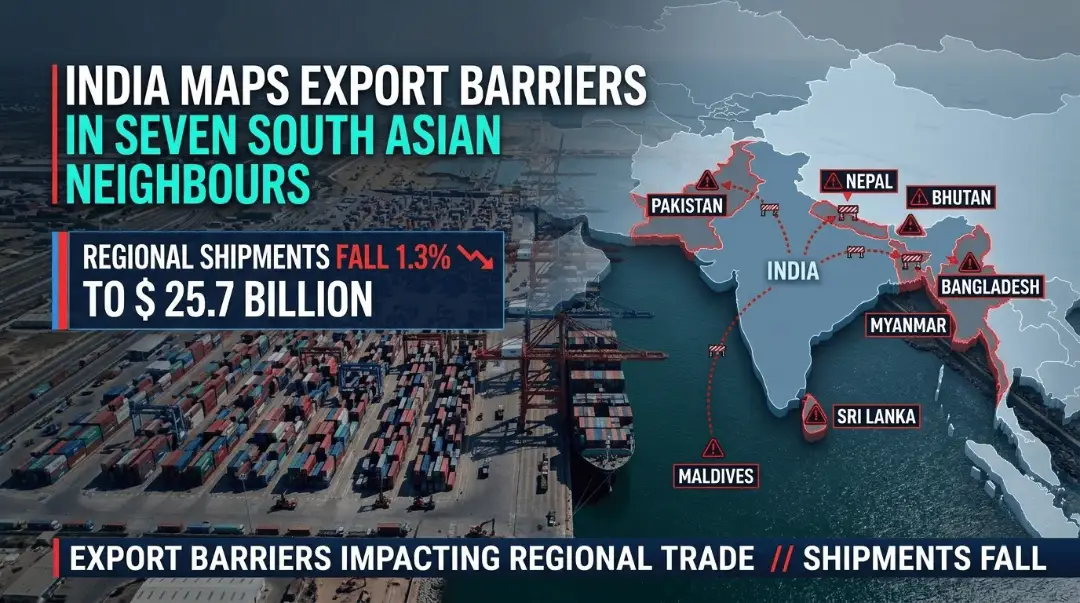
The Indian government has begun mapping the regulatory and market-access barriers that Indian exporters face in seven South Asian neighbours, as part of a broader effort to diversify export destinations and reach the $1 trillion total exports target for the current fiscal year . The exercise covers Bangladesh, Nepal, Sri Lanka, Bhutan, Maldives, Afghanistan, and Pakistan, and it comes as India's merchandise exports to these countries fell 1.3% to $25.7 billion in FY26, following a 2% increase in FY25 and an 8.57% decline in FY24 .
Exporters have been asked to flag specific hurdles including import restrictions, licensing requirements, product standards, technical regulations, banking and payment restrictions, high import tariffs, and delays in regulatory approvals . The government is also examining whether Indian testing laboratories are recognised in these markets, a detail that matters for exporters whose products must be certified before they can enter a destination country . The identification of these barriers is the first step toward resolving them through bilateral negotiations and trade facilitation measures.
The exercise is grounded in concrete, product-specific problems that have already been identified. Indian yarn exporters to Bangladesh have sought expeditious certification of rules of origin, a procedural issue that affects their ability to claim preferential tariff treatment under trade agreements . Bangladesh purchases about 45% of India's total cotton yarn exports, making it a critical market for the sector . Separately, Indian chilli and turmeric exports to Sri Lanka have faced issues over pesticide residues beyond accepted levels, a technical barrier that requires resolution through regulatory dialogue or improvements in testing and certification .
The broader trade policy context includes existing regional arrangements that could be leveraged to address these barriers. All SAARC members, including India, Pakistan, Sri Lanka, Bangladesh, Nepal, Bhutan, Maldives, and Afghanistan, are part of the South Asian Free Trade Area . India, Bangladesh, and Sri Lanka are also members of the Asia-Pacific Trade Agreement, which includes China . Separately, India and the Maldives have concluded the first round of negotiations for a bilateral free trade agreement . These frameworks provide channels for addressing non-tariff barriers, but their effectiveness depends on the political will of the participating countries to resolve specific issues.
Ajay Sahai, Director General of the Federation of Indian Export Organisations, welcomed the government's move, describing it as "strategically good" to improve intra-South Asia trade and support India's export diversification efforts toward the $1 trillion target . The FIEO's support reflects a recognition that South Asia, despite its proximity and cultural ties, remains an underutilised market for Indian exporters, and that resolving regulatory barriers could unlock significant growth.
The political dimension of regional trade cannot be ignored. Political relations between India and Bangladesh have undergone considerable changes since the ouster of Sheikh Hasina's Awami League regime in August 2024, and a commerce secretary-level meeting between the two countries, held in New Delhi in March 2022, had agreed to finalise a study on a possible bilateral comprehensive economic partnership agreement, but the initiative has not made headway since then . An Indian industry representative noted that political issues in South Asia need to be resolved for trade to increase, a point that underscores the limits of technical trade facilitation in an environment of political uncertainty.
For India's export logistics sector, the mapping exercise has implications beyond the specific barriers identified. South Asian markets are served primarily by road and rail through land border crossings, with some coastal shipping for Bangladesh and Sri Lanka. Reducing regulatory friction at these borders would lower logistics costs and transit times for exporters, making Indian goods more competitive in neighbouring markets. The exercise also complements broader efforts to diversify India's export destinations, which have been concentrated in the US, EU, and Gulf markets, and to reduce dependence on any single region amid global trade disruptions.
Looking ahead, the key milestones are the completion of the barrier-mapping exercise, the initiation of bilateral discussions to resolve the identified issues, and the translation of those discussions into tangible improvements in market access. The government has not disclosed a timeline for the exercise, and its success will depend on whether the political will exists in both India and its neighbours to address the barriers that have constrained trade. For now, the exercise signals that India is treating South Asia as a priority market for export growth, and that it is prepared to engage in the detailed, unglamorous work of resolving the regulatory and procedural obstacles that have held back intra-regional trade.