
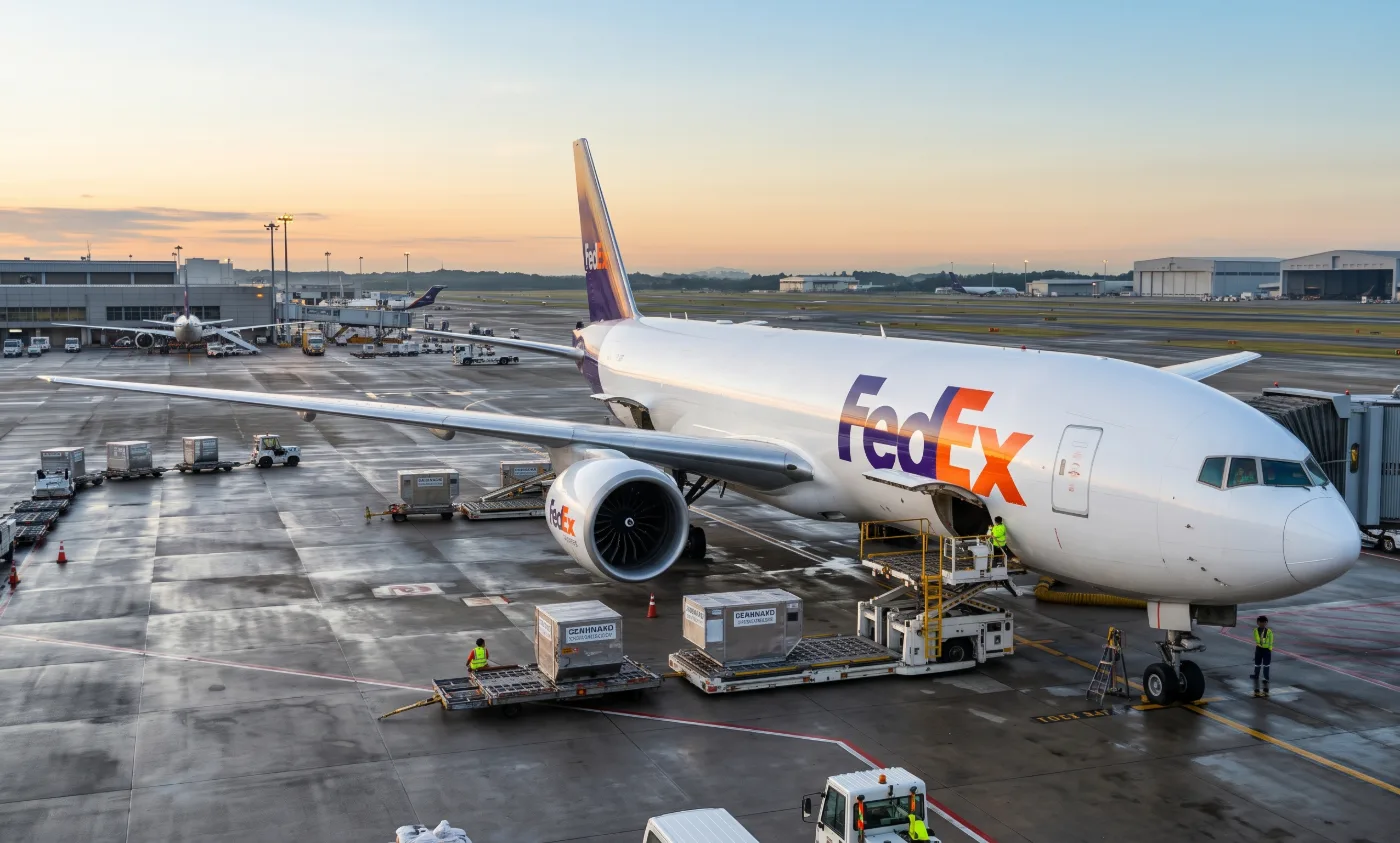
FedEx has expanded its trans-Pacific air cargo network by adding 567,000 kilograms of weekly capacity between Asia Pacific and the United States, deploying five weekly Boeing 777F freighter services to meet rising demand ahead of the year-end peak season . The expansion, announced in early November 2026, targets the high-value cargo segments that have driven air freight growth throughout the year: semiconductors, AI infrastructure components, advanced industrial manufacturing, and premium e-commerce shipments .
The routing architecture connects FedEx's Asia Pacific hub in Guangzhou with sub-regional hubs in Shanghai, Osaka, and its gateway in Clark, Philippines, before transiting Anchorage, Alaska, to the FedEx World Hub in Memphis, Tennessee . This structure allows businesses across Southeast Asia—including Singapore, Malaysia, Thailand, and Vietnam—as well as Hong Kong, to access the additional capacity through connections at Clark and Shanghai . The network also introduces a new five-times-weekly connection to Dallas–Fort Worth via Anchorage, providing a direct link to one of the United States' leading technology and data centre markets .
The capacity addition is explicitly framed around the industries that have become the engine of Asia–US air cargo growth. Asia Pacific accounts for approximately 58% of global semiconductor industry revenue, according to a 2026 FedEx and Frost & Sullivan report . The AI infrastructure buildout—servers, cooling systems, power equipment, and specialised components—has created a category of high-value, time-sensitive cargo that moves by air, and FedEx is positioning its network to capture that demand. Salil Chari, President of Asia Pacific at FedEx, said the additional flights strengthen links between Asia Pacific and key US markets including Dallas–Fort Worth, "while supporting growth across semiconductors, technology, and AI-driven industries" .
The market context validates the investment. The International Air Transport Association recorded 9% year-on-year growth on the Asia–North America corridor in July 2026, making it the fastest-growing major air cargo trade lane globally . For exporters in Thailand, Vietnam, Malaysia, and Singapore, the additional capacity provides more options and greater flexibility during a period when ocean freight reliability remains volatile due to Red Sea and Hormuz disruptions. The air cargo premium is justified for cargo where delivery windows are tight and inventory carrying costs are high, and the semiconductor and AI supply chains fit that profile.
For Indian exporters and importers, the FedEx expansion has indirect but relevant implications. The new capacity does not directly serve India-origin cargo, but it strengthens the broader Asia–US air freight network that Indian shippers access through connections at hubs like Singapore, Hong Kong, and Guangzhou. As we covered earlier, air cargo rates from India have surged approximately 80% year-on-year, driven by Diwali demand and Gulf capacity constraints. Additional transpacific capacity from Asia does not resolve the India-specific bottleneck, but it adds flexibility to a network where Indian cargo competes for space with Southeast Asian and East Asian shipments. If the added capacity absorbs some of the regional demand, it could marginally ease pressure on connecting services that Indian exporters use.
The timing of the announcement aligns with the traditional peak season for air cargo, which runs from October through December as retailers stock inventory for the holidays and e-commerce platforms prepare for peak volumes. FedEx's decision to add capacity now, rather than earlier in the year, reflects an assessment that the demand surge will be concentrated in the final quarter. The carrier described the addition as coming "at a critical time as customers prepare for increased shipping volumes ahead of the year-end peak season" .
The expansion builds on a series of network enhancements FedEx has made across Asia Pacific over the past year, including expanded flight connectivity from Bangkok, Penang, and Sydney to the Guangzhou hub . These investments reflect a broader strategic bet that Asia–US trade flows will continue to grow, particularly in the technology and advanced manufacturing segments where air freight is the preferred mode. For FedEx, the additional 777F capacity is a capital commitment that requires sustained demand to justify, and the carrier's confidence in the peak season suggests it expects the current momentum to hold.
Looking ahead, the key question is whether the added capacity will be absorbed by demand or whether it will contribute to a loosening of the transpacific air freight market. If the AI and semiconductor supply chains continue to expand at their current pace, the capacity will be utilised and rates will remain firm. If demand softens after the peak season, the additional flights could put downward pressure on rates in early 2027. For Indian shippers, the immediate takeaway is that the Asia–US air cargo corridor is becoming better served, which may offer marginal relief on connecting routes, but the India-origin rate environment will continue to depend on the Gulf capacity constraints and ocean freight reliability that have driven the 80% year-on-year increase.