
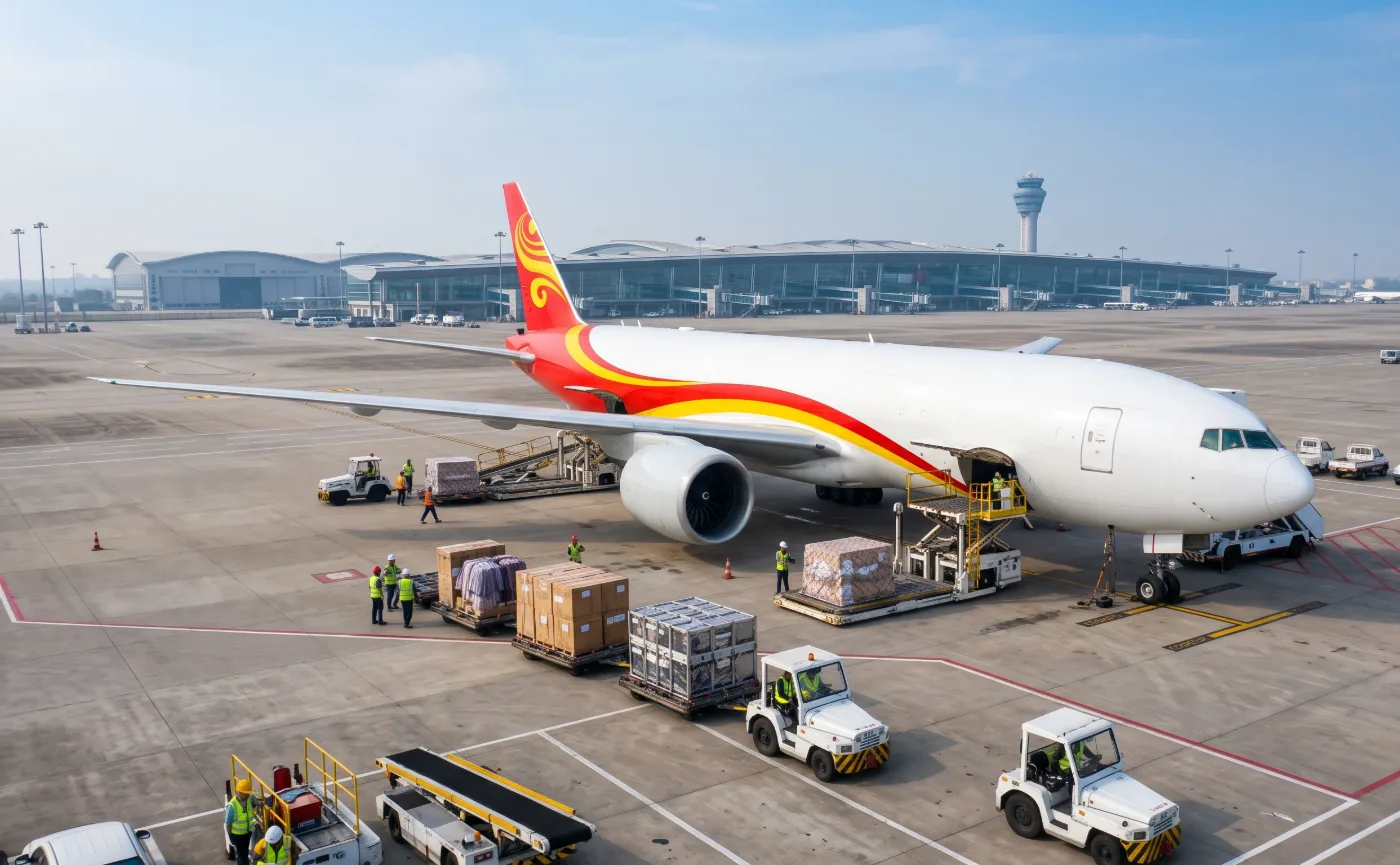
Jiaxing Nanhu Airport has opened its first intercontinental freight route connecting Amsterdam, Jiaxing, and Delhi, establishing a direct air logistics corridor between Western Europe and South Asia through the Yangtze River Delta . The inaugural flight, operated by Suparna Airlines, arrived at Jiaxing from Amsterdam Schiphol Airport on the morning of 6 November 2026, completed cargo transfer operations at the airport, and departed for Delhi carrying nearly 100 tonnes of general cargo including apparel and electronic components . The route marks the first time Jiaxing Nanhu Airport has connected directly to both the Netherlands and India .
The service is structured as a circular freight channel rather than a simple point-to-point route. Amsterdam serves as a core European air logistics gateway, while Delhi is a key node for South Asian trade. The "Europe–Jiaxing–South Asia" model allows cargo from Europe to be consolidated and transferred at Jiaxing before continuing to India, and vice versa, creating a routing option that reduces transit time and cost compared with fragmented multi-leg journeys . The return leg from Delhi is expected to carry Indian goods back through Jiaxing, completing the circular flow.
The cargo mix reflects the industrial profile of the Yangtze River Delta and the markets the route serves. The inaugural outbound flight carried solar cells, apparel, and machine parts, according to Chinese government sources . Suparna Airlines said it would continue to deepen its presence at Jiaxing, leveraging its B777F and B747 freighter fleet to further enrich the airport's international cargo network . The airline's commitment suggests that the route is intended as a regular service rather than a one-off inaugural flight.
The strategic significance for Jiaxing Nanhu Airport is substantial. The airport, which opened at the end of 2025, is the Yangtze River Delta's first specialised air cargo hub, designed around freight operations rather than passenger travel . With the addition of Amsterdam and Delhi, its international cargo routes now number eight, connecting seven countries across Asia, Europe, and North America, including Dhaka, Budapest, Los Angeles, Chicago, Luxembourg, Tokyo, Osaka, Amsterdam, and Delhi . The airport's cargo terminal is located just 100 metres from the apron, allowing cargo to be moved from aircraft to warehouse immediately upon unloading, a design feature intended to minimise turnaround times .
For the Yangtze River Delta's manufacturing and e-commerce exporters, the new route offers an alternative to routing cargo through Shanghai Pudong or Hangzhou Xiaoshan airports, which are primarily passenger-focused and rely heavily on belly-hold capacity . Jiaxing's freight-first design and its position as a dedicated cargo hub allow it to offer shorter transfer distances and more predictable schedules for time-sensitive shipments. The airport's operators have positioned it as a complement to, rather than a competitor of, the larger passenger airports, filling a gap in dedicated freighter capacity for the region's exporters.
Customs facilitation has been adapted to support the new route. Jiaxing Customs established a dedicated intercontinental route team to coordinate with airlines and freight forwarders, and it has implemented 24-hour advance customs clearance and inspection appointment mechanisms to handle nighttime arrivals and dense flight schedules . The customs authority is also using smart inspection technologies, including intelligent image review and robotic patrols, to classify and supervise different categories of goods while compressing clearance times . These measures are intended to ensure that the airport's freight-first design translates into actual speed advantages for shippers.
For India, the route adds a new air cargo connection between the subcontinent and China, with potential implications for trade flows in both directions. Indian exporters of goods that require air freight—pharmaceuticals, high-value electronics, and perishables—could benefit from additional capacity on the China–India lane, though the route's primary design is for Europe–South Asia transit rather than direct India–China trade. Indian importers of Chinese electronics and machinery parts may see improved transit options as the route matures and frequencies increase. The airport has indicated that it plans to expand its international cargo network further, with a target of ten routes by the end of 2026 .
Looking ahead, the key milestones are the route's transition to regular scheduled service, the development of return cargo flows from Delhi to Jiaxing, and the airport's broader expansion of its international freighter network. For Jiaxing, the Amsterdam–Delhi route is a step toward its ambition of becoming a global air cargo node rather than a regional feeder. For the Yangtze River Delta's exporters, it provides an additional option for reaching European and South Asian markets at a time when maritime logistics faces disruption from the Hormuz and Red Sea crises. The route's success will depend on whether shippers adopt the Jiaxing routing in sufficient volumes to sustain regular freighter operations, and whether the airport can continue to attract airline partners as it builds out its network.