
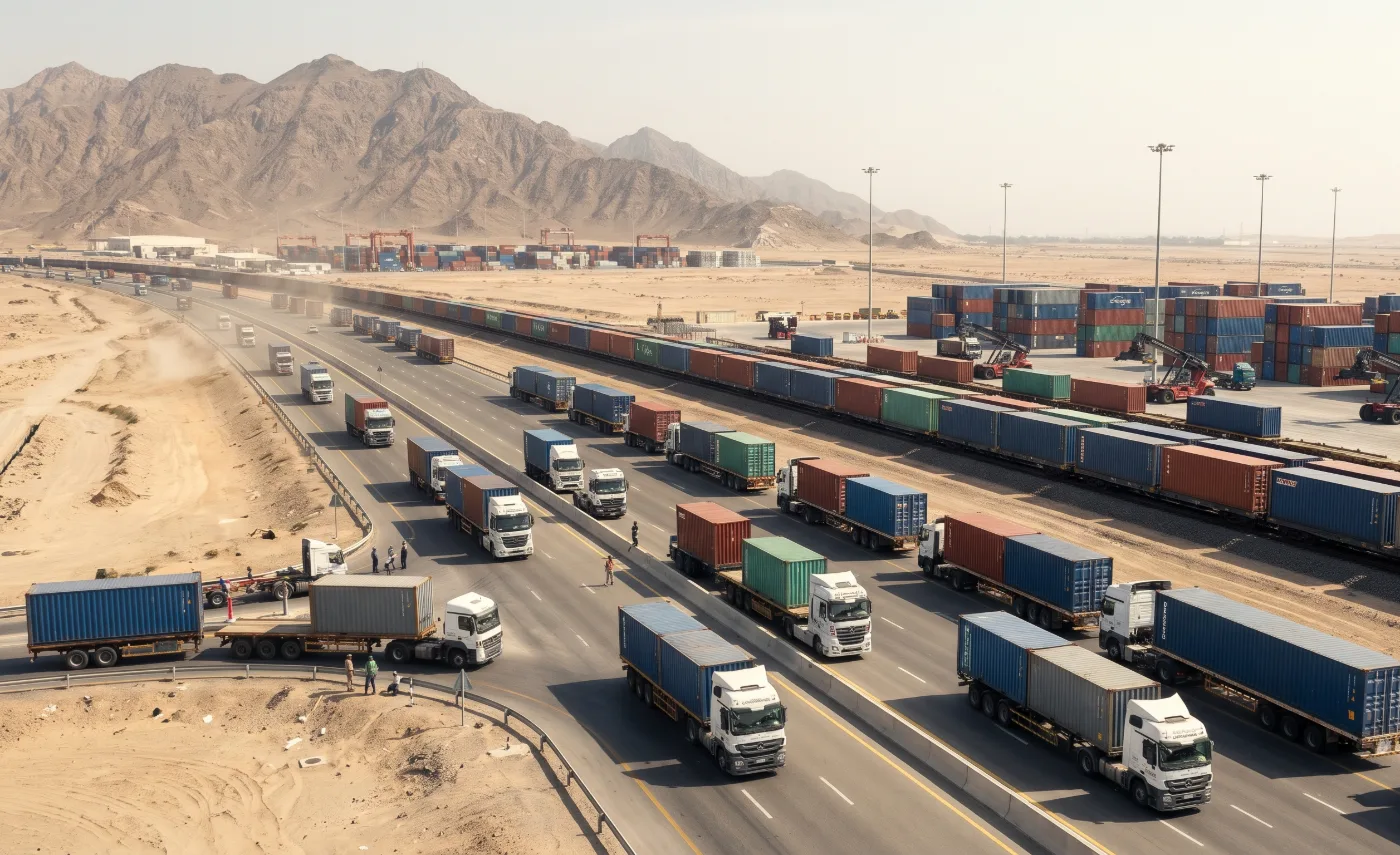
DP World has moved more than 1 million TEU through alternative land corridors since the first week of March 2026, establishing a bonded logistics network connecting the UAE's east coast ports with Jebel Ali to maintain trade flows during the closure of the Strait of Hormuz . The scale of the operation, disclosed by Ahmad Yousef Al-Hassan, CEO of DP World GCC, at a media roundtable in Dubai, represents one of the most significant logistics adaptations undertaken by any operator during the current maritime crisis.
The trucking component of the operation was built from a standing start. "We had to activate this starting from a truck fleet of zero to today, 3,000 trucks that we manage and operate," Al-Hassan said . Since March, the company has moved over 1 million TEU between the east coast and the UAE, using both road and rail . In August, DP World had reported 500,000 TEU moved through GCC corridors, meaning the operation doubled in scale over the following three months . The land bridge required close cooperation with other port operators, government authorities, and customs agencies, with DP World supplying equipment and personnel to east coast ports it does not operate .
Shihab Al Jasmi, CEO of Commercial Affairs for Ports and Terminals at DP World GCC, provided further operational detail, stating that the land corridor network now moves approximately 3,500 containers per day, supported by a fleet that includes 700 company-owned trucks within the broader 3,000-vehicle operation . The company also developed corridors through Oman's Sohar and Duqm ports, giving customers additional routes into the UAE and wider Gulf markets . The opening of the Jebel Ali rail terminal and the 100,000-square-metre Al Aweer empty container yard further enhanced the system's capacity and reduced operational pressure on the port .
The cost of replacing sea miles with road miles has been substantial. Container freight rates from China to Dubai rose from around $2,000 per box before the disruption to $10,000–$12,000 during the closure, while longer trucking distances, congestion, and higher diesel prices added further costs . DP World absorbed some transportation expenses and worked with shipping lines on solutions to reduce costs, including the transportation of empty containers from alternative ports .
Jebel Ali's operational resilience contrasts with its volume collapse. The port remained open throughout the conflict, closing for just six hours since the war began . However, blocked maritime access hit throughput severely: DP World's Q2 2026 results showed Jebel Ali volumes down 90.1% year-on-year, handling 374,000 TEU compared with 3.8 million in the same quarter of 2025 . For the first half of 2026, throughput totalled 3.1 million TEU, down 59.5% year-on-year . The port has annual capacity exceeding 20 million TEU and is connected to more than 80 weekly services reaching 150 ports worldwide .
The recovery outlook is a central part of DP World's assessment. Al-Hassan said Jebel Ali could recover within one to three months after Hormuz reopens, based on feedback from shipping lines . Meetings with nine carriers in Asia the previous week reinforced confidence. "All of them, without a doubt, told us Jebel Ali will and will always be a port of call," he said . The Jebel Ali Free Zone, home to more than 12,000 companies, maintained occupancy above 90% across asset classes during the disruption, supported by demand from major UAE infrastructure and construction projects .
The crisis has accelerated DP World's investment in gateways outside the strait. The company announced a $2–3 billion investment in two new terminals in Fujairah, including a container and multipurpose facility with capacity of up to 2.5 million TEU annually, under a 50-year concession . Al-Hassan framed the Fujairah development as part of a longer-term strategy to provide permanent alternative capacity, while acknowledging that Jebel Ali would remain central to regional trade once shipping lines were satisfied with security conditions and insurance costs declined .
The experience has also reshaped DP World's view of regional connectivity. "Everyone's come to the realisation that we need to accelerate and fast-track rail connectivity," Al-Hassan said. "Even if the Strait opens up tomorrow, our contingency planning has to be all ready" . This perspective reflects a broader recognition that the Hormuz closure has permanently altered the assumptions underpinning Gulf logistics, and that the infrastructure built to bypass the strait during the crisis may become a durable component of the region's trade architecture rather than a temporary workaround.