
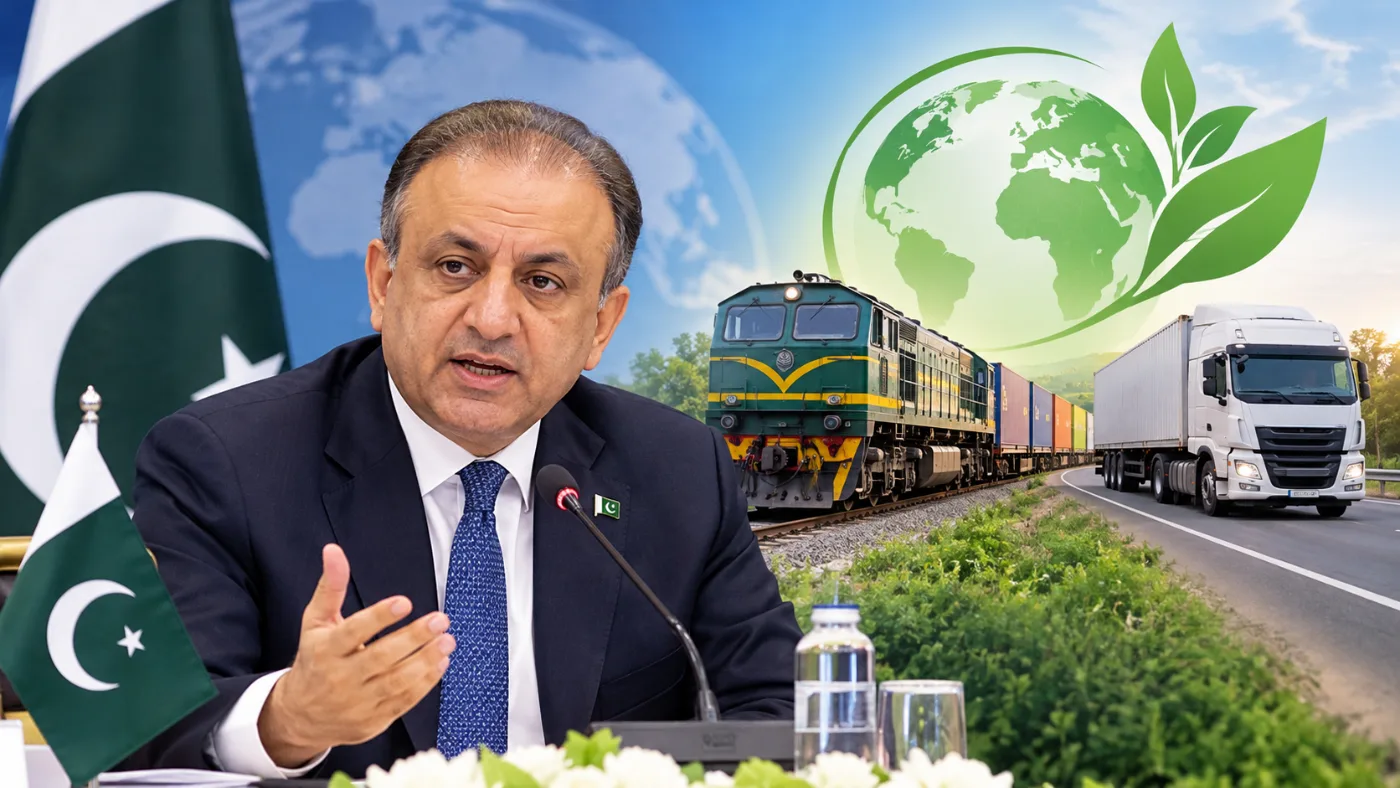
Pakistan has formally endorsed the Global Green Freight Corridors Initiative at a high-level ministerial roundtable held during COP31 in Antalya, Türkiye, on 10 November 2026, committing to decarbonise its logistics sector and build climate-resilient infrastructure . Federal Minister for Communications Abdul Aleem Khan delivered the keynote address at the roundtable, which was co-hosted by Türkiye's Minister for Transport and Infrastructure Abdulkadir Uraloglu, the United Nations Economic Commission for Europe (UNECE), and the Economic and Social Commission for Asia and the Pacific (ESCAP) .
The initiative, launched by Türkiye, is designed to create a coordination platform for sustainable international freight transport, focusing on green infrastructure, clean energy, digital and multimodal connectivity, and climate finance . By endorsing it across its four core pillars—clean technology, digital connectivity, smart route planning, and climate finance—Pakistan has aligned itself with a global framework that its minister said represents "the only viable path forward" for sustainable logistics .
The centrepiece of Pakistan's commitment is a domestic transition away from road-heavy freight. Khan acknowledged that 96% of Pakistan's domestic freight moves by road, placing strain on national resources and urban air quality . The Railway Plan 2026 aims to raise rail's share to 20% through the modernisation of the Main Line-1 (ML-1) project, while the National Electric Vehicle Policy 2025-30 envisages 3,000 EV charging stations along major corridors . These measures are complemented by maritime reforms across Pakistan's seaports.
The digital dimension of the roadmap is already showing measurable results. Khan revealed a 200% surge in TIR transit volumes under the UN TIR Convention, positioning Pakistan as one of the fastest-rising countries in regional trade facilitation . The integration of digital pre-shipment notices with the Pakistan Single Window system and the advancement of the eTIR project with UNECE are intended to create paperless, low-emission international logistics corridors .
Pakistan's geographic positioning as a trade bridge between China, Central Asia, and the Middle East was presented as a strategic asset for green corridor development. Khan highlighted the country's network of over 500,000 kilometres of roads, a 7,800-kilometre railway system, major deep-sea ports, and developing trade arteries under the China-Pakistan Economic Corridor (CPEC) . The minister extended Pakistan's full support to international partners for pilot green corridors, signalling a willingness to participate in cross-border projects rather than confine its efforts to domestic reforms .
The financing framework for these green upgrades combines Public Sector Development Programme allocations, multilateral support from the Asian Development Bank and Asian Infrastructure Investment Bank, and private investment through the Public-Private Partnership Authority Act . Major projects including the M-6 Motorway and ML-1 railway upgrades are expected to be powered by this diversified financing structure. The emphasis on multilateral and private financing reflects the scale of investment required and the recognition that public budgets alone cannot fund the transition.
For the regional logistics sector, Pakistan's endorsement adds a significant South Asian voice to a Türkiye-led initiative that has already attracted participation from countries including Georgia . The Global Green Freight Corridors Initiative's focus on multimodal connectivity and digital facilitation aligns with broader trends in Eurasian trade, where overland corridors are gaining strategic importance as maritime chokepoints face disruption. Pakistan's participation could, over time, contribute to the development of green logistics links between South Asia, Central Asia, and Europe, though the domestic transition from road to rail remains the immediate test of its commitment.
Looking ahead, the key milestones are the implementation of the Railway Plan 2026 and the ML-1 upgrades, the rollout of EV charging infrastructure along major corridors, and the translation of the COP31 endorsement into concrete participation in pilot green corridor projects. For Pakistan, the initiative offers a framework for attracting climate finance and technical support for its logistics modernisation. For the broader region, it signals that the green freight agenda is extending beyond Europe and East Asia into South Asia, with potential implications for how cargo moves across the corridors that connect the subcontinent to its neighbours.