
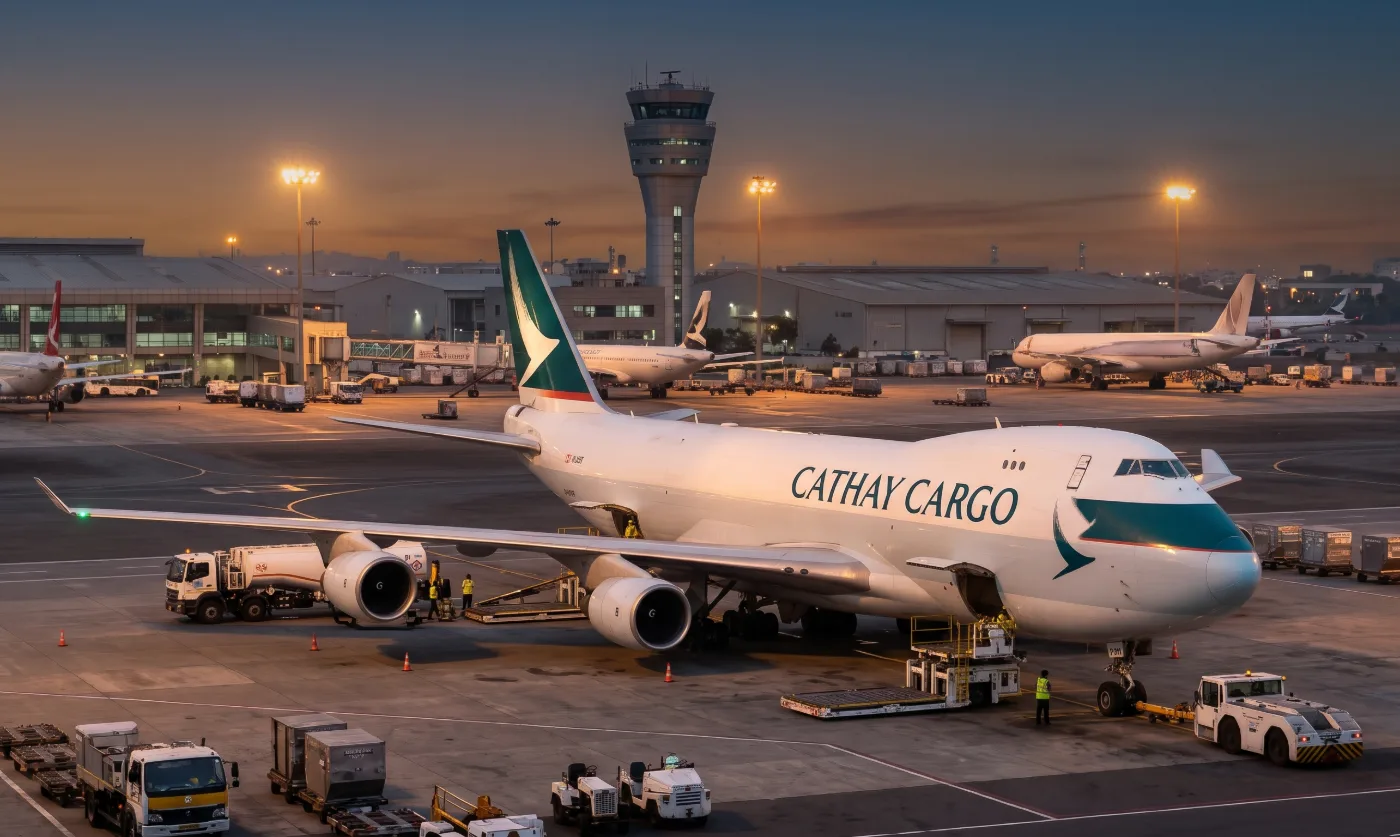
Cathay Cargo is relocating its Europe-bound freighter technical stops to India for the winter season, using Navi Mumbai International Airport and Bengaluru as the refuelling points that allow its aircraft to maintain full payload capacity on the long-haul route to Europe . The change, outlined by Director Cargo Dominic Perret during an interview at the TIACA Air Cargo Forum in Miami, reflects the cascading operational consequences of the Middle East conflict on Asia-Europe air freight routing .
The technical stop is not a commercial call; it is an operational necessity. When a freighter flies from Hong Kong to Europe without an intermediate refuelling point, it must carry additional fuel, which displaces cargo payload. Perret estimated that operating the Europe services direct would result in a payload reduction of approximately 20% . A technical stop allows the aircraft to refuel and restore full cargo capacity for the onward leg, making the stop economically essential even though no cargo is loaded or discharged at the stopover airport.
The routing has shifted twice since the conflict began. Cathay suspended flights to Dubai and Riyadh at the end of February, removing Dubai from its network. Dubai had previously served as the midpoint for five weekly Europe freighter services . During the summer, the affected aircraft used Astana in Kazakhstan for technical stops. But with winter weather conditions expected to deteriorate there, the airline decided to relocate the stops to India instead . Perret credited Cathay's India operations team with establishing both the Navi Mumbai and Bengaluru routings .
Navi Mumbai is not new to Cathay's freighter network. In September 2026, the carrier shifted its Mumbai freighter operations from Chhatrapati Shivaji Maharaj International Airport to Navi Mumbai, operating three weekly Boeing 747 freighter flights with main-deck and nose-door loading capabilities . The new technical stops are separate from those commercial freighter calls, but they build on the operational relationships and ground-handling arrangements that Cathay has already established at the airport.
Bengaluru adds a second Indian technical stop option. The city is already one of Cathay's five Indian passenger gateways, and the airline operates belly-hold cargo capacity on its passenger services from there . Using Bengaluru for technical stops leverages existing ground infrastructure and positions the airport as a refuelling node for long-haul freighter traffic, even if no commercial cargo is loaded or discharged.
The regional capacity picture is also expanding. Cathay is preparing to introduce an Airbus A330P2F converted freighter, on long-term lease from Air Transport Services Group, which is already in Hong Kong and expected to enter service by mid-November . The aircraft will primarily support regional feeder operations connecting mainland China, Southeast Asia, and India, adding capacity on the shorter-haul segments that feed Cathay's long-haul freighter network. The lease arrangement was originally announced in June, when Air Hong Kong signed the deal with ATSG .
For Indian exporters and importers, the technical stops are operationally significant even though they do not add direct cargo capacity on the India-Europe lane. The stops strengthen the ties between Indian airports and Cathay's global freighter network, and they demonstrate that Navi Mumbai and Bengaluru can handle the technical requirements of long-haul freighter operations. If the routings prove successful, they could support future commercial freighter expansion at these airports. More immediately, the A330P2F deployment adds feeder capacity that connects Indian cargo to Cathay's Hong Kong hub and onward to long-haul destinations.
The broader context is a Middle East conflict that has disrupted air freight routing across Asia. Cathay is not alone in adjusting its network; multiple Asian carriers have been forced to reconfigure routes to avoid restricted airspace and unavailable stops . The shift to Indian technical stops is a practical adaptation to a constrained operating environment, and it reflects India's growing role as an aviation node that can support long-haul freighter operations even when traditional Gulf stops are unavailable.
Looking ahead, the key question is whether the India technical stops remain a winter-season adjustment or become a permanent feature of Cathay's Europe freighter routing. The carrier's decision will depend on the security situation in the Middle East, the weather conditions in Central Asia, and the operational performance of the Indian airports. For now, the shift signals that India's aviation infrastructure is being used not just for commercial cargo movements but for the technical support that keeps global air freight networks functioning during disruption.