
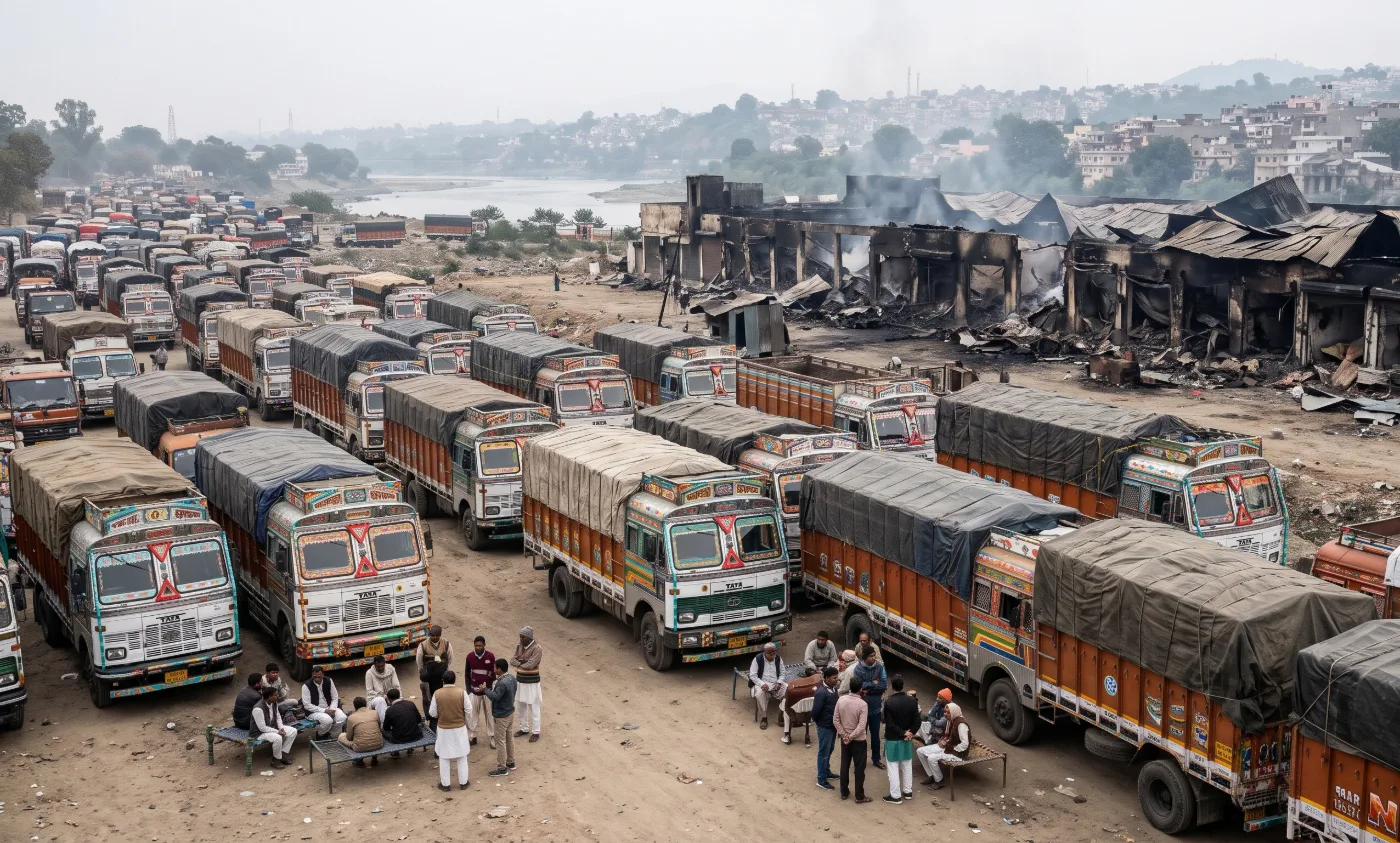
A devastating fire at the Nehru Market warehouse in Jammu has brought the region's largest wholesale grain market to a standstill, disrupting food supply chains to Kashmir, Ladakh, and several hill districts for more than 48 hours . The blaze, which broke out on Diwali night, destroyed eight shops completely and caused an estimated ₹50 crore in losses, according to the Ware House Traders Federation . Traders have kept the market closed until 11 November as a protest, demanding accountability and compensation.
The warehouse is the primary distribution hub for essential commodities across the region. Every day, approximately 250 trucks are loaded and unloaded at the facility, handling goods worth around ₹100 crore in trade . Food supplies arriving from markets across the country are unloaded here and then dispatched to Kashmir division, Pir Panjal, Chenab Valley, and districts including Doda, Kishtwar, Rajouri, Poonch, Reasi, and Udhampur . With the warehouse shut, trucks carrying food materials from other states are stranded along the Tawi River front, unable to unload their cargo, and there are growing concerns that perishable goods may spoil.
The human and economic impact extends well beyond the traders whose shops were destroyed. Thousands of workers who depend on daily wages for loading, unloading, packing, and transport have been without work for two days . Small traders from distant areas like Akhnoor and Digyana who rely on the warehouse for wholesale supplies have been unable to restock, with some reporting that their shops have run out of goods . The closure affects not only the immediate market but the entire downstream retail network that depends on the warehouse's wholesale function.
Traders have alleged that the Fire and Emergency Services department responded late, contributing to the scale of the destruction. Deepak Gupta, president of the Ware House Traders Federation, said the fire was reported around 8:30 PM, but fire tenders took more than an hour to arrive . "The fire started around 8 pm last night and around 8:45 pm I reached the warehouse. While coming to the market, I called the fire and emergency service to send the fire tenders but they took more than an hour to send the vehicles," he said . The Fire and Emergency Services department has refuted the allegations, stating that over 60 fire incidents were reported across Jammu in 24 hours during Diwali, and that fire tenders were dispatched within 20 minutes of the report .
The fire has also raised broader questions about fire safety in Jammu's commercial areas. It was the second major blaze in the city within a fortnight, following a fire at Shiv Market on 25 October that destroyed around 25–30 shops . Traders have pointed out that the Nehru Market warehouse, despite being the city's largest wholesale market, still lacks fire extinguishers and had no fire tender stationed on-site despite the Diwali festival . The twin incidents have prompted demands for a comprehensive review of firefighting preparedness in the winter capital.
The administrative response has included assurances of compensation and investigation. Jammu Divisional Commissioner Vikas Kundal and Deputy Commissioner Minga Sherpa visited the site, and the Jammu Development Authority has committed to repairing the damaged shops . The Additional Deputy Commissioner (Law and Order), Ansuya Jamwal, remained at the warehouse through the night to oversee the response . Traders have submitted a memorandum with four demands: an inquiry into the fire department's response, financial assistance for affected shopkeepers, land for new warehouses outside the city, and pre-festival fire safety arrangements . A decision on whether to continue the shutdown beyond 11 November will be taken at a federation meeting.
For the region's supply chain, the immediate priority is restoring the flow of essential goods before winter, when demand for food supplies typically increases. The warehouse's closure has created a bottleneck that affects not only Jammu but the entire Kashmir Valley and Ladakh, which depend on this single hub for a significant share of their food grain and essential commodity supplies. The loss of business records and computer data in the fire has added a further layer of complexity for traders trying to reconstruct their accounts and manage outstanding debts.
Looking ahead, the resolution of the standoff between traders and the administration will determine how quickly supply chains return to normal. The government's commitments on compensation, investigation, and land allocation will need to be translated into concrete action to restore trader confidence. For the broader region, the incident highlights the vulnerability of supply chains that depend on a single, densely packed wholesale hub with inadequate fire safety infrastructure—a vulnerability that becomes more acute as winter approaches and the demand for essential goods rises.