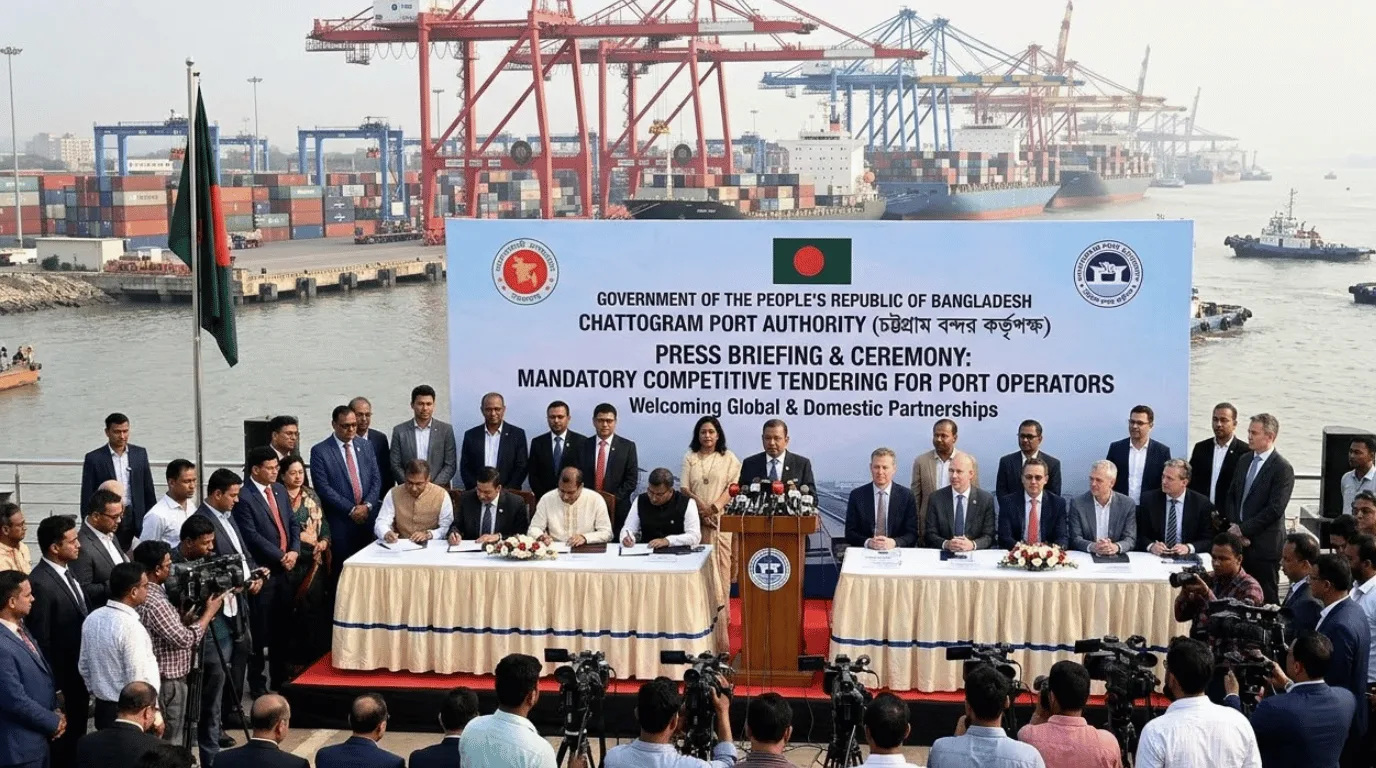
<p class="ds-markdown-paragraph" style="margin: 16px 0px; color: rgb(15, 17, 21); font-family: quote-cjk-patch, Inter, system-ui, -apple-system, BlinkMacSystemFont, "Segoe UI", Roboto, Oxygen, Ubuntu, Cantarell, "Open Sans", "Helvetica Neue", sans-serif; font-size: 16px;"><span class="">Bangladesh has moved to formalise and liberalise the operating framework at Chattogram Port, its premier seaport, by making competitive tendering mandatory for berth, terminal, and ship-handling operators while opening the sector to international terminal operators . The Chittagong Port Authority (Appointment of Berth, Terminal and Ship Handling Operators) Rules, 2026, gazetted on 5 November, define eligibility criteria, appointment procedures, operational responsibilities, and accountability for entities operating within the port .</span></p><p class="ds-markdown-paragraph" style="margin: 16px 0px; color: rgb(15, 17, 21); font-family: quote-cjk-patch, Inter, system-ui, -apple-system, BlinkMacSystemFont, "Segoe UI", Roboto, Oxygen, Ubuntu, Cantarell, "Open Sans", "Helvetica Neue", sans-serif; font-size: 16px;"><span class="">The rules represent a significant shift in how operators are appointed at Chattogram, which handles the bulk of Bangladesh's international trade. Under the new framework, operators must be appointed through competitive tendering, with bidders' qualifications and operational capabilities assessed before selection . The procurement process must follow government procurement regulations and may be conducted through the electronic government procurement (e-GP) system, though offline tendering will also be allowed with prior approval from the Bangladesh Public Procurement Authority . The rules prohibit any individual or company from operating inside the port without an appointment from the port authority .</span></p><p class="ds-markdown-paragraph" style="margin: 16px 0px; color: rgb(15, 17, 21); font-family: quote-cjk-patch, Inter, system-ui, -apple-system, BlinkMacSystemFont, "Segoe UI", Roboto, Oxygen, Ubuntu, Cantarell, "Open Sans", "Helvetica Neue", sans-serif; font-size: 16px;"><span class="">A key feature of the new rules is the opening of the sector to foreign operators. International terminal operators may be appointed subject to government approval and compliance with applicable laws . This provision formalises a trend that has already been visible at Chattogram, where DP World signed a 15-year concession in October 2026 for the New Mooring Container Terminal, and Saudi-based RSGT Bangladesh operates the Patenga Container Terminal under a 22-year concession that began in June 2024 . The new rules provide a framework for further international participation in terminal operations.</span></p><p class="ds-markdown-paragraph" style="margin: 16px 0px; color: rgb(15, 17, 21); font-family: quote-cjk-patch, Inter, system-ui, -apple-system, BlinkMacSystemFont, "Segoe UI", Roboto, Oxygen, Ubuntu, Cantarell, "Open Sans", "Helvetica Neue", sans-serif; font-size: 16px;"><span class="">The rules also impose a five-year cap on operator appointments, with any extension beyond that period requiring prior government approval . This is intended to ensure periodic review of operator performance and to prevent entrenchment of incumbents, though it also introduces a degree of uncertainty for operators investing in equipment and workforce development. The port authority is further empowered to suspend or cancel operators' enlistment and licences if they are found to be involved in activities contrary to the interests or security of the government or the port authority .</span></p><p class="ds-markdown-paragraph" style="margin: 16px 0px; color: rgb(15, 17, 21); font-family: quote-cjk-patch, Inter, system-ui, -apple-system, BlinkMacSystemFont, "Segoe UI", Roboto, Oxygen, Ubuntu, Cantarell, "Open Sans", "Helvetica Neue", sans-serif; font-size: 16px;"><span class="">Industry reaction has been cautious. Fazle Ekram Chowdhury, president of the Bangladesh Berth Operators Association, questioned whether the rules give sufficient weight to operators' experience and efficiency, warning that "an operator lacking efficiency and experience could affect specialised operations at the port, with consequences for the country's economy and port efficiency" . The concern is that a purely tendering-based system, without adequate prequalification for technical capability, could allow inexperienced firms to win contracts and disrupt operations at a port that is central to Bangladesh's economy.</span></p><p class="ds-markdown-paragraph" style="margin: 16px 0px; color: rgb(15, 17, 21); font-family: quote-cjk-patch, Inter, system-ui, -apple-system, BlinkMacSystemFont, "Segoe UI", Roboto, Oxygen, Ubuntu, Cantarell, "Open Sans", "Helvetica Neue", sans-serif; font-size: 16px;"><span class="">The timing of the rules is linked to the broader reform of Chattogram's terminal operations. The Chittagong Port Authority Act, 2022, had stipulated that berth operators, terminal operators, and ship handling operators would operate under specific rules, and the new regulations implement that provision . The rules also come as the port authority manages the transition at the Chittagong Container Terminal, where Saif Powertec's contract expired on 2 November and was extended by three weeks to allow time for a new operator to be appointed . The new tendering framework provides the mechanism for that appointment and for future operator selections.</span></p><p class="ds-markdown-paragraph" style="margin: 16px 0px; color: rgb(15, 17, 21); font-family: quote-cjk-patch, Inter, system-ui, -apple-system, BlinkMacSystemFont, "Segoe UI", Roboto, Oxygen, Ubuntu, Cantarell, "Open Sans", "Helvetica Neue", sans-serif; font-size: 16px;"><span class="">For the logistics sector, the new rules add a layer of regulatory certainty to Chattogram's operating environment, but they also introduce transition risks as incumbent operators face competitive tendering and potential replacement. For international terminal operators, the rules provide a clear pathway to entry, subject to government approval. For cargo owners and shipping lines, the immediate concern is continuity of operations during the transition, particularly at CCT, where the interim arrangement with Saif Powertec provides only a short window before a new operator must be in place.</span></p><p class="ds-markdown-paragraph" style="margin: 16px 0px; color: rgb(15, 17, 21); font-family: quote-cjk-patch, Inter, system-ui, -apple-system, BlinkMacSystemFont, "Segoe UI", Roboto, Oxygen, Ubuntu, Cantarell, "Open Sans", "Helvetica Neue", sans-serif; font-size: 16px;"><span class="">Looking ahead, the key milestone will be the first competitive tender under the new rules, likely for the CCT operation, and the subsequent appointment of a new operator. The success of the framework will depend on whether the tendering process attracts qualified bidders and whether the transition at CCT proceeds without disrupting cargo handling. For Bangladesh's port sector, the rules represent an attempt to balance liberalisation with regulatory oversight, and their implementation will indicate whether competitive tendering can deliver efficiency gains without compromising operational stability at the country's most important gateway.</span></p>
Bangladesh Makes Competitive Tendering Mandatory for Chattogram Port Operators, Opens Sector to Foreign Firms
The Bangladeshi government has issued the Chittagong Port Authority (Appointment of Berth, Terminal and Ship Handling Operators) Rules, 2026, gazetted on 5 November 2026, making competitive tendering mandatory for appointing berth, terminal, and ship handling operators at Chattogram Port. The rules allow international terminal operators to enter the sector subject to government approval, cap operator appointments at five years unless extended by the government, and empower the port authority to suspend or cancel licences for activities contrary to national or port security interests. Industry representatives have warned that inexperienced operators could undermine port efficiency.