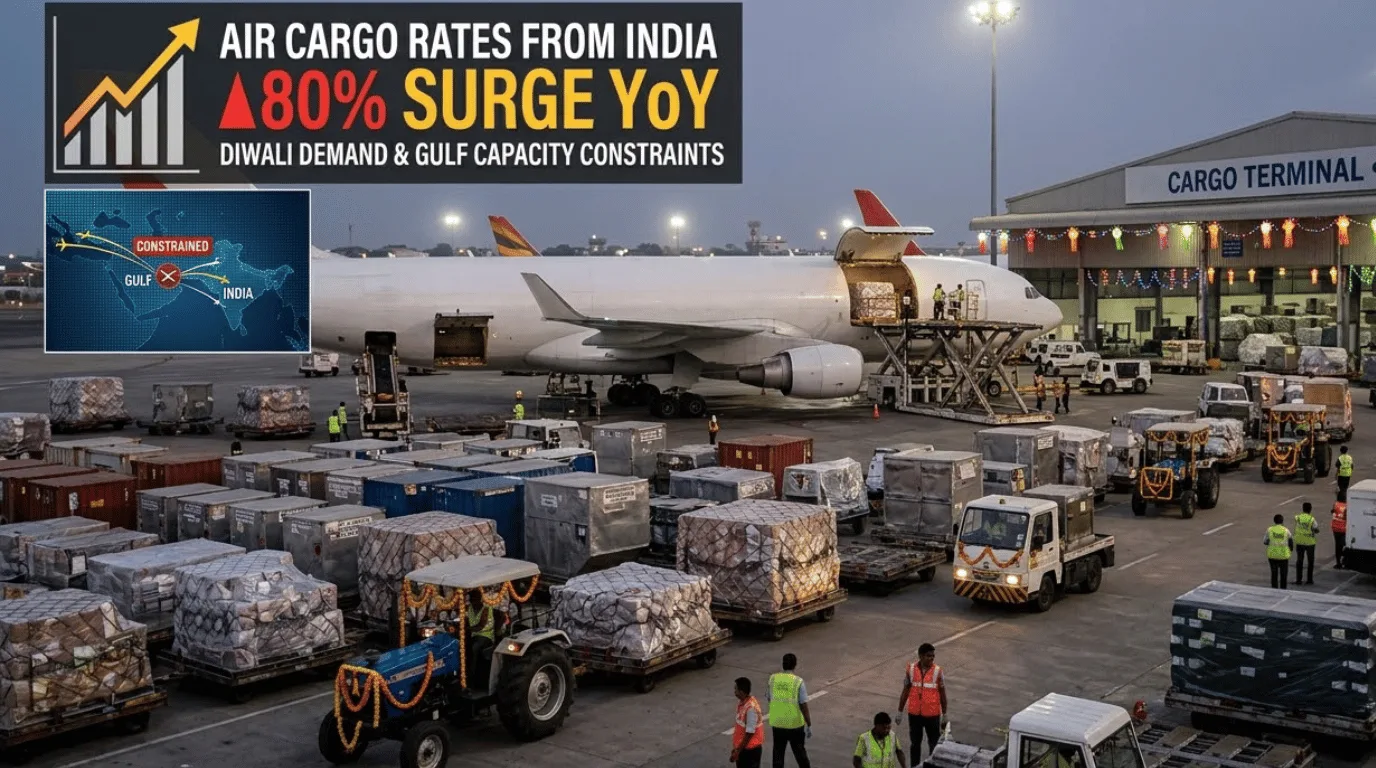
<p class="ds-markdown-paragraph" style="margin: 16px 0px; color: rgb(15, 17, 21); font-family: quote-cjk-patch, Inter, system-ui, -apple-system, BlinkMacSystemFont, "Segoe UI", Roboto, Oxygen, Ubuntu, Cantarell, "Open Sans", "Helvetica Neue", sans-serif; font-size: 16px;"><span class="">Air cargo spot rates from India have surged approximately 80% year-on-year, according to TAC Index data for the week ending 2 November 2026, positioning India as the most dynamic origin market in an otherwise mixed global air freight landscape . The data, reported by AMZ123 on 8 November, shows that while the global air cargo index declined 1.1% week-on-week, India-origin rates moved in the opposite direction, with outbound rates to both Europe and the United States climbing sharply .</span></p><p class="ds-markdown-paragraph" style="margin: 16px 0px; color: rgb(15, 17, 21); font-family: quote-cjk-patch, Inter, system-ui, -apple-system, BlinkMacSystemFont, "Segoe UI", Roboto, Oxygen, Ubuntu, Cantarell, "Open Sans", "Helvetica Neue", sans-serif; font-size: 16px;"><span class="">The timing of the surge is closely tied to India's festive calendar. Diwali this year falls around 6–11 November, compared with 18–23 October in 2025, pushing the peak export season later into the year and concentrating demand into a narrower window . WorldACD data confirms that the later Diwali timing boosted Indian air exports in October, contributing to a 10% year-on-year volume increase from the Middle East and South Asia (MESA) region despite ongoing challenges in the Arabian Gulf . The combination of a compressed festive window and strong underlying demand has created a rate environment in which India-origin cargo is commanding significant premiums.</span></p><p class="ds-markdown-paragraph" style="margin: 16px 0px; color: rgb(15, 17, 21); font-family: quote-cjk-patch, Inter, system-ui, -apple-system, BlinkMacSystemFont, "Segoe UI", Roboto, Oxygen, Ubuntu, Cantarell, "Open Sans", "Helvetica Neue", sans-serif; font-size: 16px;"><span class="">The capacity side of the equation is equally important. Capacity to and from the Arabian Gulf remained down approximately 18–19% compared with pre-conflict levels as of late October, with Riyadh almost completely closed to international flights in week 43 . While capacity to and from South Asia was less affected, down only about 3%, the overall reduction in MESA capacity has tightened the effective supply of air freight options for Indian exporters . The US-Iran conflict has disrupted flight paths, forced carriers to suspend or limit service to several Gulf destinations, and reduced belly-hold capacity on routes that connect India to Europe and North America via Gulf hubs.</span></p><p class="ds-markdown-paragraph" style="margin: 16px 0px; color: rgb(15, 17, 21); font-family: quote-cjk-patch, Inter, system-ui, -apple-system, BlinkMacSystemFont, "Segoe UI", Roboto, Oxygen, Ubuntu, Cantarell, "Open Sans", "Helvetica Neue", sans-serif; font-size: 16px;"><span class="">The rate increase is not merely a festive-season phenomenon. Xeneta data shows that air's share of EU import tonnage from Asia rose from 1.1% in 2023 to 1.7% in 2024, at the height of the Red Sea crisis, as ocean freight schedule reliability collapsed from 28% to 9.3% . When reliability recovered to 20% in 2025, air's share fell back to 1.2%. In the first eight months of 2026, it edged up to 1.3%, after the closure of the Strait of Hormuz in February led carriers to shelve their planned return to the Suez Canal . This pattern suggests that the current air cargo demand from India is partly structural, driven by shippers who need reliability rather than speed and who will continue to use air until ocean schedules demonstrate sustained recovery.</span></p><p class="ds-markdown-paragraph" style="margin: 16px 0px; color: rgb(15, 17, 21); font-family: quote-cjk-patch, Inter, system-ui, -apple-system, BlinkMacSystemFont, "Segoe UI", Roboto, Oxygen, Ubuntu, Cantarell, "Open Sans", "Helvetica Neue", sans-serif; font-size: 16px;"><span class="">For Indian exporters, the rate environment presents a difficult trade-off. The 80% year-on-year increase in outbound rates represents a substantial cost increase for time-sensitive shipments, particularly in sectors such as pharmaceuticals, electronics, and perishables where air freight is the only viable mode. At the same time, the alternative—ocean freight via disrupted routes—carries its own costs and uncertainties, including longer transit times, port congestion, and the risk of further disruption. The decision to use air is therefore a calculation about total supply chain cost and reliability, not simply a comparison of freight rates.</span></p><p class="ds-markdown-paragraph" style="margin: 16px 0px; color: rgb(15, 17, 21); font-family: quote-cjk-patch, Inter, system-ui, -apple-system, BlinkMacSystemFont, "Segoe UI", Roboto, Oxygen, Ubuntu, Cantarell, "Open Sans", "Helvetica Neue", sans-serif; font-size: 16px;"><span class="">The global context provides some indication of where rates might go. Xeneta expects air freight rates to decline as shippers begin tender processes for 2027 and as capacity constraints ease if the Middle East situation recovers . "If the Middle East situation recovers, there will be a rebalancing of demand and supply and rates will then become lower," Xeneta's chief airfreight officer said . However, the same analyst cautioned that the current environment is strong but not a classic peak season, and that time is running out for volumes to shift higher before the year ends .</span></p><p class="ds-markdown-paragraph" style="margin: 16px 0px; color: rgb(15, 17, 21); font-family: quote-cjk-patch, Inter, system-ui, -apple-system, BlinkMacSystemFont, "Segoe UI", Roboto, Oxygen, Ubuntu, Cantarell, "Open Sans", "Helvetica Neue", sans-serif; font-size: 16px;"><span class="">Looking ahead, the trajectory of India-origin air cargo rates will depend on three variables: the duration of the Gulf capacity constraints, the pace of ocean freight reliability recovery, and the strength of post-Diwali demand. If the Red Sea recovery continues and carriers restore Suez routings, some of the cargo that shifted to air for reliability reasons could return to ocean, easing pressure on air rates. If the Gulf disruption persists or escalates, air cargo will remain the default option for time-sensitive Indian exports, and rates will stay elevated. For now, India's exporters face a market in which air freight is expensive but necessary, and the 80% premium is the price of keeping goods moving in a disrupted logistics environment.</span></p>
Air Cargo Rates from India Surge 80% Year-on-Year as Diwali Demand and Gulf Capacity Constraints Converge
Air cargo spot rates from India have risen approximately 80% year-on-year, according to TAC Index data for the week ending 2 November 2026, making India the standout market in an otherwise softening global air freight environment. Global air cargo rates dipped 1.1% week-on-week, but the India-origin market bucked the trend, with outbound rates to both Europe and the US climbing. The surge reflects strong Diwali-season export demand, persistent capacity constraints linked to the US-Iran conflict and the near-closure of Riyadh to international flights, and a structural shift of cargo from ocean to air as Red Sea and Hormuz disruptions continue to affect shipping reliability.