
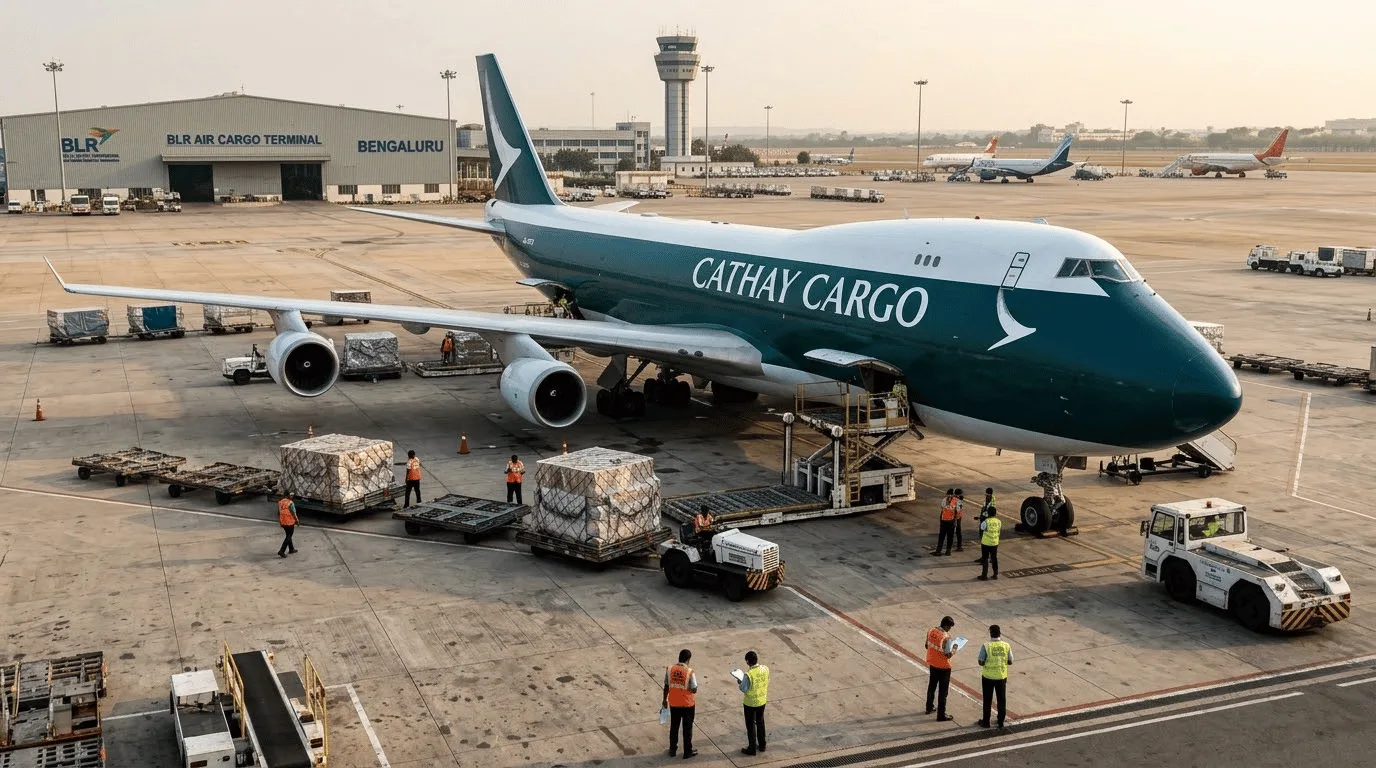
Cathay Cargo is restructuring its Europe freighter routings for the winter season, shifting technical stops from Dubai to India's new Navi Mumbai International Airport and Bengaluru as it adapts to network changes and seasonal weather conditions . The move, reported by STAT Times on 10 November 2026, reflects both the carrier's response to the removal of Dubai from its network and its assessment of India's growing importance as an air cargo market.
The technical stops serve a specific operational purpose. Freighters flying from Hong Kong to Europe require refuelling stops, and the choice of stopover location affects both the routing efficiency and the cargo capacity available on the route. With Dubai no longer part of Cathay's network and winter weather making other traditional stops more difficult, the carrier has turned to Indian airports that offer the necessary infrastructure and geographic position. Perret, the carrier's cargo head, credited Cathay's India operations team with setting up both routings .
The addition of the A330P2F converted freighter provides a separate capacity increment. The aircraft, on long-term lease from Air Transport Services Group, is already in Hong Kong and is expected to start operating by mid-November . It will be deployed on regional feeder routes to mainland China, Southeast Asia, and India, adding capacity on shorter-haul segments that connect to Cathay's long-haul freighter network. The converted freighter format offers a cost-effective way to add capacity without committing to new-build aircraft, and it is well-suited to the regional routes where Cathay sees demand growth.
Cathay's assessment of future opportunities places India alongside Southeast Asia and the Chinese mainland as key markets for 2027. The carrier's cargo leadership sees the biggest opportunities in Malaysia, Thailand, Vietnam, India, and the Chinese mainland, as well as on transpacific lanes to North America . This outlook reflects the broader pattern of air cargo demand growth in Asia, where e-commerce, electronics manufacturing, and pharmaceutical exports are driving volumes even as ocean freight faces disruption.
For India's air cargo sector, Cathay's decision to route Europe freighters through Navi Mumbai and Bengaluru is a validation of the infrastructure investments that have been made at these airports. Navi Mumbai International Airport has been positioning itself as a cargo hub for western India, and Bengaluru's Kempegowda International Airport has been expanding its cargo capabilities. The technical stops will bring additional freighter movements to these airports, even though the cargo carried on the Europe-bound leg is not destined for India itself. The stopovers contribute to airport revenue and demonstrate the operational viability of Indian airports as technical stop locations.
The timing of the rerouting coincides with a period of elevated air cargo rates and capacity constraints. As we covered earlier, global air cargo spot rates have risen sharply as Middle East capacity constraints and peak season demand converge. Cathay's addition of the A330P2F and its use of Indian technical stops adds capacity to the Asia-Europe air cargo corridor at a time when shippers are seeking alternatives to ocean freight for time-sensitive cargo. The technical stops do not add cargo capacity on the India-Europe lane specifically, but they support the overall network efficiency that allows Cathay to maintain its freighter schedules.
For Indian exporters and importers, the development has indirect benefits. The technical stops strengthen the operational links between Indian airports and Cathay's global network, and the A330P2F deployment on regional routes to India adds feeder capacity that can connect Indian cargo to Cathay's long-haul services. Over time, if the technical stops prove operationally successful, they could lead to increased freighter frequency or even cargo pick-up and drop-off at the Indian stops, though the current arrangement is limited to technical stops for refuelling.
Looking ahead, the key question is whether Cathay's India routings become a permanent feature of its winter schedule or a temporary adjustment to the Dubai removal. The carrier's assessment of India as a key market for 2027 suggests that the relationship will deepen, and the technical stops provide a foundation for that growth. For Navi Mumbai and Bengaluru airports, the Cathay routings are an opportunity to demonstrate their capability to handle international freighter traffic and to position themselves for further cargo network development.