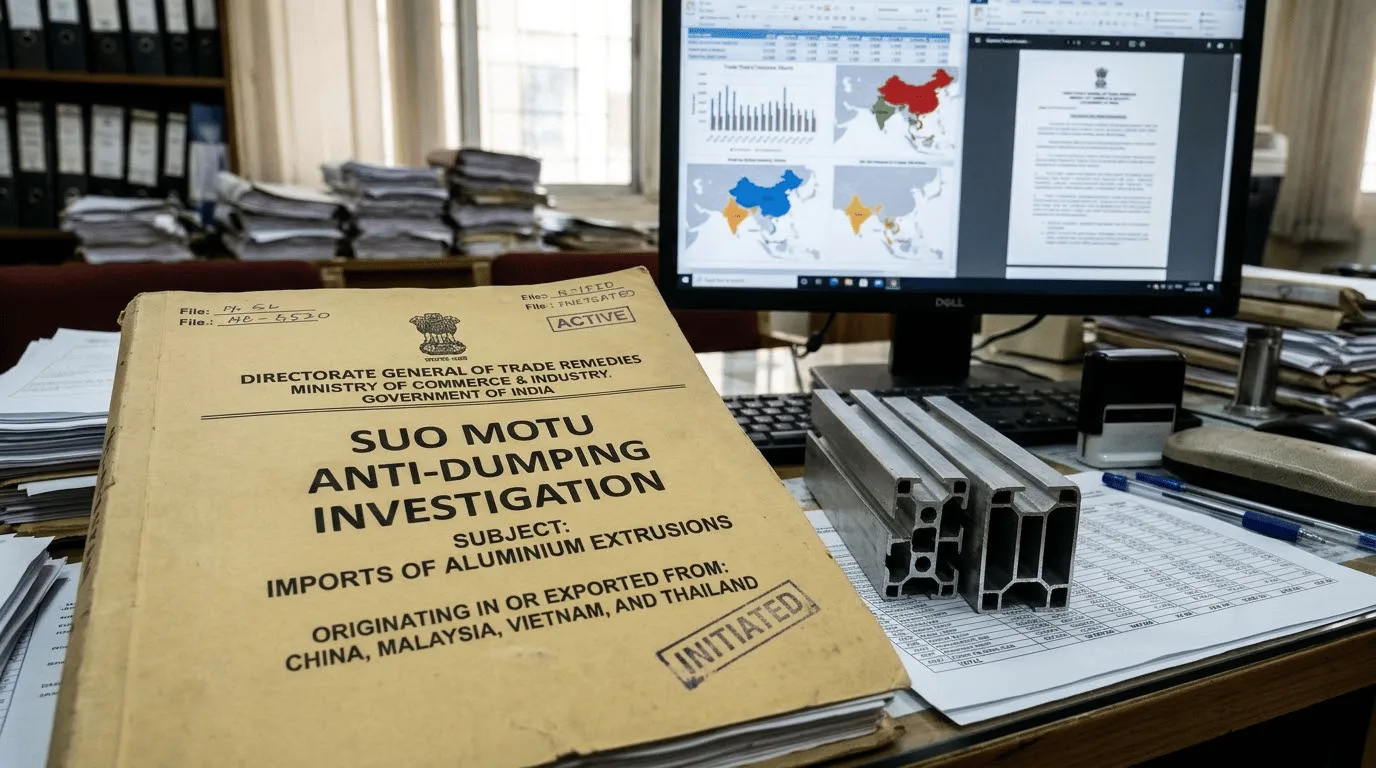
<p class="ds-markdown-paragraph" style="margin: 16px 0px; color: rgb(15, 17, 21); font-family: quote-cjk-patch, Inter, system-ui, -apple-system, BlinkMacSystemFont, "Segoe UI", Roboto, Oxygen, Ubuntu, Cantarell, "Open Sans", "Helvetica Neue", sans-serif; font-size: 16px;"><span class="">The Directorate General of Trade Remedies has launched a suo motu anti-dumping investigation into aluminium extrusion products from China, Malaysia, Vietnam and Thailand, marking a significant trade remedy action aimed at protecting India's fragmented aluminium extrusion industry from cheap imports . The notification, dated 9 November 2026, was issued after the Aluminium Extrusion Manufacturers Association of India, which represents 228 manufacturers of aluminium extrusion profiles, structures and articles, submitted representations alleging that the domestic industry was suffering injury due to a significant increase in dumped imports .</span></p><p class="ds-markdown-paragraph" style="margin: 16px 0px; color: rgb(15, 17, 21); font-family: quote-cjk-patch, Inter, system-ui, -apple-system, BlinkMacSystemFont, "Segoe UI", Roboto, Oxygen, Ubuntu, Cantarell, "Open Sans", "Helvetica Neue", sans-serif; font-size: 16px;"><span class="">The product under consideration has broad industrial applications. Aluminium extrusions are used in windows, doors, curtain walls, partitions, railings, lighting profiles, industrial framing, solar mounting structures, ladders, furniture, kitchen and wardrobe profiles, and bicycle parts . This breadth of use means that the investigation touches multiple downstream sectors, from construction and renewable energy to consumer goods and transportation, and any duty recommendation could have ripple effects across supply chains that depend on these inputs.</span></p><p class="ds-markdown-paragraph" style="margin: 16px 0px; color: rgb(15, 17, 21); font-family: quote-cjk-patch, Inter, system-ui, -apple-system, BlinkMacSystemFont, "Segoe UI", Roboto, Oxygen, Ubuntu, Cantarell, "Open Sans", "Helvetica Neue", sans-serif; font-size: 16px;"><span class="">The suo motu nature of the investigation is notable. Typically, anti-dumping probes are initiated based on applications filed by domestic producers, but the DGTR has the authority to initiate investigations on its own initiative when fragmented industries lack the know-how or capacity to file trade remedy petitions . The aluminium extrusion sector, with 228 manufacturers represented by ALEMAI, fits this profile: numerous small and medium-sized producers who compete with imports but may not have the resources to navigate the complex anti-dumping process individually.</span></p><p class="ds-markdown-paragraph" style="margin: 16px 0px; color: rgb(15, 17, 21); font-family: quote-cjk-patch, Inter, system-ui, -apple-system, BlinkMacSystemFont, "Segoe UI", Roboto, Oxygen, Ubuntu, Cantarell, "Open Sans", "Helvetica Neue", sans-serif; font-size: 16px;"><span class="">The investigation will determine the existence, degree and effect of the alleged dumping and recommend the amount of anti-dumping duty that, if levied, would adequately remove the injury to the domestic industry . If the DGTR establishes that dumping has caused material injury, it will recommend duties, but the final decision rests with the Finance Ministry. This two-stage process is standard for Indian trade remedies, and it provides a window for diplomatic and commercial considerations to be weighed alongside the technical findings.</span></p><p class="ds-markdown-paragraph" style="margin: 16px 0px; color: rgb(15, 17, 21); font-family: quote-cjk-patch, Inter, system-ui, -apple-system, BlinkMacSystemFont, "Segoe UI", Roboto, Oxygen, Ubuntu, Cantarell, "Open Sans", "Helvetica Neue", sans-serif; font-size: 16px;"><span class="">For India's trade policy, the probe reflects a broader pattern of heightened scrutiny of imports from Southeast and East Asian economies. India has already imposed anti-dumping duties on several products from China, and the current investigation extends this scrutiny to Malaysia, Vietnam and Thailand, which have become significant sources of intermediate goods for Indian manufacturers . The DGTR's action suggests that the government is responding to concerns that these countries may be serving as conduits for goods that would otherwise face duties if imported directly from China.</span></p><p class="ds-markdown-paragraph" style="margin: 16px 0px; color: rgb(15, 17, 21); font-family: quote-cjk-patch, Inter, system-ui, -apple-system, BlinkMacSystemFont, "Segoe UI", Roboto, Oxygen, Ubuntu, Cantarell, "Open Sans", "Helvetica Neue", sans-serif; font-size: 16px;"><span class="">For the logistics and supply chain sector, the investigation creates uncertainty for importers and users of aluminium extrusions. Provisional assessments or guarantees may be required during the investigation, and if duties are ultimately imposed, the cost of imported extrusions will rise, affecting construction projects, solar installations, and manufacturing operations that rely on these inputs. Importers will need to monitor the investigation's progress and assess their exposure to potential duty liabilities.</span></p><p class="ds-markdown-paragraph" style="margin: 16px 0px; color: rgb(15, 17, 21); font-family: quote-cjk-patch, Inter, system-ui, -apple-system, BlinkMacSystemFont, "Segoe UI", Roboto, Oxygen, Ubuntu, Cantarell, "Open Sans", "Helvetica Neue", sans-serif; font-size: 16px;"><span class="">Looking ahead, the key milestones are the DGTR's preliminary findings, the final determination, and the Finance Ministry's decision on whether to impose duties. The investigation will examine imports and trade patterns during a defined period, and the outcome will depend on whether the DGTR concludes that the domestic industry has suffered material injury and that duties would be an appropriate remedy. For now, the suo motu initiation signals that India's trade remedies framework is being actively used to address import surges in sectors where domestic capacity exists but is under competitive pressure, and the aluminium extrusion case will be watched as a precedent for other fragmented industries facing similar challenges.</span></p>
DGTR Opens Suo Motu Anti-Dumping Probe into Aluminium Extrusions from China, Malaysia, Vietnam and Thailand
The Directorate General of Trade Remedies has initiated a suo motu anti-dumping investigation into imports of aluminium extrusion profiles, structures and articles from China, Malaysia, Vietnam and Thailand, following representations from the Aluminium Extrusion Manufacturers Association of India representing 228 manufacturers. The probe, notified on 9 November 2026, will determine the existence and degree of dumping and recommend duties if material injury to the domestic industry is established. The Finance Ministry will make the final decision on imposition.