
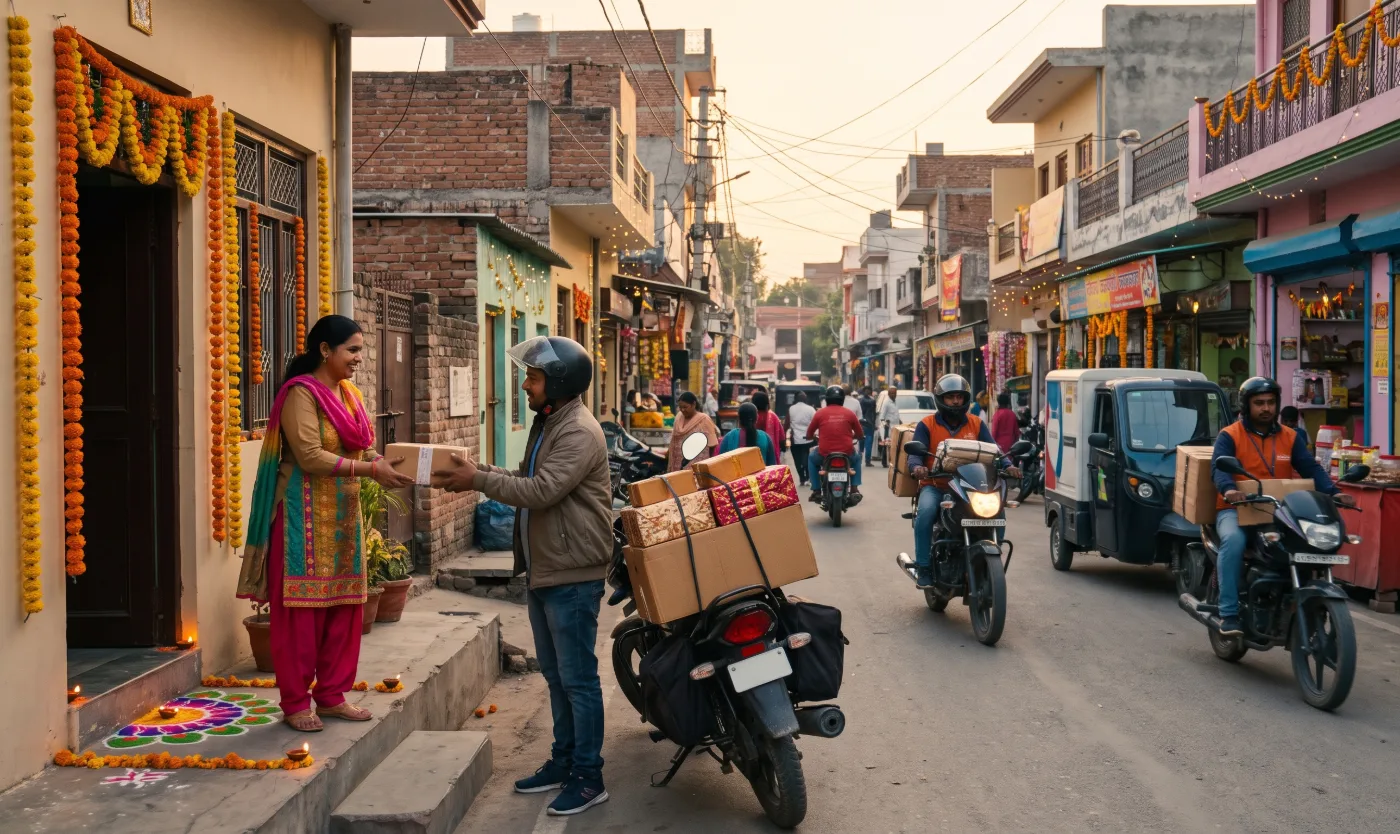
The findings, published in ClickPost's "Great Indian Festive Report 2026," are based on a like-for-like cohort of nearly 400 D2C brands shipping through their own storefronts and apps. The comparison windows were September 1 to October 17, 2025, and September 20 to November 5, 2026 . The report analysed more than 80 million orders and found that the traditional assumption—that fast, reliable delivery belongs exclusively to major metros—no longer holds.
The reliability gap between non-metros and metros was five percentage points, a significant margin for logistics operations where even single-digit differences represent thousands of shipments. Tier 3 cities recorded the largest year-on-year improvement, rising from 74% to 83% on-time delivery, while Tier 2 moved from 76% to 83%. Tier 1 metros also improved, from 71% to 78%, but did not keep pace with smaller cities . Prashant Gupta, Co-founder and CTO of ClickPost, stated: "The assumption that high-speed, reliable logistics belongs exclusively to Tier 1 metros is officially obsolete" .
Transit speed data revealed a similar inversion. Chandigarh delivered in approximately 52 hours and Agra in 54 hours, both faster than Hyderabad at roughly 57 hours. Lucknow and Jaipur, both at approximately 57 hours, matched Hyderabad and arrived 7 to 10 hours earlier than Chennai, Pune, Kolkata, and Ahmedabad, which ranged from 64 to 67 hours . The National Capital Region cluster—Delhi (~35h), Noida (~38h), Gurugram (~43h), and Faridabad (~45h)—formed the country's fastest fulfillment corridor, with all four cities beating Bengaluru (~47h) and Mumbai (~49h) .
The improvement in non-metro performance likely reflects sustained investment in regional inventory positioning, decentralized sorting infrastructure, and improved mid-mile routing by logistics operators and D2C brands. Rather than routing all orders through centralized metro warehouses, brands have increasingly positioned stock closer to demand in Tier 2 and Tier 3 clusters, reducing the long-haul segment of the delivery journey.
Nationwide, average delivery time fell from nearly three days to about two and a half days, even as daily order volumes rose 27% year-on-year. The estimated gross merchandise value of those orders grew approximately 45%, indicating that shoppers purchased higher-value items rather than trading down . Failed delivery attempts declined from 22% to 21%, and the return-to-origin rate fell from 11% to 10% .
The 2026 festive calendar contributed to the improved performance. Dussehra (October 21), Karwa Chauth (October 29), and Diwali (November 8) fell within three weeks of each other, spreading demand across more than 10 high-volume days in late October alone, each matching or exceeding 2025's single busiest shipping day . This rolling wave of orders was easier for logistics networks to absorb than a concentrated last-minute surge, allowing carriers to maintain service levels without the bottlenecks that typically accompany peak compression.
The findings carry implications for D2C brands planning their 2027 logistics footprints. Operational readiness is no longer concentrated in the six largest metropolitan areas, and brands that continue to prioritize metro-centric fulfillment at the expense of regional distribution may find themselves at a disadvantage as demand growth shifts decisively toward smaller cities. ClickPost's Gupta noted that for brands planning their 2027 footprint, "operational readiness is no longer concentrated in six cities" .