
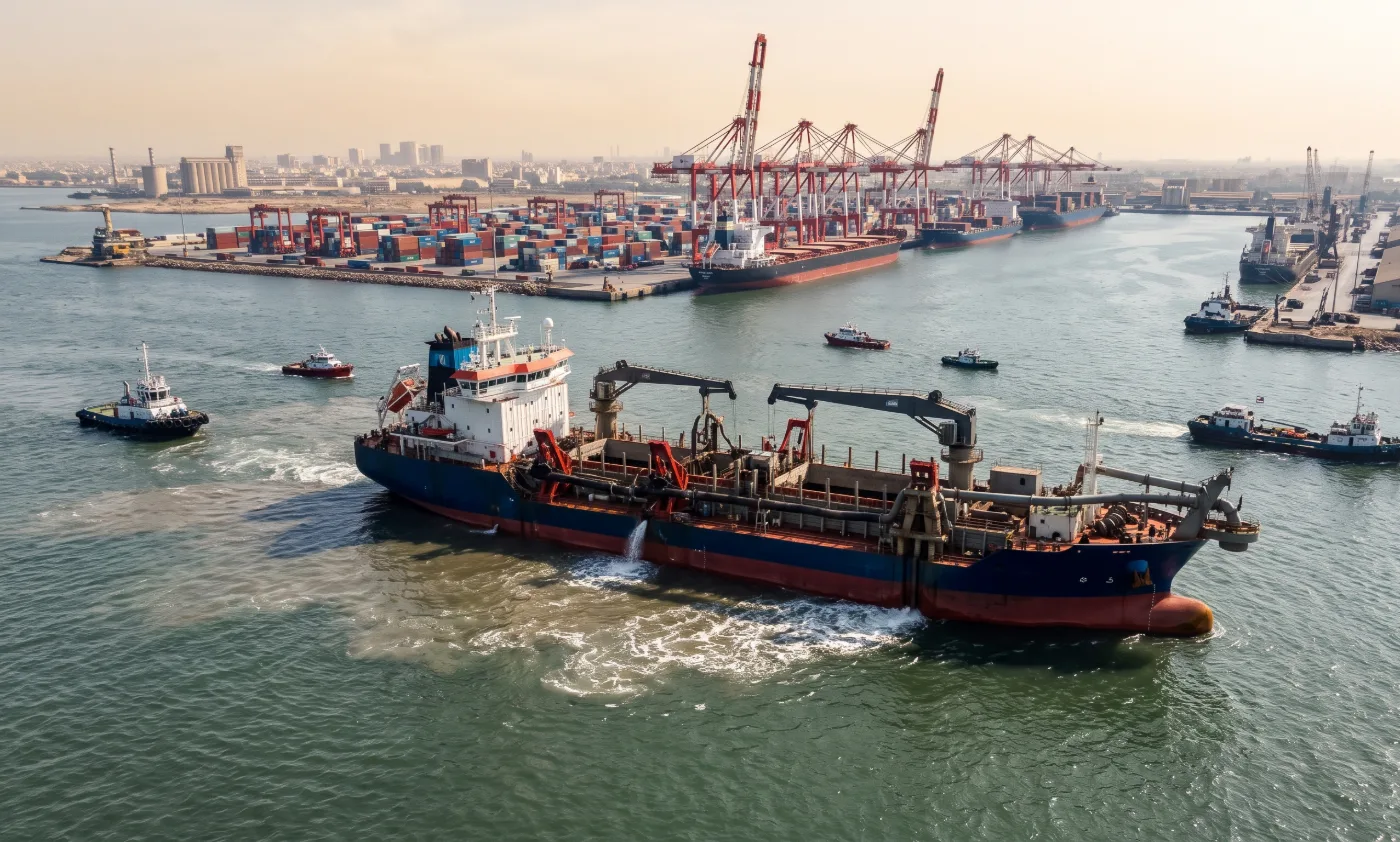
The dredging project, awarded by the Karachi Port Trust (KPT) to National Dredging & Marine Services (NDMS) in August 2026, covers the Approach Channel, Tippu Sultan Channel, and South Wharf . NDMS is a joint initiative of the National Logistics Corporation (NLC), Karachi Port, Port Qasim, and Gwadar Port, established under the Prime Minister's Task Force on Maritime Reforms to build Pakistan's indigenous dredging capacity and reduce reliance on foreign contractors .
As of mid-October 2026, KPT Chairman Rear Admiral (Retd) Shahid Ahmed reported that approximately 90% of the long-pending dredging project had been completed, with the main channel deepened to around 14.5 meters. The approach channel was expected to reach 16 meters once remaining work concluded within 30-40 days . The timeline provided in October aligns with the December 2026 completion target cited in November reporting .
The deepened channel is expected to enable the arrival and berthing of larger, deep-draft vessels at Karachi Port, which in turn should reduce freight costs and the overall cost of goods . This capability upgrade is particularly significant given Karachi Port's role in handling Pakistan's import and export cargo, including bulk commodities, containers, and general cargo.
The dredging work complements separate upgrades at terminal facilities. Karachi Gateway Terminal Multipurpose Limited (KGTML), operated by a joint venture involving Abu Dhabi's AD Ports Group, completed its own dredging project that deepened berths to 15 meters, enabling the terminal to handle bulk vessels of up to 120,000 metric tonnes—double the previous capacity of 60,000 tonnes . KGTML's CEO projected that the upgrade could reduce freight costs by 25-35% and cut vessel turnaround time from 13 days to three days, with potential savings exceeding $150 million annually as larger vessels are deployed .
The dredging initiative is part of a broader effort by KPT to expand capacity, connectivity, and maritime services. Chairman Ahmed has emphasized that the port is pursuing dredging, modernization, and investment to strengthen Karachi's position as a regional trade gateway . The port has also been urging importers and clearing agents to adopt pre-arrival Goods Declaration filing, which KPT says reduces cargo clearance time from 296 hours to approximately 90 hours .
However, infrastructure challenges beyond the port's gates remain. KPT officials have warned that dilapidated road links connecting Karachi's ports to industrial zones and national highways continue to delay cargo movement and inflate logistics costs, potentially undermining the benefits of the channel deepening . The contrast between improved maritime access and constrained landside connectivity underscores that port efficiency depends on the entire logistics chain, not just channel depth.