
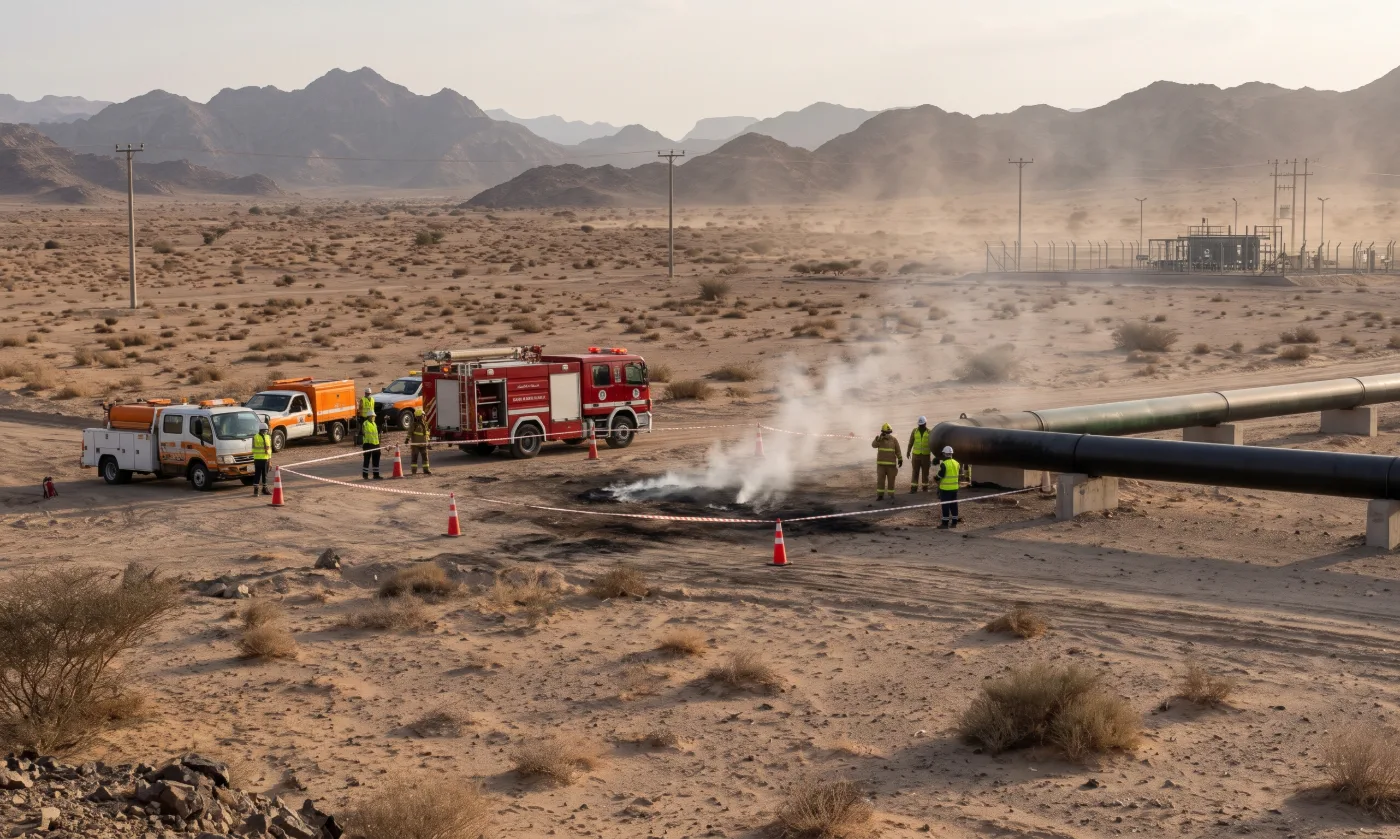
The attack occurred on Monday, November 9, according to a statement from an official source at the Ministry of Energy carried by the Saudi Press Agency . The statement said the East-West pipeline in the Madinah Region "was targeted," resulting in a "limited fire that was extinguished by emergency response teams" . Emergency and specialized technical crews responded immediately and took measures to secure the site and verify its safety in accordance with established protocols .
The ministry explicitly stated that there were "no injuries or fatalities" and that "pipeline operations were unaffected" . The swift containment and confirmation that flows continued uninterrupted suggest the attack caused minimal physical damage to the pipeline infrastructure itself, though the security implications are significant.
Responsibility for the attack was not immediately claimed. The incident occurred amid ongoing military escalation between the Saudi-led coalition supporting Yemen's internationally recognized government and the Houthi group, which has launched repeated missile and drone attacks toward Saudi territory . The East-West pipeline has been targeted multiple times during the broader US-Iran conflict that began in February 2026 .
This is not the first time the pipeline has been struck. In September 2026, a UAV attack originating from Iraqi territory damaged a pumping station, forcing the pipeline to shut down for several weeks for repairs . The pipeline resumed transporting crude for export later in September . The recurrence of attacks underscores the vulnerability of this critical infrastructure even as Saudi Arabia works to expand its capacity.
The East-West pipeline is one of the most important components of Saudi Arabia's oil infrastructure. Spanning approximately 1,200 kilometers, it connects production and processing facilities at Abqaiq in the Eastern Province to export facilities at Yanbu on the Red Sea coast . Its primary strategic value lies in allowing Saudi Arabia to export crude without transiting the Strait of Hormuz, a chokepoint that has been effectively blockaded during the conflict .
Current capacity stands at approximately 7 million barrels per day, though a portion is allocated to domestic refineries . Saudi Energy Minister Prince Abdulaziz bin Salman stated in October that the kingdom is considering development plans to raise pumping capacity to approximately 10 million barrels per day in the coming years . Aramco CEO Amin Nasser confirmed in early November that expansion work has already begun .
The attack highlights the persistent security risks facing Saudi Arabia's alternative export routes. While the pipeline's ability to bypass Hormuz has been a critical lifeline during the conflict—Nasser said it helped prevent oil prices from climbing even further—its repeated targeting demonstrates that no export route is entirely secure . Aramco is also exploring additional export routes and overseas storage capacity as it seeks to reduce exposure to disruptions .
For global oil markets, the immediate impact of this attack appears limited given the uninterrupted operations. However, the recurrence of strikes on the pipeline reinforces concerns about the durability of Saudi Arabia's export capacity at a time when the Strait of Hormuz remains constrained and global inventories are below required levels . The market's muted reaction likely reflects both the successful containment and the broader recovery in Middle East oil flows, which averaged more than 24 million barrels per day in the week through October 18, above prewar levels .