
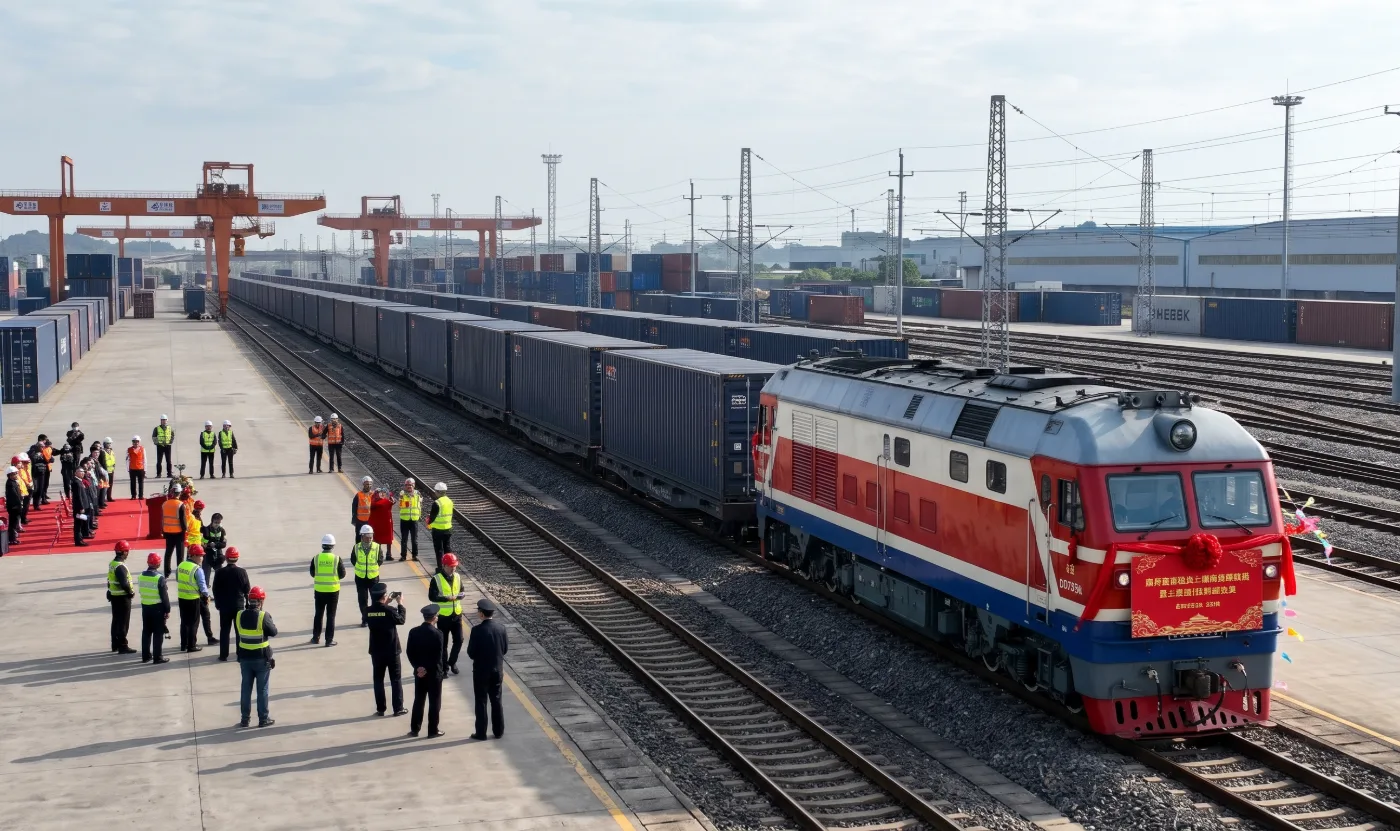
The inaugural service departed Liuzhou Railway Port on the morning of November 6, loaded with 12 40-foot containers of automobile spare parts. The cargo moved by rail to Qinzhou Port, where it was transloaded onto ocean-going vessels for shipment to India . The route has been designated the "Liuzhou Railway Port–Qinzhou Port–South Asia" Western Land-Sea New Corridor rail-sea intermodal dedicated train, and represents the first time Guangxi has operated a dedicated South Asia-bound intermodal service under the corridor framework .
The operational innovation lies in replacing the previous fragmented logistics model. Auto parts exporters in Liuzhou had relied on scattered, segmented trucking to collection points in the Pearl River Delta before ocean export. The new service integrates rail and sea legs into a single "block train plus liner" product, with seamless衔接 between the train schedule and vessel departure at Qinzhou . According to Wu Peiqin, deputy manager of the Liuzhou South Business Department at China Railway Nanning Group's Nanning Railway Logistics Center, this integrated model saves approximately three days in total transit time and further reduces comprehensive cross-border logistics costs for Guangxi automotive enterprises .
Liuzhou serves as a critical node for the corridor and is a national base for auto parts production, auto and parts export, and automotive industry demonstration. To meet export demand from Liuzhou's auto parts sector, China Railway Nanning Group has been operating scheduled passenger-style freight trains for auto parts on a weekly basis, enabling the "block train plus liner" connection . For this inaugural dedicated train, the railway department established a dedicated service task force to coordinate container loading plans, capacity allocation, and loading operations in line with the handling characteristics of auto parts .
The Western Land-Sea New Corridor is the strategic framework linking China's southwestern hinterland with international markets through transport nodes including Liuzhou Railway Port, Qinzhou Port East Station, and the Guangxi Beibu Gulf port cluster. The corridor is designed to smooth the logistics chain for goods moving from southwest China to overseas markets and for imported goods entering the domestic market . The addition of a South Asia-bound route extends the corridor's reach beyond its traditional Southeast Asian destinations.
The timing of the launch reflects growing export momentum from Guangxi's automotive sector. As of November 5, China Railway Nanning Group had transported more than 294,000 commercial vehicles in 2026, a year-on-year increase of 8 percent . The new South Asia service is expected to support this growth by providing a more efficient channel for "Guangxi-made" products to reach Indian and broader South Asian markets.
Next steps focus on scaling and service diversification. China Railway Nanning Group stated that it will continue to leverage the corridor's transport advantages, improve train operating efficiency, expand product offerings including total logistics contracting and end-to-end agency services, and broaden the categories of goods handled through multimodal transport. The objective is to provide efficient and convenient transport services for Guangxi-manufactured goods reaching the sea and international markets . Whether the service becomes a regular scheduled product or remains an occasional dedicated train will depend on sustained cargo demand from Liuzhou's auto parts exporters and the willingness of shipping lines to maintain South Asia connections at Qinzhou.