
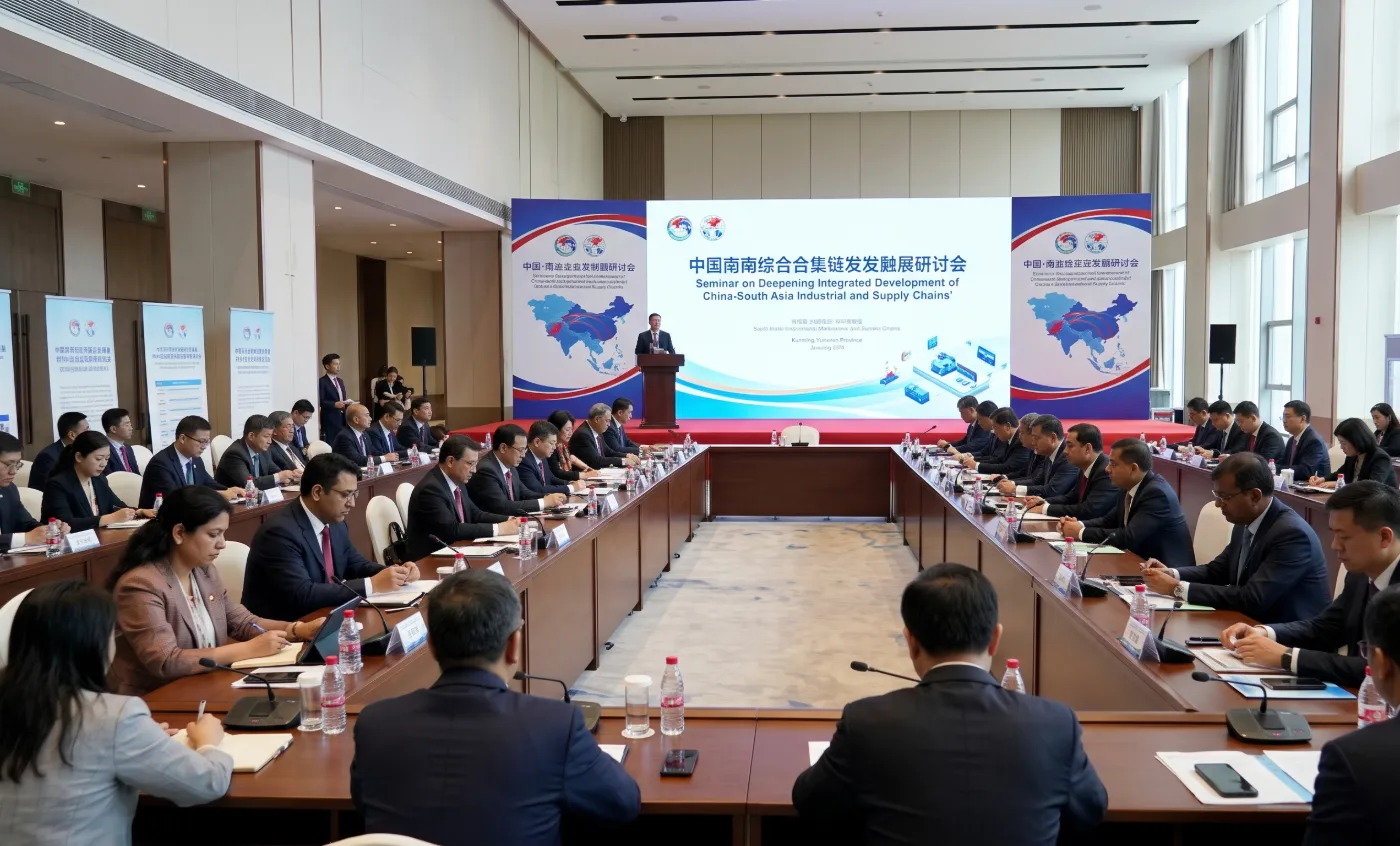
The seminar was held over four days in Kunming, the capital of Yunnan Province and China's designated gateway for engagement with South Asia. According to a brief report by Mekong News Network under Yunnan Gateway, the event brought together participants from China and South Asian countries who "delivered witty remarks," but the report did not identify specific delegates, countries represented, or the substance of their remarks .
The event's title—"Deepening Integrated Development of China-South Asia Industrial and Supply Chains"—positions it within China's broader push to deepen industrial and supply chain cooperation with South Asian economies. This theme has been a recurring priority in Chinese regional diplomacy. In May 2026, Vice Commerce Minister Yan Dong stated at a press conference that China would "deepen industrial and supply chain cooperation with South Asian countries, and explore cooperation potential in emerging fields like cross-border e-commerce, green development, environmental protection, digital economy and biomedicine" .
The seminar also follows a period of accelerating trade ties. Trade between China and South Asian countries exceeded $200 billion in 2025, a year-on-year increase of 10.7 percent, and grew by 15.8 percent in the first four months of 2026 . China is now the largest trading partner of Pakistan, Bangladesh, Sri Lanka, and the Maldives . These figures provide the economic context for why supply chain integration has become a recurring theme in China-South Asia engagements.
Kunming has served as the primary venue for China-South Asia institutional cooperation. The city hosts the biennial China-South Asia Expo, which in its 10th edition in June 2026 attracted exhibitors from over 60 countries and regions . The expo has historically served as a platform for project signings and trade facilitation, and the November seminar appears intended as a more focused, technical follow-up to the broader commercial event.
Notably, the seminar's timing coincided with other regional logistics developments. On November 6, Guangxi launched its first dedicated rail-sea intermodal freight train to South Asia, linking the Western Land-Sea New Corridor to South Asian markets. The convergence of these events suggests a coordinated push to improve both physical connectivity and institutional coordination for China-South Asia supply chains.
However, the absence of substantive public reporting raises questions about the seminar's actual deliverables. Unlike the China-South Asia Expo, which publishes participation figures and signing totals, the November seminar has generated only a brief news item with no disclosed outcomes, agreements, or follow-up mechanisms. It is unclear whether the event produced any actionable commitments, working groups, or policy recommendations.
For logistics operators and traders tracking China-South Asia supply chain developments, the seminar represents a signal of continued institutional interest but provides no concrete information about new corridors, facilitation measures, or regulatory changes. The absence of detail is itself notable: in a region where supply chain integration is a stated priority for Beijing, the limited public record of this event suggests it may have been a closed-door technical discussion rather than a platform for announcing new initiatives. Further details, if any, would need to come from official Chinese or South Asian government channels that have not yet published readouts.